

China’s military leadership faces a serious problem
Analysis and commentary – Maritime Security Forum
The disappearance at the end of last week of senior Chinese general Zhang Youxia, along with another top military commander, General Liu Zhenli, has raised serious concerns about internal power struggles among the country’s elites, with implications for China’s military strength, whether it be the goal of conquering Taiwan by force or engaging in any other major regional confrontation.
Recently, the highest-ranking general in the Chinese political system and also the “number two” in the army’s chain of command, Zhang Youxia, was arrested at the end of last week on charges of passing nuclear secrets to the US and also for other acts intended to undermine the power of President Xi Jinping, despite his long-standing personal and family ties to him. General Zhang, 75, was vice chairman of the Central Military Commission (CMC), the Communist Party’s governing body, under the authority of the nation’s leader, Xi Jinping, who exercises full control over the armed forces.
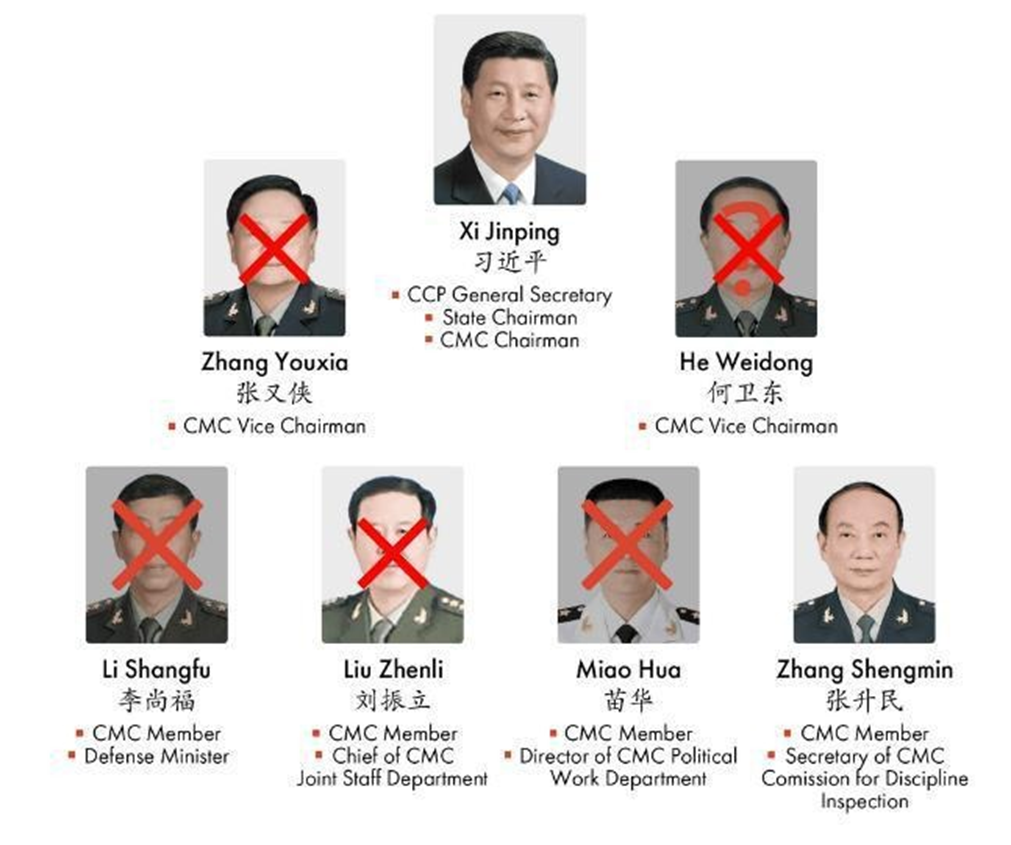
The CMC, normally composed of about seven members, has now been reduced to just two figures: Xi and General Zhang Shengmin.
All other members have been removed amid the “anti-corruption” purge that followed earlier arrests.
The CMC is the entity responsible for overseeing military personnel. Its power is so great that, when Deng Xiaoping was China’s supreme leader in the 1980s, it was the only position he held most of the time.
The fact that only Xi and a single general remain in the CMC is an unprecedented situation.
The defense is in complete chaos, and the People’s Liberation Army (PLA) is currently suffering from “a major leadership vacuum,” according to various chancelleries.
The exact causes of the dismissals and arrests of high-ranking generals are unknown. Numerous reports are circulating, but there is no certainty about what is true and what is false… but it is certainly a negative signal for Xi Jinping, for the way he exercises his authority and control over the PLA. Or it may be a self-triggered situation with the aim of strengthening control and power!
There are various rumors about nuclear information leaks to the United States, even plans for a coup attempt, as well as internal disputes between various factions. Even if these are speculations aimed at amplifying uncertainty, with rumors even circulating about an exchange of fire in Beijing, which is highly unlikely.
What is certain is that Xi’s position remains unassailable and that there are significant limitations on access to information from Beijing, a situation that fuels uncertainty and intensifies these assumptions, sometimes leading to conspiracy theories.
The official statement announced that Zhang and Liu are “under investigation” for “serious violations of discipline and the law,” wording that suggests corruption. The PLA Daily highlighted the “zero tolerance” policy towards corruption in its editorial. Zhang Youxia, considered close to Xi Jinping, is suspected of leaking nuclear secrets to the US, which would reflect major tensions within the Chinese military leadership.
Zhang Youxia held the position of joint vice-chairman of the Central Military Commission (CMC), the entity that leads China’s People’s Liberation Army (PLA). As second in command to Xi in the army’s chain of command, Zhang has long been seen as the Chinese president’s most basic military supporter.
The Ministry of Defense issued a statement on Saturday announcing that both Zhang and Liu Zhenli, chief of staff of the CMC’s joint staff department, are under investigation.
An editorial published Sunday in the military publication Liberation Army Daily said Zhang and Liu “seriously betrayed the trust and expectations” of the Communist Party and the CMC, and “fueled political and corruption problems that undermined the supremacy of party control over the armed forces and threatened the very foundation of the party’s regime.”
According to the Wall Street Journal, citing sources familiar with a high-level internal briefing on the allegations, Zhang is suspected of passing information about China’s nuclear arsenal to the US and accepting bribes for official decisions, including promoting an individual to the rank of defense minister.
In addition to his military role, Zhang was also a member of the Chinese Communist Party’s Politburo and is one of the few leaders with actual combat experience. At the age of 75, Zhang was kept in the military leadership by Xi even after the standard retirement age, a gesture that suggests a high level of trust in the general whom he is now removing.
The military is a priority area for the vast anti-corruption offensive launched by Xi in 2012. This campaign reached the top of the PLA hierarchy in 2023.
In 2022, President Xi Jinping’s wife was included in the “Cadre Examination and Evaluation Committee.”
This situation has sparked debate about the possibility that China’s leader is indirectly influenced by his wife, who is recognized for her significant contributions. According to media sources, China’s first lady, Peng Liyuan, may exert informal influence over military and diplomatic decisions relevant to President Xi Jinping’s governance and strategy.
There are reports suggesting that Peng Liyuan, President Xi Jinping’s wife, may have played a role in the resignations of two former defense ministers, Wei Fenghe and Li Shangfu, from both their ministerial positions and the Chinese Communist Party. This information raises questions about the challenges President Xi faces in maintaining the loyalty of the Chinese military.
If such a prominent figure as General Zhang is dismissed in Xi’s anti-corruption campaign, serious questions arise about the stability of China’s military leadership, especially as the international community closely monitors its preparedness and intention to launch a possible offensive against Taiwan, a situation that could draw the US into a conflict in the Indo-Pacific region.
This purge raises broader questions about political stability within a rising nuclear power, generated by the misguided appointment of some very important people.
Of the seven appointed to the CMC at the party’s 20th congress in 2022, only two have remained unaffected by corruption controversies: Xi himself and Zhang Shengmin, the CMC’s anti-corruption chief, which may lead to the conclusion that the latter is the source of the information to the president.
CMC Co-Vice Chairman He Weidong was expelled from the party and the People’s Liberation Army in October last year after being found guilty of corruption.
At the international diplomatic level, all countries are closely monitoring developments, given Zhang’s close relationship with Xi and the fundamental importance of the commission’s work in terms of appointments at the top of the command, but also the ongoing process of modernization and positioning of the People’s Liberation Army.
Although China has not participated in any wars for decades, it is taking an increasingly aggressive stance in territorial disputes in the East China Sea and South China Sea, as well as toward self-governing Taiwan, which Beijing claims as its own. The People’s Republic of China conducted its largest military exercises in history around Taiwan late last year.
To date, the day-to-day operations of the military appear to be unaffected.
The two goals set by Xi for the PLA—namely, the complete modernization of the PLA by 2035 and its transformation into a world-class military force by 2049—as well as other elements of the Chinese military’s transformation, will continue.
At the same time, eight retired generals were expelled from the Communist Party on corruption charges in October 2025, including He Weidong. In recent years, two former defense ministers have also been removed from the ruling party for corruption. This purge is slowing down the procurement of advanced weapons and affecting the cash flows of some of China’s largest defense companies. This may also be a topic for analysis.
Born in Beijing, Zhang joined the army in 1968, rising quickly through the ranks and joining the CMC in late 2012, just as the campaign to modernize the armed forces was gaining momentum.
He took part in the short but bloody border conflict in Vietnam in 1979, a war launched by China in retaliation for Vietnam’s invasion of Cambodia the previous year and the removal of the Khmer Rouge regime, which was supported by Beijing.
According to state-controlled media reports, Zhang was sent to the front lines to fight the Vietnamese and enjoyed rapid promotion. He also took part in an exchange of fire on the border with Vietnam in 1984, as territorial disputes continued.
Some Chinese researchers have pointed out that Zhang emerged from those conflicts as a visible advocate of modernization, both in terms of tactical methods and the need for a better trained and equipped army. And here there may be a disagreement of principles.
It is expected that the situation will suddenly disappear from the daily news, in keeping with China’s style, and new political and military figures will appear at the helm of the PLA. As a rule, when leaders fall, their trusted teams follow!
In the series of news reports about the purge at the top of the Central Military Commission (CMC), in addition to the stated goal of modernizing and streamlining the army by refreshing its personnel, a deeper political idea is emerging for the first time. So it seems.
The CMC has always been the basis of the party leader’s power, practically the supreme power, or the highest in terms of legitimacy. This organization was valid for Mao and Deng (who refused another position), but also for Jiang Zemin, who temporarily needed the veterans from the PLA leadership to stabilize the post-Tiananmen situation. It is believed that Hu Jintao had leadership problems because behind the collegial leadership, both on the civilian and military sides, corruption, a multimillennial national art, deepened with prosperity.
China’s systemic problems always resurface when such episodes occur. For example, how Hu Jintao was removed from the hall at the last congress when he apparently protested that Li Keqiang was no longer elected to the restricted Standing Committee. Or rumors about criticism of Xi by senior leaders at the traditional summer meeting in the Bedaihe resort.
In China’s recent history, there has been only one example of suspected coup d’état. Lin Biao, who was Mao’s designated successor and a political and military leader. His plane was shot down in Inner Mongolia on its way to the USSR in 1971, after the 1969 conflict in Ussurysk on the Amur River brought the two powers to the brink of war.
The dismissed foreign minister had been ambassador to Washington, and the defense minister had spoken with Defense Secretary Lloyd in Shangrila.
Stalin and Khrushchev did the same with Marshal Zhukov.
Tuckacevsky’s elimination was the work of the Nazi services, which exploited Stalin’s pathological suspicion. But in Zhukov’s case, the issue was serious, as it raised the question of continuing the war in the West to the Atlantic. There was also such a camp.
But even in Xi’s case, who is said to have been in the upper echelons of leadership, there was a dispute over the path to follow regarding Taiwan between the war party and a peaceful alternative.
Prime Minister Keir Starmer, the first British leader to visit Beijing in eight years, wants to resume relations between Britain and China, considering the country too influential to be ignored. He will meet with President Xi and Premier Li Qiang during a three-day visit. Starmer acknowledges the risks but says the UK must maintain a realistic approach to China, emphasizing the country’s economic importance.
Meanwhile, the Finnish prime minister’s visit to Beijing ended a few days ago. This is the Greenland effect.
But we still don’t know what is happening behind closed doors in the Middle Kingdom.
MARITIME SECURITY FORUM