

PHASES OF THE ATTACK ON IRAN AND MULTIDOMAIN WARFARE
ANALYSIS: Maritime Security Forum
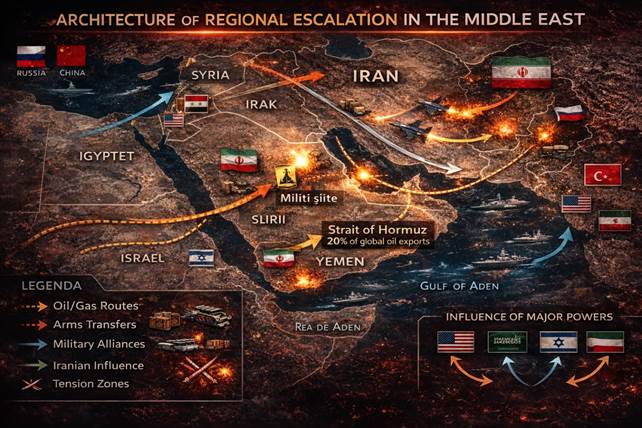
Multidomain warfare in the architecture of regional escalation
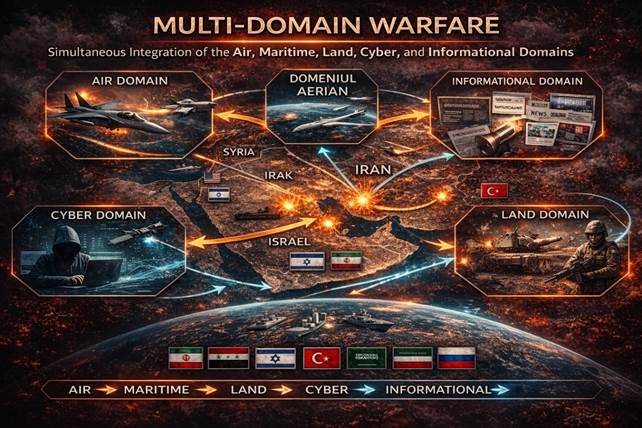
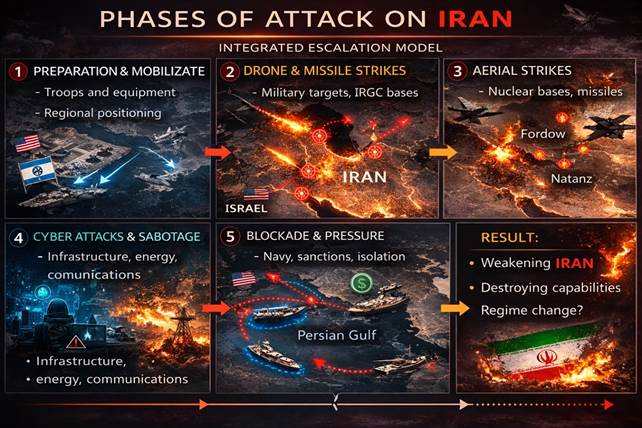
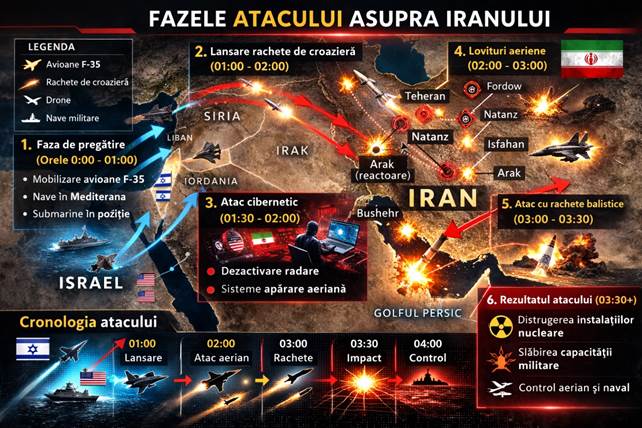
The concept of multi-domain warfare expresses the profound transformation in the way contemporary conflict is conceived and conducted. We are no longer talking about a succession of separate operations – land, air or naval – but about the simultaneous and synchronised integration of all areas of confrontation, including cyber and information. In a region such as the Middle East, where energy interdependencies, historical rivalries and the density of state and non-state actors are extremely high, this doctrine takes on major strategic relevance.
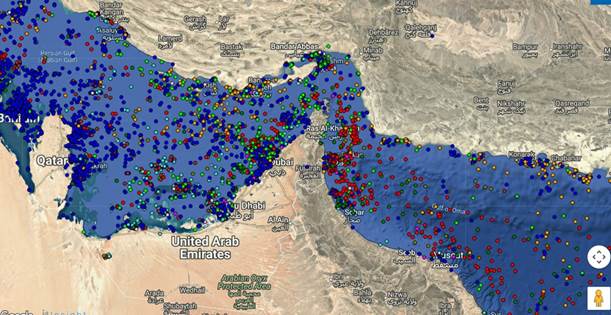
In such a context, the air domain remains essential for achieving rapid operational advantage, but it no longer functions autonomously. Air superiority is complemented by multi-source surveillance and reconnaissance capabilities, satellite data integration and interoperability with naval platforms and digital command systems. At the same time, the maritime domain, particularly in the vicinity of the Persian Gulf and the Strait of Hormuz, is becoming a strategic multiplier with global impact, as control or disruption of energy routes affects international markets and the global economic balance.
The cyber dimension introduces a structural change in the logic of escalation. Attacks on energy and financial infrastructure or on command and control systems can precede any visible action, creating destabilising effects without explicitly engaging in armed confrontation. In this sense, conflict often begins invisibly, in networks and algorithms, and its effects only manifest themselves in the physical space later on. In a digitised ecosystem, decision-making speed becomes critical, and the interconnection of domains allows for almost instantaneous reactions between seemingly distinct spaces.
In turn, the information domain is an autonomous battlefield. Managing public perception, shaping narratives and influencing international legitimacy can determine the course of escalation as much as actual military deployment. In a media-saturated environment, image, symbolism, and narrative chronology can produce psychological effects that are disproportionate to the strictly military dimension of an incident.
The current regional architecture involves actors with divergent agendas, such as Iran, Israel, the United States, Saudi Arabia and Turkey, to which is added the indirect influence of powers such as Russia and China. The interaction between these centres of power does not take place exclusively through direct confrontation, but through networks of alliances, proxy actors and economic instruments. Multidomain warfare thus becomes a system of continuous pressure, in which every move in one domain generates reverberations in another.
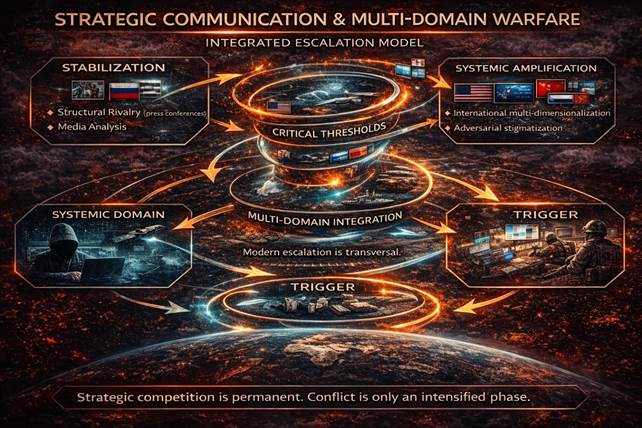
The essence of this paradigm lies in the integration and synchronisation of effects. Escalation is no longer linear, but transversal. A cyber incident can trigger naval mobilisations; an economic sanction can amplify informational tensions; a show of air power can alter diplomatic positions. Conflict becomes a fluid, distributed process, permanently calibrated below the threshold of declared war.
In this context, multidomain warfare is not just a military doctrine, but a new strategic APPLICATION. It reflects the shift from point-to-point confrontation to systemic competition, in which technology, information and global interdependence transform every regional escalation into a phenomenon with potential global impact.
Schematic representation of the multidomain escalation mechanism
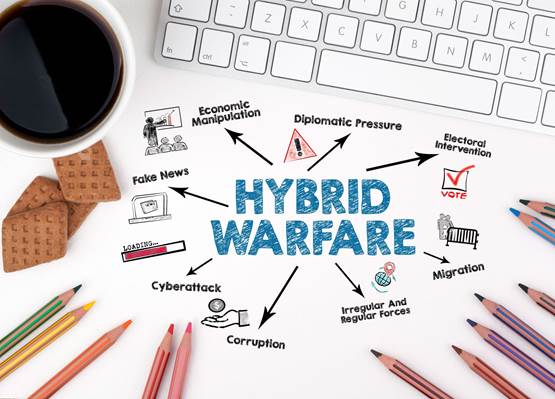
The escalation mechanism in multidomain warfare does not function linearly, but systemically. It can be understood as an interconnected spiral in which actions in one domain produce cross-cutting effects in others. In a densely populated regional space such as the Middle East, this interdependence accelerates the reaction-counterreaction cycle.
Escalation usually begins below the visible threshold of open conflict. The initial phase consists of informational and cyber competition: influence campaigns, media pressure, digital operations on critical infrastructure. This stage produces strategic tension without explicit military involvement.
Subsequently, a phase of coercive demonstration may intervene, characterised by naval mobilisations, military exercises, air deployments or calibrated official statements. These actions serve as strategic signalling and testing of the adversary’s reaction.
If tensions persist, limited incidents may occur: pinpoint strikes, proxy attacks, infrastructure sabotage. At this stage, strategic ambiguity is deliberately maintained to avoid triggering a full-scale confrontation.
Escalation becomes critical when cross-domain reactions occur. For example, a naval incident can generate cyber retaliation; an information attack can lead to economic sanctions; a limited strike can activate regional alliances. Thus, the conflict quickly moves from one domain to another, reducing the space for de-escalation.
At the upper stage of the spiral, three major risks emerge: compressed decision-making time, strategic miscalculation, and internationalisation of the crisis through the involvement of major powers. Actors such as Iran, Israel, the United States, Russia, or China can quickly turn a regional escalation into an episode with global repercussions.
The mechanism can be summarised conceptually as follows: latent competition → coercive signalling → limited incident → multi-domain response → internationalisation → either stabilisation through negotiation or systemic amplification.
The key element is interconnection. Escalation is no longer determined solely by military intensity, but by each actor’s ability to simultaneously integrate the air, sea, land, cyber and information domains. In this architecture, perception control and time management become as decisive as material superiority.
Strategic communication in the architecture of MULTIDOMAIN WARFARE
Strategic communication is the coherent set of messages, symbols and actions through which a political or institutional actor projects its intentions, legitimises its behaviour and shapes perceptions relevant to its security environment. It is not limited to public statements or relations with the press; on the contrary, it is an integrated process that synchronises official discourse, diplomatic gestures, military signalling, economic measures and presence in the digital space.
In today’s international environment, strategic communication operates simultaneously on three levels. The first is the normative level, where actors justify their actions by referring to international law, legitimacy, collective security or self-defence. The second is the perceptual level, where messages are calibrated to influence domestic public opinion, allies and adversaries. The third is the operational level, where communication becomes a tool of deterrence or coercion, synchronised with concrete moves in other areas – military, economic or cybernetic.
An essential element of strategic communication is framing, i.e. how an event is narratively framed. Two identical actions can produce different reactions depending on how they are presented: defensive, preventive, aggressive or legitimate. Thus, international competition takes place not only on the ground or in the air, but also in the symbolic space of interpretations. In this logic, perception becomes the critical variable in escalation or de-escalation.
Strategic communication operates through continuous feedback loops. An official message generates media reactions, which influence public opinion, and the resulting pressure can change subsequent political decisions. At the same time, the adversary interprets the signals transmitted and adjusts their own behaviour. The process is circular and adaptive. Therefore, managing the timing and clarity of the message is as important as its content.
In contexts of regional or global competition, strategic communication becomes a tool of narrative deterrence. By sending clear signals about their capacity and willingness to act, actors can prevent the material escalation of conflict. At the same time, controlled ambiguity can be used to maintain strategic flexibility. The balance between clarity and ambiguity is one of the most sophisticated dimensions of this practice.
The digital dimension significantly amplifies the impact of strategic communication. The speed of information circulation compresses reaction time and can turn minor incidents into major crises through viralisation and polarisation. In this environment, narrative coherence and anticipation of reactions become strategic imperatives. A lack of synchronisation between message and action can erode credibility, and credibility is the central capital of any security policy.
In conclusion, strategic communication is not a secondary element of foreign or security policy, but a structural pillar of it. It connects perception with action, legitimacy with power, and message with strategic effect. In the architecture of contemporary competition, controlling perception often equates to controlling the pace of escalation.
MARITIME SECURITY FORUM