

The decline of Iran’s naval power in the current conflict. The destruction of major platforms and the survival of asymmetric capabilities
Analytical study – Maritime Security Forum
Authors: Admiral (ret.) PhD. Aurel POPA, Commander (ret.) PhD. Sorin LEARSCHI
Abstract
This study examines the degradation of Iranian naval power in the current conflict, starting from a key methodological distinction between the conventional component of the Iranian navy, represented by large surface vessels and larger submarines, and the asymmetric component, represented by fast patrol boats, small platforms, auxiliary combat vessels, minelayers and mini-submarines. The central thesis is that the war has not only led to a quantitative reduction in the Iranian fleet, but also to its structural transformation. The conventional segment has been disproportionately affected, both through the destruction of major vessels and the degradation of port infrastructure, shipyards and command centres. In contrast, the asymmetric segment, although seriously affected, remained the main instrument through which Iran can continue to pose a maritime threat in the Persian Gulf and the Strait of Hormuz. The study shows that the issue is not merely how many ships Iran has lost, but rather what kind of navy it has left.
Introduction
Analysing Iranian naval losses presents a methodological challenge from the outset. At present, there is no public, independent and fully verified ship-by-ship and submarine-by-submarine tally of all Iranian units destroyed, sunk, seriously damaged or taken out of service. However, there is a sufficiently substantial body of data from highly credible international media, institutional assessments and previous strategic analyses that allows for a firm conclusion to be drawn: Iran entered the war with a fleet that was apparently numerous but profoundly heterogeneous; it lost, in the first weeks of the conflict, a very large part of its conventional segment; and it was left, primarily, with residual naval power geared towards denying access, not towards conventional competition at sea.[1]
This distinction is crucial. The raw figures regarding Iran’s naval inventory are misleading if read without distinguishing between major and asymmetric platforms. A frequently cited open-source benchmark for 2026 credits Iran with approximately 109 naval platforms in total, including 25 submarines, 7 frigates and 3 corvettes.[2] However, this statistic lumps together submarines of very different sizes and roles, large surface vessels, patrol boats, fast attack craft and auxiliary vessels. For this reason, it does not describe a homogeneous conventional fleet, but rather a mixed structure, in which the dimension of naval prestige coexists with an asymmetric dimension far better suited to the Persian Gulf and the Strait of Hormuz.
Consequently, this study is structured around a clear distinction. First, large surface vessels and larger submarines are analysed, that is, the platforms through which Iran sought to maintain a conventional dimension to its naval power. Subsequently, small vessels, fast patrol boats, auxiliary combat vessels and mini-submarines are analysed, that is, the part of the navy that directly served the doctrine of access denial and strait warfare. Such an approach is justified by assessments from the Middle East Institute, which show that the IRGC Navy dominates the tactical environment of the Persian Gulf and the Strait of Hormuz ( ), whilst the regular navy, the IRIN, is more oriented towards a broader naval presence, including in the Gulf of Oman and the Arabian Sea.[3]
I. The structure of Iranian naval power at the start of the conflict
At the start of the conflict, Iranian naval power was profoundly dual in nature. On the one hand, the IRIN represented the state’s regular navy, with larger surface vessels, part of the submarine force, and a role of representation and strategic presence. On the other hand, the IRGC Navy concentrated precisely those components most relevant to the Persian Gulf and the Strait of Hormuz: fast patrol boats, mines, light platforms, mini-submarines, anti-ship missiles and a doctrine of maritime interdiction firmly rooted in geography.[4]
This duality was not a mere arrangement, but reflected two distinct conceptions of the role of naval power. The IRIN approached the classic model of a state navy: presence, escort, patrol, institutional continuity and a certain form of limited power projection outside the Persian Gulf. The IRGC Navy, by contrast, did not seek control of the seas in the classical sense, but rather control of the risk at sea: transforming a narrow, congested and vital space for energy trade into an environment where transit becomes uncertain, costly and dangerous for the adversary.[5]
In strictly numerical terms, Iran’s naval inventory might have seemed impressive. But such an impression fades as soon as qualitative criteria are introduced: tonnage, modernity, range, protection, dependence on infrastructure and suitability for the theatre of operations. Large surface vessels and larger submarines offered Iran a certain symbolic and conventional capital, but they were relatively few in number and relatively vulnerable. In contrast, the segment comprising small vessels, fast patrol boats and mini-submarines was less impressive in terms of image, but better suited to the local environment and easier to disperse and conceal.
Thus, from the very start of the war, the Iranian navy was less a unified conventional fleet and more a blend of naval prestige and tactical coercion. This reality explains why the military campaign affected the two components differently and why the strategic effect of the strikes cannot be reduced to a simple decrease in the total number of vessels.
II. Large surface vessels: conventional value, prestige and vulnerability
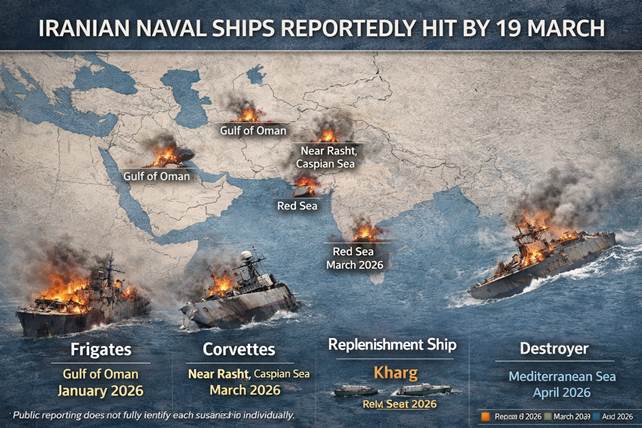
Iran’s large surface vessels had a strategic value that went beyond their tonnage and actual combat capability. They represented the most visible component of the regular navy, the symbol of the IRIN’s institutional continuity and the expression of a conventional naval ambition that Iran sought to maintain despite economic, technological and sanctions-related constraints. In this sense, Iranian frigates and corvettes played a political role almost as important as their operational role.
However, in a conflict dominated by Western air and naval superiority, persistent ISR and precision strikes, it was precisely these platforms that were among the most vulnerable. Dependent on ports, shipyards and identifiable logistical infrastructure, they could not disperse and camouflage themselves in the same way as fast patrol boats or small platforms. For this reason, they became priority targets in a campaign that sought to cripple the conventional arm of the Iranian navy from the very outset.
Reuters reported in early March that Washington claimed to have destroyed nine Iranian vessels and was continuing to strike the rest of the fleet. A few days later, the same agency noted that the US military was already claiming to have sunk over 30 Iranian vessels, including a drone ship.[6] Even if these figures must be treated with the caution required for any wartime claims, they indicate not isolated incidents, but a systematic campaign to neutralise Iran’s naval power.
In this context, the sinking of the IRIS Dena is of particular significance. Reuters reported that the Dena was sunk by a US submarine in the Indian Ocean whilst returning from the MILAN exercise in India.[7] The incident is revealing on two levels. Operationally, it shows that not even Iranian ships outside the immediate theatre of the Gulf were safe from attack. Symbolically, the Dena embodied the very essence of the Iranian Navy’s external prestige, one of the few platforms capable of sustaining the narrative of an extensive regional naval presence. Its sinking was thus a blow not only against a vessel, but against the IRIN’s image as a state navy with minimal relevance beyond the Gulf.
Subsequently, Israeli strikes in the Caspian Sea compounded this deterioration. Reuters reported that Israel had struck dozens of naval targets there, including missile-carrying vessels, a corvette, a shipyard and a command centre, claiming to have “largely neutralised” Iranian naval capabilities in that theatre.[8] This is a crucial development because it shows that not only the southern theatre, linked to Hormuz and Bandar Abbas, has been affected, but also part of the northern naval capability. From a strategic perspective, such a development dramatically reduces Iran’s freedom to maintain a conventional reserve force or to rapidly reconstitute part of its battle order.
Consequently, in terms of large surface vessels, the conclusion is that Iran has largely lost not just individual units, but the very foundation of a credible conventional navy. Even though there is not yet a complete public ship-by-ship assessment, the available data allow us to state that the frigate and corvette segment has been reduced to a residual form, and its immediate military relevance is now marginal compared to the asymmetric segment. This deterioration has greater strategic significance than the mere loss of tonnage: it signifies the brutal retreat of the IRIN as the Iranian state’s expression at sea.
III. Large submarines: the loss of conventional depth
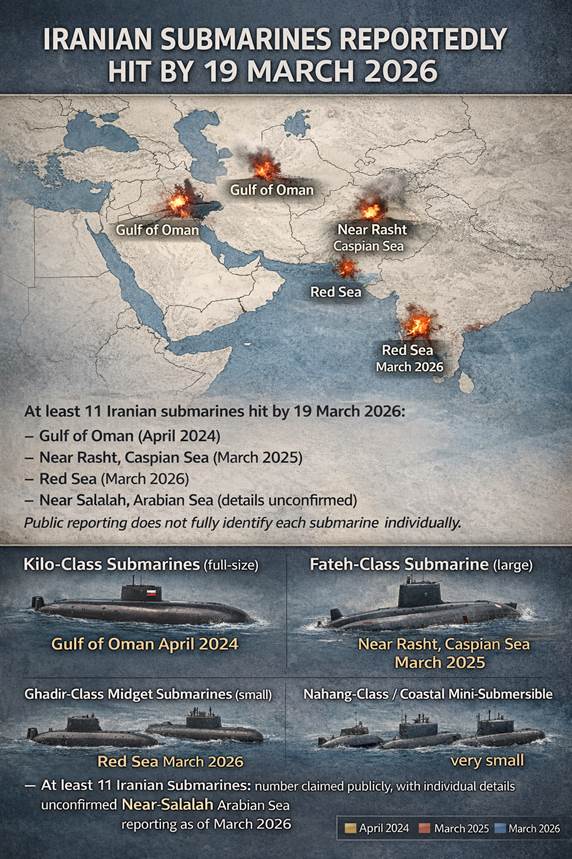
The Iranian submarine force must be analysed with particular care, as it is the category most prone to statistical confusion. The figure of 25 submarines, frequently cited in open-source materials, includes both larger submarines and mini-submarines. Consequently, it cannot be used directly to argue that Iran was entering a conflict with a large-scale conventional submarine force. In reality, the submarine segment was already divided between a few platforms of broader relevance and a larger number of vessels adapted to the coastal environment and strait warfare.[9]
The larger submarines had a strategic importance distinct from that of the mini-submarines. They provided operational depth, the possibility of more sophisticated ambushes, a degree of flexibility beyond the Gulf, and added prestige for the IRIN. In a broader sense, they were part of the conventional dimension of Iranian naval power. Yet it was precisely this value that made them priority targets. Larger platforms are easier to track, more dependent on infrastructure, and more costly to replace. In a campaign of systematic neutralisation, they become vulnerable not only tactically, but also strategically.
Reuters reported that by 19 March, the Pentagon claimed to have struck 11 Iranian submarines.[10] Without a complete independent list, this figure cannot be converted into an accurate tally of the remaining submarines. We do not know publicly how many of these were large submarines and how many were mini-submarines, nor how many were completely destroyed, how many merely damaged, and how many temporarily taken out of service. However, the data allow for a firm conclusion: Iran’s submarine segment has been severely degraded. Furthermore, it is likely that the larger and more conventional part of this force suffered disproportionately, precisely because it was more exposed to detection and because it had greater military and symbolic value.
From a doctrinal perspective, this degradation has a clear significance. Iran has lost not only submarines, but also part of the conventional depth of its naval power. While large surface vessels represented the outward image of a state navy, larger submarines represented its more discreet, yet more sophisticated, aspect. The weakening of this segment inevitably pushes the Iranian navy towards an even more local and asymmetric form of submarine power. Thus, what remains relevant underwater is no longer primarily the concept of conventional submarine force, but the capacity for mining, ambush and pressure within a narrow and shallow space.
IV. Small vessels, fast patrol boats and auxiliary platforms: the survival of the tactical ecosystem
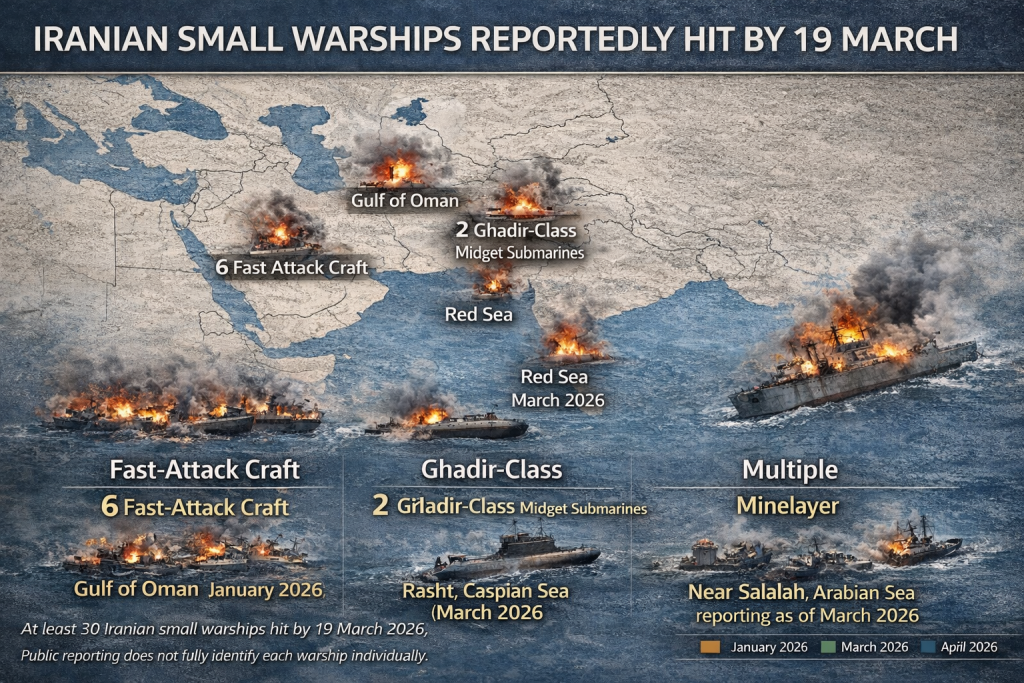
Whilst the main body of the Iranian navy has been severely depleted, the component comprising small vessels and auxiliary platforms has remained far more resilient. This includes fast-attack craft, fast patrol boats, small patrol vessels, auxiliary ships, mining platforms and other assets designed not for conventional control of the seas, but for disruption, harassment and denial of access. The Middle East Institute and the DIA indicate that it is precisely this component that has been the core of the IRGC Navy’s doctrine in the Persian Gulf.[11]
Its advantages are clear. These vessels are harder to track comprehensively, less dependent on large ports and complex shipyards, easier to disperse around islands and the coastline, and incomparably cheaper to replenish than frigates or corvettes. In a confined environment such as the Strait of Hormuz, they are far more useful than large ships because they do not need to ‘win’ the sea, but merely to make it unsafe. A small number of fast attack craft, used intelligently, can generate delays, confusion, incidents and sufficient psychological pressure to disrupt commercial traffic and the adversary’s political calculations.
Reuters confirms precisely this paradox: following the destruction of a large part of the conventional navy, the assets that continue to make the Strait of Hormuz dangerous are precisely fast-attack craft, mines and mini-submarines.[12] This fact is crucial. It shows that what remains of Iran’s naval power no longer impresses in classical terms of tonnage or presence, but continues to be relevant precisely in the area most sensitive to the global economy and energy security: the disruption of traffic through a critical chokepoint.
Of course, this segment has not remained intact either. The US military has claimed to have struck over 40 vessels used for mining, and other figures regarding destroyed vessels inevitably include small platforms as well.[13] However, this is where the fundamental difference from the main segment comes in. For an asymmetric fleet, the loss of dozens of platforms does not automatically lead to the collapse of its strategic function, as long as the tactical ecosystem survives: small bases, islands, dispersed logistics, some of the mining assets, and enough fast patrol boats to maintain the credibility of the threat. In other words, unlike the conventional navy, where a few major losses can immediately shift the entire balance, the asymmetric navy can continue to operate even after heavy losses, provided the infrastructure for dispersion and resurgence is not completely neutralised.
V. Mini-submarines: the category best suited to the Gulf
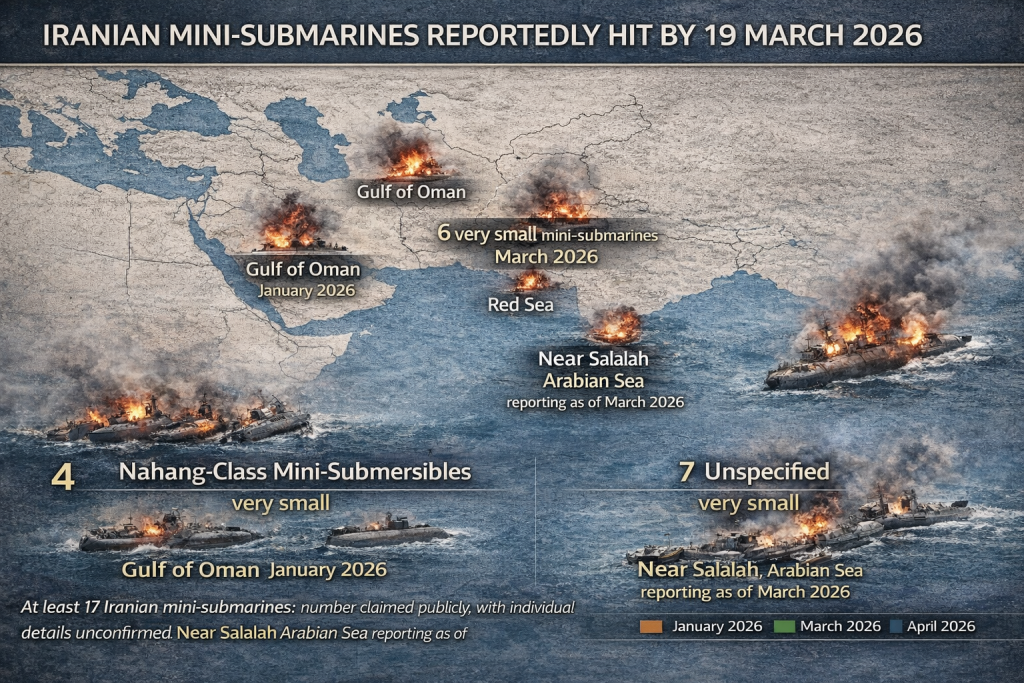
Mini-submarines must be treated separately from large submarines, not only for technical reasons, but also because they belong to almost a different philosophy of maritime use. In raw statistics, they artificially inflate the impression of submarine force. Tactically, however, they are precisely the most suitable tools for the shallow and narrow waters of the Persian Gulf. They cannot sustain an oceanic presence, nor support major conventional ambitions, but they can lay mines, support ambushes and maintain a very high level of uncertainty around maritime routes. [14]
MEI clearly describes mini-submarines as a central part of the IRGC Navy’s doctrine of disrupting traffic and effectively blocking navigation through the Strait of Hormuz without a formal blockade.[15] Precisely for this reason, even if they too were likely affected by the campaign of strikes, it is reasonable to assume that they have survived to a relatively greater extent than large submarines. They are more stealthy, less dependent on large-scale infrastructure and better adapted to the local environment. Whilst large submarines provided Iran with conventional depth, mini-submarines offer it what, in the current context, may be more important: the continuity of the local submersible threat.
In strategic terms, mini-submarines encapsulate the transformation undergone by the Iranian navy. Before the war, they coexisted with larger submarines and conventional surface vessels. After the first few weeks of strikes, they have become one of the most important residual categories, not because they are impressive in themselves, but because they fit perfectly with the type of navy Iran has left: one focused on denying access, not on conventional control of the sea.
VI. Institutional reconfiguration: the decline of the IRIN and the rise of the IRGC Navy
A major outcome of the conflict is the internal reconfiguration of Iranian naval power. Before the war, two institutional logics coexisted: the IRIN, as the state’s conventional navy, and the IRGC Navy, as an instrument of asymmetric coastal and strait warfare. In practice, the two did not overlap perfectly, but reflected a functional division between the broader naval presence and control of the tactical space of the Persian Gulf. [16]
However, the destruction of the main segment of the fleet primarily affected the assets most closely associated with the IRIN’s identity and mission: frigates, corvettes, larger submarines, and conventional port and naval infrastructure. In contrast, what remains most relevant is precisely the segment specific to the IRGC Navy: fast patrol boats, small platforms, mini-submarines and mine-laying assets. This means that the war has not only reduced the Iranian navy, but has also shifted its institutional and doctrinal centre of gravity.
This shift is crucial to understanding Iran’s future behaviour in the Gulf. An Iran deprived of a large part of its conventional navy, yet still equipped with anti-access capabilities, is likely to rely even more heavily on tactics of local coercion, distributed maritime risk and the militarisation of proximity, rather than on a conventional naval presence. In other words, not only has the fleet shrunk; it has also become much more ‘IRGC-ised’ in terms of doctrine.
VII. What Iran has lost and what it has retained
The question “what has Iran lost?” cannot be answered purely in numerical terms without being misleading. Firstly, it has lost a large part of its conventional segment of prestige and limited projection: large surface vessels, some of the larger submarines, naval infrastructure and command centres. Secondly, it has lost a significant part of its ability to present a coherent and credible national navy in the classical sense. Thirdly, it has lost the strategic freedom to rely on a relatively balanced combination of the IRIN and the IRGC Navy. [17]
The question ‘what is left?’ must be formulated just as carefully. There is currently no independent, comprehensive and verified public inventory of each remaining unit. But there is sufficient data to support the claim that Iran has been left primarily with the asymmetric component of its naval power: fast patrol boats, small platforms, some of its mini-submarines, and means of mining and harassment. In other words, it has been left largely without a robust conventional navy, but it has not been left without naval power relevant to the Strait of Hormuz. [18]
This conclusion is essential to any strategic assessment. It is not correct to say that Iran ‘no longer has a navy’. The correct formulation is that Iran has largely lost its conventional navy and is left primarily with an access-denial navy. Precisely for this reason, the residual threat is no less real. It is simply different: less visible, less impressive in conventional terms, but still sufficient to turn the Strait of Hormuz into an area of persistent risk.
Conclusions
The current war has brought about a structural, not merely quantitative, transformation of Iranian naval power. The major segment — large surface vessels and larger submarines — has been disproportionately and severely hit. Ports, shipyards, command centres and platforms of conventional and symbolic value have been destroyed or severely degraded. In contrast, the asymmetric segment — fast patrol boats, small vessels ( ), mini-submarines, mines and associated dispersed infrastructure — has survived relatively better and remains the main bearer of Iranian naval risk. [19]
This shift has important theoretical and strategic implications. It shows that a mixed naval power, such as Iran’s, can suffer an almost total collapse of its conventional component without the maritime threat disappearing. On the contrary, sometimes it is precisely that component which, in a narrow and congested theatre such as the Strait of Hormuz, is best suited to disrupting traffic. In this sense, the paradox of the Iranian navy is clear: it has lost almost everything that gave it the image of a conventional state navy, but has retained enough of what allows it to make navigation dangerous, costly and politicised in one of the world’s most important maritime chokepoints. [20]
Ultimately, the issue is not merely how many ships Iran has lost, but rather what kind of navy it has left. And the answer is that, first and foremost, it has retained the least impressive and most troublesome navy in the reality of the Strait of Hormuz.
MARITIME SECURITY FORUM
[1] Reuters, ‘What are the challenges in securing shipping through the Strait of Hormuz?’ (10 March 2026).
[2] Global Firepower, ‘Iran Military Strength 2026’.
[3] Alex Vatanka et al., The IRGC and the Persian Gulf Region in a Period of Contested Deterrence (Middle East Institute, 2021).
[4] Ibid.
[5] Ibid; Defence Intelligence Agency, Iran Military Power (2019).
[6] Reuters, ‘US is sinking Iran’s navy, Trump says’ (1 March 2026); Reuters, ‘US military says it has sunk over 30 Iranian ships so far’ (5 March 2026).
[7] Reuters, ‘Iranian warship sunk by US torpedo participated in Indian drill’ (5 March 2026).
[8] Reuters, ‘Israeli military carried out strikes against Iran in the Caspian Sea, spokesperson says’ (19 March 2026).
[9] Global Firepower, ‘Iran Military Strength 2026’; Defense Intelligence Agency, Iran Military Power (2019).
[10] Al-Monitor, ‘US objectives in Iran have not changed, Hegseth says’ (19 March 2026).
[11] Defense Intelligence Agency, Iran Military Power (2019); Alex Vatanka et al., The IRGC and the Persian Gulf Region in a Period of Contested Deterrence (Middle East Institute, 2021).
[12] Reuters, ‘What are the challenges in securing shipping through the Strait of Hormuz?’ (10 March 2026).
[13] Reuters, ‘US military says it has sunk over 30 Iranian ships so far’ (5 March 2026); Al-Monitor, ‘US objectives in Iran have not changed, Hegseth says’ (19 March 2026).
[14] Defense Intelligence Agency, Iran Military Power (2019).
[15] Alex Vatanka et al., The IRGC and the Persian Gulf Region in a Period of Contested Deterrence (Middle East Institute, 2021).
[16] Ibid.
[17] Reuters, ‘Iranian warship sunk by US torpedo participated in Indian drill’ (5 March 2026); Reuters, ‘Israeli military carried out strikes against Iran in Caspian Sea, spokesperson says’ (19 March 2026).
[18] Reuters, ‘What are the challenges in securing shipping through the Strait of Hormuz?’ (10 March 2026).
[19] Reuters, ‘US military says it has sunk over 30 Iranian ships so far’ (5 March 2026); Reuters, ‘Israeli military carried out strikes against Iran in Caspian Sea, spokesperson says’ (19 March 2026).
[20] Reuters, ‘What are the challenges in securing shipping through the Strait of Hormuz?’ (10 March 2026).