

The French nuclear deterrence initiative and European security: legal and strategic implications of a debate on Romania
ANALIZA :MARITIME SECURITY FORUM
The topic analysed in this study has recently come to the attention of the European and Romanian public following political statements and debates on the possibility of expanding the role of French nuclear deterrence in European security. This analysis is for informational and analytical purposes only. The analysis does not seek to formulate solutions or public policy recommendations and does not assume that a decision has been made regarding Romania’s involvement in the initiatives discussed in the public sphere. The analysis aims only to clarify the strategic and legal framework of a recently publicised topic, providing readers with a structured overview of the main arguments and implications identified in the public debate.
The legal, strategic and political-institutional implications of Romania potentially hosting components of France’s nuclear deterrent. Prospective analysis to inform public decision-making
Premise of the analysis and delimitation of the subject of the study
Any serious study must start from a methodological clarification: the subject is not a decision already taken by Romania, but the evaluation of a strategic option that has not yet been taken. At present, there is a French initiative to deepen the role of its own deterrence in European security, including through strategic dialogue, exercises and the possible hosting of French aircraft capable of deterrence missions, but there is no confirmation of Romania’s acceptance of hosting nuclear components. On the contrary, the official Romanian statement of 6 March 2026 excludes such hosting in the medium term.
Therefore, the study must be formulated prospectively and conditionally. It does not answer the question “what are the effects of a decision that has already been taken?”, but rather “what would be the consequences if Romania were to consider such an option in the future?”. This shift in emphasis is essential because it allows for an analysis in which the advantages, costs, risks and legal conditions are compared before the political choice is made. For this reason, the study is not purely descriptive, but informative: it must provide the public and politicians with a rational basis for evaluation.
The theoretical framework: why it is indispensable for a probable decision
To decide rationally on a nuclear issue, an intuitive, emotional or strictly political reaction is not enough. A theoretical framework is needed to explain how deterrence works, when it is credible, to what extent it can be ‘extended’ to an ally, and why certain institutional arrangements reduce risk while others increase it. Without this framework, public decision-making remains captive to slogans: ‘more security’ versus ‘more danger’. In reality, both can be true at the same time.
The theory of deterrence starts from the idea that an adversary is prevented from attacking not because any option is physically blocked, but because they come to believe that the price of aggression will exceed the anticipated benefit. In the nuclear sphere, the logic is extreme: the effectiveness of deterrence derives from the credible ability and willingness to impose unacceptable costs. NATO explicitly reiterates that the fundamental purpose of nuclear capability is to preserve peace, prevent coercion and deter aggression.
The second key notion is extended deterrence. This occurs when a nuclear state promises, explicitly or implicitly, that the security of another state is included in its own deterrence calculation. NATO operates on this logic: the ultimate guarantee is provided primarily by US strategic forces, while the independent forces of France and the United Kingdom contribute to the overall security of the Alliance through the existence of separate decision-making centres, which complicate the adversary’s calculations. NATO states this directly: US strategic forces are the “ultimate guarantee” of the Alliance’s security, while French and British forces contribute significantly to its security.
The third concept is nuclear sharing. In the NATO system, certain states host US nuclear weapons and provide infrastructure and dual-capable aircraft, but the US retains absolute control and custody of the weapons. This precedent is decisive for the analysis of Romania, as it shows that there is already an institutional model of nuclear hosting within an allied framework. However, the same precedent also shows the limit: what is tolerated and politically legitimised within NATO does not automatically transfer, without legal and political costs, to an autonomous European formula built around French doctrine. NATO emphasises that nuclear sharing arrangements are part of its deterrence posture and that the United States retains absolute control over the weapons deployed in Europe.
The fourth concept, which is indispensable here, is European strategic autonomy. The current French initiative seems to aim precisely at deepening the role of French deterrence in a more robust European architecture, without however creating a “nuclear umbrella” identical to the American one and without automatically integrating France into the Nuclear Planning Group, of which it continues to be excluded. NATO expressly states that France does not participate in the NPG. Recent analyses by the French Presidency and IFRI show that the new French doctrine of “forward deterrence” seeks to embed French deterrence more deeply in European security, but without sharing control and without automatically transforming it into an equivalent of the NATO nuclear umbrella.
3. Strategic context: why this debate is happening now
The debate did not arise in a vacuum. It is the product of a convergence of factors. The first is the severe deterioration of the European security environment after 2014 and, in particular, after the large-scale invasion of Ukraine in 2022. The second is the growing perception that the eastern flank, including the Black Sea region, is an area of permanent strategic pressure. The third is the resurgence of questions about the adequacy of the long-term American strategic commitment, fuelled by internal political debates in the US. Reuters explicitly linked Macron’s initiative to the Trump administration’s criticism of Europe’s ability and willingness to defend itself, as well as to the broader context of geopolitical instability.
Against the backdrop of these developments, France is trying to shift the European debate from simple dependence on the American guarantee to a formula in which European security would also have a more visible French nuclear component. Emmanuel Macron’s visit to the Île Longue operational base on 2 March 2026 and the official French documents published on that occasion confirm that Paris treats deterrence as a central element of European security and that it wants a more structured dialogue with its partners.
For Romania, this debate is directly relevant for two reasons. The first is its geostrategic position: Romania is an eastern flank state, bordering the Black Sea and a key element in the defence of the region. The second is the nature of the vulnerabilities associated with this position: proximity to the Russian-Ukrainian conflict, exposure to hybrid pressure, operational relevance for allied logistics and importance in the regional defence architecture. Consequently, Romania is not a peripheral case, but a possible test case for the extent to which the French initiative can be transformed into a practical option.
The two institutional scenarios that completely change the analysis
This is the crux of the entire study. Not all “hosting” is the same. From a legal and strategic point of view, the difference between an arrangement placed within NATO and one developed outside the NATO nuclear structure is radical.
In the first scenario, the initiative would be formally or functionally integrated into NATO. This would not necessarily mean that France would join the NPG, but it would at least require doctrinal, procedural and political-strategic compatibility with the Alliance’s nuclear posture. The major advantage is that there would already be an established institutional framework for consultation, exercises, security standards, burden-sharing and risk management. NATO reaffirmed in February 2026 that nuclear burden-sharing and nuclear consultation remain fundamental principles of its nuclear policy.
In the second scenario, closer to the current French proposal, the initiative would remain a European or bilateral European construct based on French doctrine, complementary to NATO but not absorbed into its nuclear architecture. This is, in fact, the scenario closest to what Macron announced. The analysis emphasises that the new French doctrine pursues a “dissuasion avancée” without creating a formal NATO-type nuclear umbrella and without transferring control over the arsenal.
From a decision-making point of view, this second scenario is more difficult for Romania. It may bring greater political and symbolic benefits in relation to the European strategic autonomy project, but it also raises the level of legal, institutional and geopolitical uncertainty. In other words, it is not enough to ask “do we accept or not?”; we must first ask “in what exact framework would we accept?” Without this clarification, any Romanian decision would be poorly founded.
Potential advantages for Romania, explicitly developed
The first potential advantage is the amplification of deterrence credibility on the eastern flank. If an adversary perceives that Romanian territory is connected not only to the conventional allied posture, but also to a component of French nuclear deterrence, the strategic cost of aggression increases. NATO itself explains that the existence of distinct nuclear decision-making centres complicates the adversary’s assessment and contributes to deterrence. From this perspective, a deeper Romanian-French link in the field of deterrence could increase the adversary’s strategic uncertainty and, therefore, stability.
The second advantage is the increase in Romania’s geopolitical relevance. A state that becomes a platform for a sensitive component of European security changes its position in the strategic hierarchy. Romania would move from being an important beneficiary of collective protection to being a central node in a European or Euro-Atlantic deterrence formula. This would have an impact on its weight in its relations with France, Germany, NATO and probably even the United States. Reuters has already indicated that Romania is among the states invited to the discussions arising from the new French initiative.
The third advantage is the diversification of security guarantees. In a volatile strategic environment, redundancy is useful. If Romania’s security relies not only on the American umbrella in NATO, but also on a stronger anchor in French deterrence, its vulnerability to possible fluctuations in American strategic will decreases. However, a clarification must be made here: the current French formula does not imply that there is a legal guarantee equivalent to Article 5 or an automatic extension of the nuclear “umbrella” in the American sense. The benefit would therefore be one of strategic densification, not of legal substitution for NATO.
The fourth advantage is the acceleration of military infrastructure modernisation and interoperability. Any hosting scenario, even if only at the level of aircraft, exercises or related facilities, would ly require increased standards of physical security, cyber security, air defence, CBRN protection, command and control, and logistical resilience. Even if Romania does not actually host anything, simply participating in exercises and planning could bring about institutional and technological modernisation. NATO insists in its documents on the coherence between conventional and nuclear components and on the role of regular exercises for the credibility of the deterrence mission.
Risks and disadvantages, developed unequivocally
The most serious risk is Romania becoming a more explicit strategic target. This is not a rhetorical argument, but a classic one in deterrence studies. A state that hosts components related to nuclear missions inevitably moves higher up the list of priorities for intimidation, sabotage, conventional strikes or hybrid pressure from its adversary. The more sensitive the infrastructure, the higher the cost of protection and the greater the symbolic exposure. In the Black Sea scenario, this problem is particularly serious.
The second risk is regional escalation. In the Black Sea region, strategic symbols have a material effect. A possible presence associated with French nuclear deterrence on Romanian territory could be interpreted by Moscow as a change in status, not as mere continuity. In other words, Romania would no longer be just an eastern flank state, but an outpost of a Franco-European nuclear posture. Even if the stated goal were defensive, the adversary’s perception matters in the stability equation.
The third risk concerns the ambiguity of the real benefit. In the current French proposal, control remains in Paris. France does not participate in the NPG and has not announced any transfer of nuclear co-determination to its partners. Therefore, Romania could end up bearing an additional strategic risk without acquiring operational control, co-decision-making power, or any additional legal guarantees equivalent to those of NATO. This is probably the most serious rational reservation in a cost-benefit analysis.
The fourth risk is intra-allied friction. If the arrangement were perceived as an alternative to NATO or as the nucleus of a strategic autonomy that weakens transatlantic cohesion, Romania could find itself in a very uncomfortable balancing position between Paris and Washington. On the other hand, if the arrangement were clear within NATO or at least fully compatible with it, the political cost would be considerably lower. NATO continues to assert that American strategic forces remain the ultimate guarantee of allied security.
The fifth risk is internal. The nuclear issue almost invariably causes polarisation. In Romania, such a decision would require a degree of institutional and social consensus that would be difficult to achieve without serious preparation, public debate and an extremely disciplined government communication strategy. In the absence of these, any initiative could become fertile ground for misinformation, social panic and political exploitation.
Legal implications: the core of the decision
From a legal perspective, the first level is international non-proliferation law. The Non-Proliferation Treaty obliges nuclear states not to transfer nuclear weapons or control over them, and non-nuclear states not to receive them or acquire control over them. Articles I and II are central here. The traditional interpretation of nuclear sharing arrangements within NATO has been doctrinally contested for decades, but NATO and the states involved argue that as long as control remains with the nuclear state and no transfer takes place in peacetime, there is no violation of the treaty. The text of the NPT and official UN presentations clearly show the core of the prohibition: the transfer of weapons or control over them.
For Romania, the legal issue is therefore not a simple one of “allow or prohibit absolutely”, but one of accurately qualifying the arrangement. A formula within NATO, analogous to existing practice, could be defended by the nuclear sharing precedent. A new bilateral European formula, outside the established NATO architecture, would be legally more vulnerable to criticism, precisely because it would not be based on the same established institutional practice. In other words, perceived legality is stronger in the NATO scenario than in the autonomous French scenario.
The second legal level is the allied-institutional one. NATO has rules, procedures, consultation and exercises. It has a Nuclear Planning Group and a burden-sharing framework. However, NATO also specifies that France does not participate in the NPG. This fact is of major relevance: any French initiative that would claim full NATO-type legitimacy without integration into an appropriate consultative framework would remain institutionally incomplete.
The third level is Romanian domestic law. Even without going into an exhaustive constitutional exegesis here, it is clear that such an option would require a robust political and legal basis: a clear government mandate, presidential involvement, probably parliamentary validation, and a clear regulatory regime for stationing, security, accountability, and democratic control. From a good governance perspective, a decision of this kind cannot be the result of a simple opaque executive agreement.
Comparative analysis: NATO versus the current French proposal
If the initiative were placed within NATO, Romania would benefit from four risk-reducing elements. First, familiar and accepted allied doctrinal language. Second, existing consultation procedures and exercises. In addition, greater political legitimacy in relation to Washington and other allies. Finally, better legal defence by analogy with current nuclear sharing. This scenario does not eliminate strategic risk, but it makes it more predictable and manageable.
In contrast, in the formula close to the current French proposal, Romania would perhaps gain more in terms of its special relationship with France and its European profile, but it would enter a more ambiguous area: there would be no NPG, there would be no established framework identical to that of NATO, control would remain exclusively French, and the adversary’s perception could be that Europe is creating a new, less predictable nuclear layer. This formula is riskier for a border state than for a state located in strategic depth.
Therefore, for Romania, the right question is not whether the French initiative is “good” or “bad” in the abstract, but whether it is sufficiently institutionalised and ally-compatible to justify the additional strategic cost. At this stage, public data suggests that the French initiative is evolving, but does not yet offer a framework equivalent to that of NATO.
The need for an analytical model for strategic decision-making
The assessment of a possible hosting in Romania of components of French nuclear deterrence cannot be carried out exclusively through political arguments or intuitive normative reactions. In strategic literature and security analysis, such decisions are frequently examined using multi-criteria models, which allow for the comparison of public policy alternatives in relation to a set of relevant strategic criteria.
The use of an evaluation matrix is particularly useful in this case because the hypothesis under consideration does not have a single institutional form. In reality, two distinct scenarios must be differentiated:
- The autonomous French initiative, in which nuclear cooperation would take place within the framework of the French doctrine of deterrence, without formal integration into NATO’s nuclear mechanisms.
- The initiative integrated within NATO, analogous to existing nuclear sharing arrangements, in which French deterrence would complement the Alliance’s nuclear architecture.
This distinction is essential because the legal, strategic and political implications of the two scenarios are different.
Comparative matrix: advantages and disadvantages for Romania
| Strategic criterion | Autonomous French initiative | Initiative within NATO |
| Credibility of deterrence | Moderate – depends exclusively on French doctrine | High – integrated into the NATO deterrence system |
| Legal legitimacy | more questionable in relation to the non-proliferation regime | more solid due to the nuclear sharing precedent |
| Relationship with the US | potentially tense | consolidated |
| Decision-making control for Romania | almost non-existent | consultation within NATO mechanisms |
| Moderate military benefits | Moderate | high (exercises, nuclear planning) |
| Risk of becoming a strategic target | very high | high, but manageable |
| Impact on geopolitical status | very high in Europe | high within NATO |
| Domestic political cost | very high | high |
| Allied cohesion | potentially affected | strengthened |
| Strategic sustainability | uncertain | high |
Interpretation
This matrix indicates that the NATO option offers a more stable combination of legitimacy, strategic credibility and allied compatibility, while the autonomous French initiative produces European geopolitical gains, but with greater institutional uncertainties.
Multi-criteria strategic assessment model
To transform the analysis into a more rigorous decision-making tool, the criteria can be weighted according to their strategic importance for Romania.
Scale used:
- 1 = very unfavourable
- 2 = unfavourable
- 3 = mixed
- 4 = favourable
- 5 = very favourable
Strategic scoring matrix – similar to those used in NATO analysis
| Criterion | Weight | Autonomous French initiative | Weighted score | Initiative within NATO | Weighted score |
| Credibility of deterrence | 20 | 3 | 12 | 5 | 20 |
| Legal soundness | 15 | 2 | 6 | 4 | 12 |
| Transatlantic compatibility | 15 | 2 | 6 | 5 | 15 |
| Control/decision-making consultation | 10 | 1 | 2 | 3 | 6 |
| Military utility | 10 | 3 | 6 | 4 | 8 |
| Strategic risk | 10 | 1 | 2 | 2 | 4 |
| Domestic political cost | 8 | 2 | 3.2 | 3 | 4.8 |
| Allied cohesion | 7 | 2 | 2.8 | 5 | 7 |
| Long-term sustainability | 5 | 2 | 2 | 4 | 4 |
| Geopolitical gain | 10 | 4 | 8 | 4 | 8 |
Total score
| Scenario | Total score |
| French autonomous initiative | 50 |
| NATO initiative | 88.8 |
Interpretation of the model
The multi-criteria model indicates a significant difference between the two scenarios analysed. Integrating the initiative into NATO achieves a much higher score due to three main elements:
- the superior credibility of deterrence resulting from integration into an already consolidated allied architecture;
- greater legal and institutional solidity, thanks to the precedent of nuclear sharing;
- transatlantic compatibility, which reduces the risk of fragmentation of European security.
In contrast, the autonomous French initiative offers a more pronounced European geopolitical advantage, but this advantage is offset by greater legal and strategic uncertainties.
Implications for Romania’s strategic decision
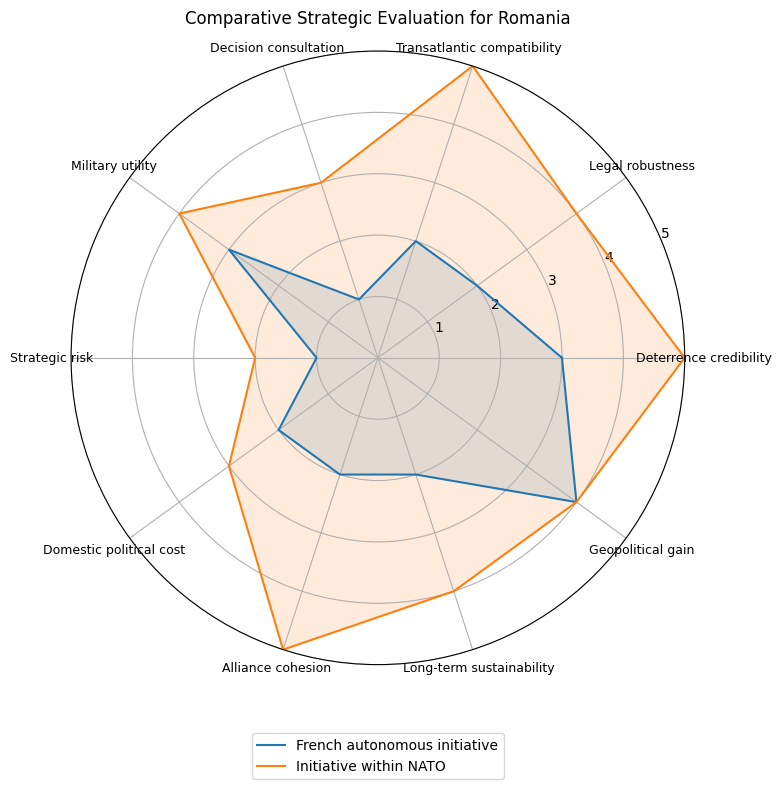
The comparative analysis and multi-criteria model suggest three main conclusions for Romania.
First, the NATO integration scenario is the most favourable from a strategic point of view, as it combines legal legitimacy, military credibility and political stability.
Second, the scenario of an autonomous French initiative involves greater strategic risks, particularly in terms of transatlantic relations and the perception of adversaries.
Thirdly, given the current state of the European strategic environment, the most rational option for Romania remains participation in strategic dialogue and cooperation exercises without immediately committing to hosting nuclear components.
This position allows Romania to participate in the evolution of the European security architecture, while maintaining the strategic flexibility necessary to adapt to future developments.
Conclusion of the MARITIME SECURITY FORUM
Romania should not move directly from “no” to “yes”, but rather build a gradual path of assessment. This path should begin with participation in strategic dialogue, exercises, doctrinal consultation and joint risk assessments, without any commitment to host. This option is compatible with both the current statement by the Romanian president and the legitimate interest of the Romanian state in not remaining outside the European debate on deterrence.
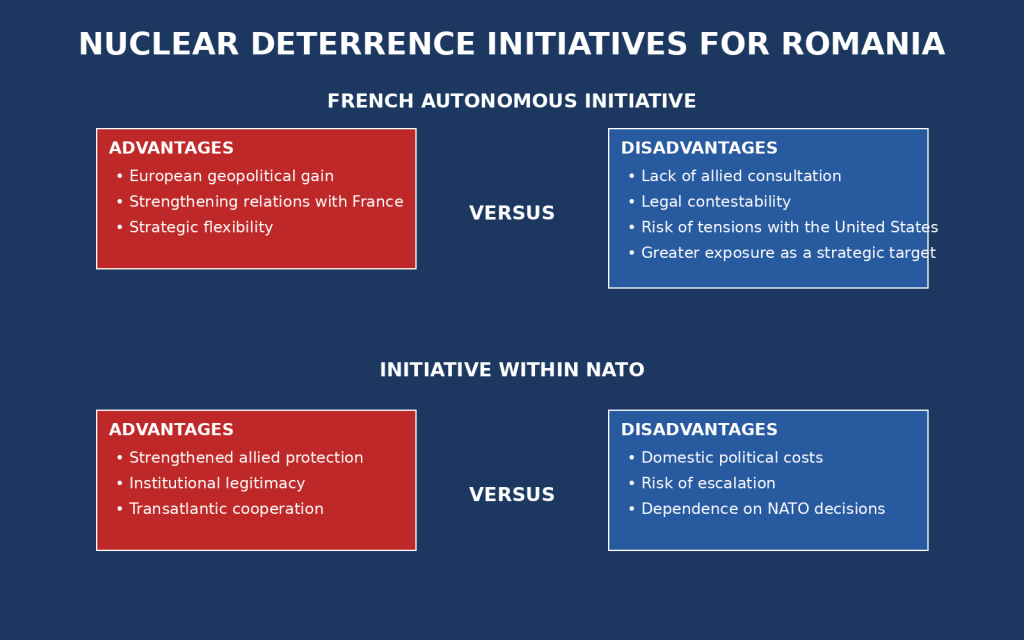
From a strictly analytical perspective, Romania does not currently have sufficient reasons to move from strategic interest to accepting the hosting of components of French nuclear deterrence, especially in the autonomous form suggested by current French doctrine. Public data indicate that the French initiative is real, that dialogue with European partners is deepening, and that Romania has been invited to discussions, but public data also show that Bucharest has ruled out hosting for the time being.
The most rational Romanian position at this stage is one of strategic openness without a commitment to host. Romania has an interest in participating in the debate, understanding the emerging architecture of European deterrence, achieving interoperability and political relevance, but it has not yet demonstrated a sufficiently clear interest in accepting the transformation of its territory into an additional nuclear-strategic exposure point. If, in the future, the initiative moves to a NATO framework or a fully validated allied arrangement and if the strategic environment deteriorates substantially, then the assessment may change. In its current form, however, the optimal scenario for Romania is deepened cooperation without hosting.
Before any discussion about hosting, Romania needs to know exactly what infrastructure will be more exposed, what protective measures would be necessary, what budgetary costs would arise, and how the hybrid and cyber risk profile would change. Without this strategic accounting, the decision would be speculative.
Any discussion about nuclear power causes panic, manipulation and simplification. Therefore, the Romanian state should have a communication framework based on three ideas: democratic control, international legality and strategic proportionality. In the absence of such a doctrine, even moderate scenarios can be politically compromised.
In our opinion, the hosting scenario should only be considered if four conditions are cumulatively met: the existence of an aggravating regional crisis that radically changes the assessment of the threat; the integration of the initiative into a clear allied framework; substantial domestic political consensus; and demonstration that the deterrence benefit explicitly outweighs the strategic targeting cost.
MARITIME SECURITY FORUM