


FIFA World Cup 2026 – A World Cup Diary
A comprehensive chronicle of the competition, compiled day by day throughout the tournament and brought together in a documentary history of the largest World Cup in the history of football.
AUTHORS: Admiral (ret.) PhD. Aurel POPA, Rear Admiral (ret.) PhD. Sorin LEARSCHI
Throughout the 2026 FIFA World Cup, the Maritime Security Forum (MSF) published daily updates on the progress of the competition, providing readers with a documented chronicle of each day of the tournament. Today, these reports have been compiled into a single article – a documentary history of the largest World Cup in football’s history, built up step by step as events unfolded. We invite you to relive the thrills, surprises and moments that defined the footballing summer of 2026.
Contents
Prologue – When the World Came Together Again Through Football 2
11 June 2026 – The day the biggest World Cup began. 4
12–15 June 2026 – The World Cup finds its rhythm.. 5
16–22 June 2026 – The first confirmations and the first major surprises. 6
23–27 June 2026 – The days when every goal changed history. 7
28 June – 3 July 2026 – When the real World Cup began. 9
4–8 July 2026 – The quarter-finals. When the dream begins to take shape. 11
9–13 July 2026 – Four teams, one trophy. 13
17 July 2026 – The penultimate match before the final 13
19 July 2026 – The day the world stopped for football 14
The legacy of the 2026 FIFA World Cup. 15
The World Cup in figures, records and moments that will go down in history. 16
A competition of great stories. 18
The revelations of a historic World Cup. 18
Three countries, one World Cup. 19
The cities that became the capitals of world football 20
The Fans – The Heart and Soul of the World Cup. 22
The World Cup in the digital age. 24
The World Cup and the future of football 25
The final page of the diary. 26
Epilogue – The summer when the world shared the same dream.. 27
Prologue – When the World Came Together Again Through Football
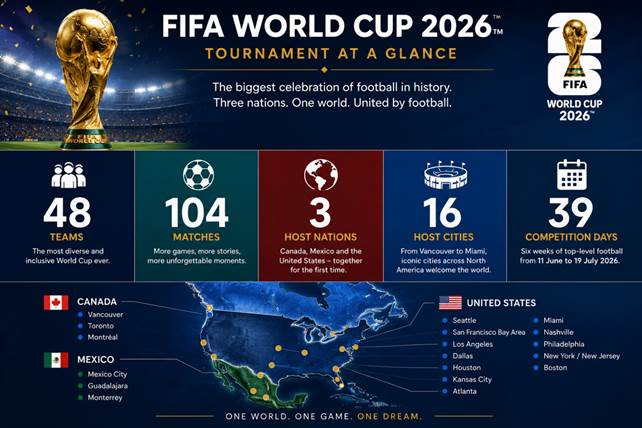
For nearly six weeks, between 11 June and 19 July 2026, football once again became the centre of a world which, for a few hours each day, seemed capable of speaking the same language. The 2026 FIFA World Cup was not merely another edition of the most important international sporting competition. It marked the start of an unprecedented format, an event on a scale that world football had never before seen: 48 teams, 104 matches, 16 host cities and three countries coming together to organise the same tournament. (FIFA)
Canada, Mexico and the United States provided the competition with a vast territory, stretching from Vancouver and Toronto to Mexico City, Monterrey, Los Angeles, Miami and New York–New Jersey. For fans, this World Cup meant impressive distances, varied atmospheres and a continuous succession of landscapes, cultures and stadiums. For the teams, it meant a longer, more intense and more demanding tournament than any of the previous editions. For the history of football, it marked the moment when the World Cup truly became a nearly global competition.
At the outset, there were many questions. Would the expansion to 48 teams dilute the standard of the tournament, or would it open the competition up to new stories? Would the big favourites be able to confirm their status in a longer format and an expanded knockout stage? Will the distances, climate and pace of matches played across an entire continent make physical endurance and adaptability decisive factors? And, above all, who will manage to navigate all these stages to reach the final on 19 July?
The answers did not come all at once. They took shape day by day, in step with the matches, the goals, the shifting league tables and the favourites forced to reinvent themselves. Some teams entered the competition brimming with confidence and were knocked out sooner than they had anticipated. Others arrived without the pressure of high expectations and went on to achieve runs that few could have predicted. There were resounding victories, matches decided in the dying minutes, penalty shoot-outs, improbable comebacks and eliminations that reshaped the entire landscape of the competition.
The tournament kicked off on 11 June in Mexico with the first two Group A matches. Mexico’s victory over South Africa and the Republic of Korea’s win against the Czech Republic provided the first indications of a competition that would bring together, day after day, very different styles, traditions and footballing experiences.
In the hours leading up to the first whistle, however, the results did not yet matter. The stadiums were filling up, the supporters were wearing their team colours, and for a moment the 48 teams seemed equal in their shared hope. The defending champions, Argentina, arrived in North America bearing both the burden and the privilege of defending the trophy they had won in 2022. The major European and South American sides staked their claim as favourites, whilst the representatives from Africa, Asia, North America and Oceania entered a tournament whose new format offered them more scope to make their mark.
The 2026 World Cup was to confirm the strength of established teams, but also the fact that the traditional gaps in international football had narrowed. In a 48-team tournament, an upset could no longer be viewed as an isolated exception. It became part of the rhythm of the competition. Every new day brought the possibility that a seemingly modest team might shake up a group’s standings, alter a favourite’s path, or even change the shape of the knockout stages.
This chronicle was written in the same spirit. Not after the tournament had ended, through a simple retrospective glance, but throughout its duration, following the results daily, the evolution of the standings, the changes in the knockout draw, the decisive moments and the stories that emerged from one match to the next. For this reason, the pages that follow are not merely a succession of scores. They capture something of the uncertainty of every tournament morning, the excitement of every evening, and the way in which the picture of the World Cup changed constantly right up until the final whistle.
Viewed in hindsight, the path seems clear. We know who progressed, who were knocked out, who reached the semi-finals and who lifted the trophy. Experienced day by day, however, the World Cup was an open-ended story. No one knew the next result, no one knew which favourite would hold their ground and which dark horse would manage to turn a moment of inspiration into a historic run.
That is why the story of the 2026 FIFA World Cup must be told in the order in which it unfolded: beginning with the excitement of the opening ceremony, continuing with the first signs of major upsets, the drama of the qualifiers and the intensity of the knockout stages, right up to the evening when the tournament crowned its champion. It is the story of a World Cup on a grander scale than any other, but also of a competition that remained true to its essence: one pitch, two teams, one ball and the hope that, for ninety minutes, any result is possible.
In the summer of 2026, the world came together once more through football. And the story began in Mexico.
11 June 2026 – The day the biggest World Cup began
The opening match of a World Cup always carries significance that goes beyond the result. It is the moment when months of preparation, predictions and discussions about the favourites give way to the game itself. In 2026, this excitement was amplified by the historic scale of the tournament. For the first time, 48 teams were in the running, and the opening day was set to provide the first clues as to how the new format would change the competition.
Mexico took to the pitch under the pressure and energy of a host nation. Facing South Africa, the Mexican side won 2–0 and gave the home crowd the start they had hoped for. It was not just a victory on the scoreboard, but a symbolic moment for a country that was, once again, taking centre stage in the history of the World Cup. (FIFA)
In the other match of the day, South Korea beat the Czech Republic 2–1 in Guadalajara. The match confirmed, right from the opening hours of the tournament, that the differences between the teams would be harder to predict than the traditional rankings suggested. South Korea began the competition with confidence, and Group A immediately took on an interesting dynamic: the two winners of the first day had secured favourable positions, but qualification was far from decided
Figure 1. Opening Ceremony of the 2026 FIFA World Cup, marking the start of the biggest tournament in football history.
By the end of the first evening, the World Cup had found its voice. The first goals had been scored, the first three points awarded, and the vast map of the competition had begun to take shape. In the stands, Mexico was celebrating. In the other host cities, the teams due to make their debuts were making their final preparations. The World Cup had begun.
12–15 June 2026 – The World Cup finds its rhythm
After the excitement of the first day, the World Cup quickly settled into the rhythm that would characterise it right through to the final. The competition’s schedule picked up pace, and every day more stadiums across Canada, Mexico and the United States hosted matches that brought together different playing styles, footballing cultures and generations of players. For the fans, every morning began with fresh calculations, and every evening ended with league tables that were almost constantly changing.
From the very first days, the competition’s new format created a different atmosphere compared to previous editions. The twelve groups allowed for some unprecedented match-ups and gave teams making their debut or returning after many years the chance to test themselves against some of the world’s footballing powerhouses. Whilst attention had been focused almost exclusively on the traditional favourites before the tournament began, the opening rounds were to demonstrate that the 2026 edition was set to be one of the most evenly matched in World Cup history.
In Canada, Mexico and the United States, the atmosphere was becoming increasingly spectacular. Each host city was forging its own identity within the tournament. Veritable football festivals were taking place around the stadiums, and the tens of thousands of supporters who had travelled from all corners of the globe turned every match into a celebration of diversity. On the same day, dozens of different languages could be heard in the stands, and the colours of the national teams blended together in a scene that once again confirmed the global scale of the competition.
The top favourites took to the pitch under the usual pressure of a opening match. Argentina, the reigning world champions, Brazil, France, Spain, England, Germany and Portugal knew that any misstep could quickly complicate their path to the knockout stages. At the same time, teams such as Morocco, Norway, Paraguay, Egypt and Cape Verde saw the new format as a real opportunity to spring surprises and demonstrate that the gaps between the major footballing nations are narrowing from one tournament to the next.
As the first two rounds of group matches drew to a close, the competition was already beginning to produce its first upsets. Some favourites lived up to expectations and consolidated their positions in the standings, whilst others were forced to play their final matches under the pressure of having to qualify. For the teams considered underdogs, every point earned became a source of confidence and proof that a place in the knockout stages was no longer reserved exclusively for the big names in world football.
Another factor that became apparent from the very first days was the physical intensity of the competition. The new format involved a greater number of matches and a very packed schedule, which forced managers to carefully manage squad rotation and player recovery. Far from being merely a competition of individual talent, the World Cup was beginning to transform into a test of squad depth and the teams’ ability to maintain the same level of performance throughout a tournament longer than any of its predecessors.
In those early days, the names of the players who would go on to make their mark on the 2026 edition began to emerge. Some confirmed their status as leaders of their generation, whilst others took advantage of the world stage to make a name for themselves with a global audience. As with every World Cup, the tournament became a place where established stars and rising talents coexisted, and every match had the potential to change a footballer’s sporting destiny.
Meanwhile, off the pitch, the organisation of the competition underlined the unprecedented scale of the project. The flow of supporters between the three host nations, the smooth running of the infrastructure, the use of modern refereeing technology and the huge media interest turned every day into a global event. Millions of television viewers watched the matches live, and the images from the North American stadiums quickly became the symbols of a World Cup that was forging its own identity.
After just a few days, it was already clear that the tournament would not be defined solely by the big favourites. The competition had become unpredictable, and the differences between teams were measured less and less by their track records and more and more by their current form, the players’ inspiration and their ability to handle the pressure of each match. The standings remained wide open, and almost every group held enough unknowns to make the final round decisive.
16–22 June 2026 – The first confirmations and the first major surprises
As the second week of the World Cup took shape, the competition began to reveal its true nature. Whilst the opening days had been dominated by the excitement of the debut and the teams’ desire to avoid mistakes, every match was now a decisive one. The standings were beginning to take shape, and the calculations for qualification were becoming increasingly complex. For some teams, it was a time to confirm their status as favourites; for others, every match turned into a battle for survival.
One of the most striking features of the 2026 edition was the remarkable balance among the participants. The expansion of the competition to 48 teams had not diminished the standard of football, as some experts had predicted ahead of the tournament. On the contrary, numerous teams considered outsiders demonstrated that the traditional gap between the major powers and emerging sides is steadily narrowing. Football organisations in Africa, Asia and North America saw a return on the investments made in recent years, and this progress was reflected in increasingly competitive matches and results that forced the favourites to fight right up to the final minutes.
Brazil, France, Spain, England and Argentina have begun to live up to expectations, though without the displays of dominance that had characterised previous World Cups. Each victory was built on patience and concentration, and opponents no longer readily accepted the role of certain underdogs. Even the teams that were knocked out had moments when they managed to dominate the game or cause problems for opponents with a far richer tradition.
At the same time, the international press began to talk about the competition’s surprise packages. Morocco confirmed that their performance at Qatar 2022 had not been a fluke, once again demonstrating organised and mature football. Norway impressed with their balance between collective discipline and individual quality, whilst Paraguay and Egypt became tricky opponents for any national team. Each of these teams contributed to the image of a World Cup in which reputation mattered less and less the moment the referee blew the whistle to start the match.
For the fans, every day was a different experience. In the major host cities, the fan zones were packed from the early hours of the morning, and the streams of supporters crossing the borders between Canada, the United States and Mexico had become a familiar sight. National colours, fan chants and the traditions of each country came together in a unique spectacle, transforming the World Cup into a celebration of cultural diversity just as much as it was a sporting competition.
On the pitch, the pace of the matches was sustained by impeccable organisation and the use of modern technology. The VAR system, automatic offside detection technology and digital monitoring of players’ performance had become natural features of the competition, helping to reduce refereeing errors and increase the transparency of decisions. Although some interventions sparked heated debates amongst supporters and commentators, most acknowledged that technology had become an indispensable part of modern football.
From a sporting perspective, another aspect was beginning to emerge clearly: the importance of extended squads. In such a long tournament, the difference was no longer made solely by the starting eleven. Injuries, suspensions and accumulated fatigue forced managers to constantly call upon substitutes, and teams with players of the same calibre on the bench began to gain a clear advantage. Every substitution could influence the outcome of a match, and the substitutes’ bench became just as important as the starting line-up.
As the group stage progressed, the standings became increasingly dynamic. In some groups, the top two places already seemed set, whilst in others the difference between qualification and elimination was measured in a matter of minutes or a single goal. Each matchday altered the outlook, and the possible combinations of results became ever more complicated. For fans and journalists, this was perhaps the most spectacular period of the tournament: almost every match influenced the fate of other teams, and the picture of the knockout stages began to change even before it was complete.
The overall atmosphere confirmed that the 2026 edition had already transcended the status of a mere sporting competition. The World Cup had become a global event dominating the media agenda, social media and the everyday conversations of millions of people. Spectacular scenes from the stands, goals that went viral in a matter of minutes, and moving human stories turned every day into a new chapter in a competition that seemed to be pushing its own boundaries.
However, the most intense period was yet to come. The final round of group matches was drawing near, and experience from previous tournaments showed that it is precisely at this stage that the most dramatic moments of a World Cup unfold. Teams that seemed already through could lose everything in ninety minutes, whilst sides considered out of the running could make a spectacular comeback in the battle for a place in the knockout stages. In such a closely contested tournament, nothing had yet been decided.
23–27 June 2026 – The days when every goal changed history
Whilst the first two weeks of the World Cup were devoted to getting to know the teams and settling into the rhythm of the competition, the final days of the group stage turned the tournament into a spectacle of uncertainty. No table could be regarded as definitive any longer, and every goal scored in any of the stadiums across Canada, Mexico or the United States instantly altered the fate of other teams hundreds or even thousands of kilometres away.
For the first time in World Cup history, the system of twelve groups and the qualification of the best third-placed teams meant that almost every match had consequences for several standings simultaneously. It was no longer enough to follow your own group. Without realising it, supporters had also become mathematicians of the competition. Mobile phones displayed standings updated minute by minute, television studios were mapping out increasingly complex scenarios, and commentators were constantly explaining how a goal scored in one city could eliminate or qualify a team playing that same evening in another corner of the North American continent.
This dynamic lent the competition a level of tension rarely seen. In many groups, the difference between qualification and elimination was decided by a single goal, a booking or a few minutes of inspiration. Some teams took to the pitch convinced that a draw would be enough, only to be forced to attack after the result of another match completely changed their situation. Others began their matches with little hope, only to discover, over the course of the ninety minutes, that results elsewhere had reopened their path to the knockout stages.
The big favourites navigated these days with caution. Argentina, France, Spain, England and Brazil quickly realised that their quality alone was not enough in such a closely contested tournament. Managing emotions, experience and the ability to handle difficult moments became just as important as possession or individual quality. At the same time, the teams considered underdogs continued to play without any inhibitions, turning every match into a display of courage and discipline.
In the stands, the atmosphere had become almost electric. Every goal was greeted not only by the joy of the supporters of the scoring team, but also by the reactions of those simultaneously following the progress of other groups. In the fan zones, giant screens showed several matches simultaneously, and shifts in the standings produced successive waves of excitement and disappointment. Rarely had a World Cup offered so many moments in which teams’ fates were being decided in real time.
Beyond the calculations and statistics, these final days of the group stage also produced some of the most emotional moments of the tournament. There were players who burst into tears immediately after the final whistle, not knowing whether the result was enough to secure qualification. There were supporters who watched the final minutes of other matches with the same intensity as they watched their own team. And there were teams who only found out whether they were through or eliminated once all the group matches had finished.
This was probably one of the greatest benefits of the new competition format. Instead of meaningless final matches, the 2026 World Cup offered decisive, dramatic and unpredictable matches in almost every group. The new system did not take the suspense away; on the contrary, it amplified it and extended it right into the final seconds of the group stage.
As the final results were confirmed, the knockout stage draw began to take shape. The names of the qualified teams were known, but their paths to the trophy were set to be completely different from what the experts had anticipated before the tournament began. Some favourites found themselves on the same half of the draw, whilst other teams discovered unexpected opportunities to go as far as possible.
Looking back, the final days of the group stage represented the true turning point of the World Cup. Up until then, the competition had been about hope and possibilities. From that moment on, every match would become a knockout tie, and every mistake could spell the end of the World Cup dream.
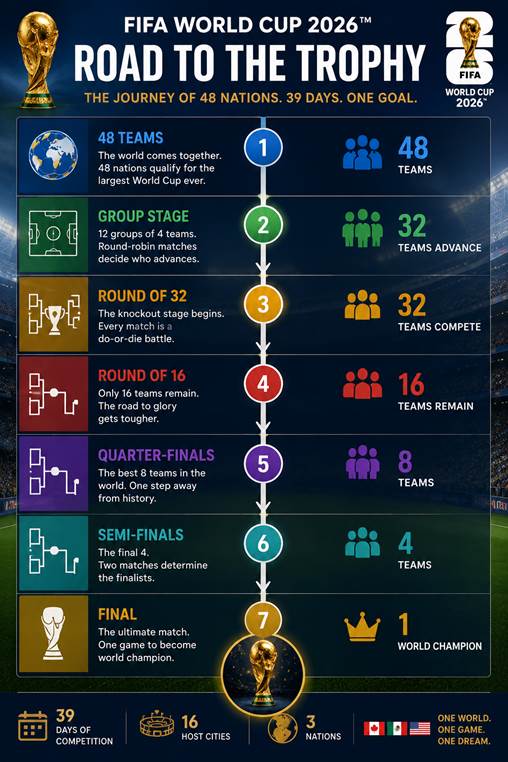
When the final whistle of the group stage sounded in one of the North American stadiums, the tournament had entered a new phase. The forty-eight teams that had set out on their journey had been whittled down to a select group of contenders for the trophy. Before them lay no more mathematical calculations , nor the possibility of a rematch in the next round. This was the start of the phase in which world football forges its legends.
28 June – 3 July 2026 – When the real World Cup began
In every edition of the World Cup, there is a moment when the competition completely changes its character. In 2026, that moment came with the start of the knockout stage. After nearly three weeks in which league tables, goal differences and mathematical calculations had dominated the discussions, everything boiled down to a simple and unforgiving rule: whoever wins goes through, whoever loses goes home.
For the thirty-two teams remaining in the competition, the World Cup was effectively starting all over again. Everything that had been built up during the group stage – spectacular victories, attacking records or hard-fought qualifications – became merely the starting point for a new challenge. In the knockout stages, there was no longer any room for recoverable mistakes. Ninety minutes, sometimes extra time or a penalty shoot-out, separated glory from elimination.
The opening matches immediately confirmed that the intensity of the competition had increased considerably. The pace of the game was faster, the challenges tougher, and every set-piece seemed capable of deciding the fate of an entire generation of players. Whereas in the group stage some teams had been content with a draw, now no one could avoid a direct showdown that would determine the outcome of the competition.
The opening days of the round of 16 also brought the first major upsets. Canada, one of the host nations, saw their campaign come to an end against a Morocco side that confirmed once again that their success at Qatar 2022 had been no fluke. Impeccable defensive organisation, tactical discipline and efficiency at decisive moments transformed the African side into an opponent that nobody wanted to face as the competition progressed.
France overcame the challenge posed by Paraguay with composure, without giving the impression that they were unnecessarily forcing the pace of the game. World champions in 2018 and runners-up in 2022, the French side once again demonstrated the experience they have gained in major competitions. They may not have been the most spectacular team of the tournament, but they continued to inspire that same sense of confidence that only the great footballing nations can convey.
The following day was to produce one of the biggest upsets of the World Cup. Brazil, considered before the tournament to be one of the main favourites to win the trophy, were knocked out by Norway. It was a result that sent shockwaves through the footballing world and demonstrated once again that the 2026 edition defied traditional hierarchies. The Norwegians combined defensive organisation with a remarkable spirit of self-sacrifice and capitalised on every opportunity offered by their opponents, turning a historic victory into one of the defining moments of the competition.
In the same round, England saw off Mexico in a spectacular match played in an extraordinary atmosphere. For the Mexican side, the elimination marked the end of an honourable run in front of their own supporters, whilst for the English, the victory bolstered the confidence of a team that was beginning to believe it could reach the final stages of the tournament.
The other round of 16 matches were not without their own drama either. Spain and Portugal delivered one of the most eagerly anticipated clashes of the competition, and the encounter between the two great Iberian footballing traditions was decided by the finest of margins. Spain progressed, confirming the excellent form they had shown since the group stage and cementing their status as favourites for the trophy.
Belgium impressed with the attacking prowess they displayed against the United States, whilst Argentina continued their campaign after a tough match against Egypt. The reigning world champions no longer had the freshness of their opening matches, but continued to demonstrate what characterises great teams: the ability to win even when their performance is not at its peak.
Perhaps the most dramatic day of the round of 16 was the one in which Switzerland and Colombia needed a penalty shoot-out to decide who would go through. It is at moments like these that the World Cup reveals its most thrilling side. Hours of training, years of hard work and the hopes of an entire nation come to hinge on a few spot-kicks from the penalty spot. A team’s joy is always accompanied by the other’s disappointment, and the images of players collapsing onto the pitch after the final penalty remain among the most powerful symbols of the competition.
By the end of the round of 16, the quarter-final line-up was complete. The big favourites still in the competition had confirmed their status, but alongside them were teams which, before the tournament, had not been considered among the main contenders for the trophy. Morocco and Norway had become the revelations of the tournament, Paraguay had shown they could compete on equal terms with the strongest sides, and England, France, Spain and Argentina seemed ready for the decisive clashes.
Looking back, the round of 16 marked the moment when the World Cup changed its tone for good. The romantic tales of surprise qualifiers gave way to clashes between teams convinced they could become world champions. From then on, every victory brought the trophy closer, and every defeat immediately went down in history.
The tournament had reached the stage where any match could be considered a final before the final itself. And the eight teams remaining in the competition were set to deliver some of the most intense and spectacular days of the entire 2026 FIFA World Cup.
4–8 July 2026 – The quarter-finals. When the dream begins to take shape
After nearly a month of competition, the 2026 FIFA World Cup had reached a stage where every remaining team could view the trophy as a realistic goal. Of the forty-eight national teams that had set out in June, only eight remained in the running for the world title. The journey had been long, gruelling and often unpredictable, but it was precisely this natural selection that had transformed the quarter-finals into a contest between teams that had earned their place through merit, resilience and consistency.
At this stage of the competition, the technical differences had become almost imperceptible. No team could any longer hope to win on the strength of individual talent alone. Organisation, concentration and the ability to handle moments of pressure had become the factors separating victory from elimination. Every misplaced pass, every missed chance and every split-second decision took on a significance that only the final days of a World Cup can bestow.
The quarter-final fixtures featured clashes which, in other tournaments, might well have been World Cup finals in their own right. France and England reignited one of European football’s oldest rivalries, in a match where French experience came up against the energy and enthusiasm of an English generation in search of a new world title. The match confirmed the exceptional calibre of both teams and demonstrated once again that, at this stage of the competition, it is the finer details that decide the outcome.
Argentina and Belgium produced a clash that was different in style but just as intense. The world champions were attempting to defend their title in a tournament where every opponent was determined to knock out the team at the top of the world. Belgium, true to the attacking football that had made their name over the last decade, tried to dictate the pace of the game, but the experience the Argentines had gained in major competitions proved decisive once again.
On the other side of the draw, Spain and Norway demonstrated that the beauty of football also lies in the contrast between styles. The Spaniards remained true to their possession-based game and rapid ball movement, whilst Norway created their chances through defensive discipline and capitalising on every counter-attacking opportunity. For the Nordic side, simply reaching this stage was already one of the greatest achievements in their history, but their run up to that point had led their supporters to believe that anything was possible.
The other quarter-final once again brought Morocco to the fore, the undisputed revelation of the tournament. Following their extraordinary performance at Qatar 2022, many had thought that repeating such a feat would be difficult. The 2026 World Cup, however, was to confirm that Moroccan football had firmly established itself amongst the world’s elite. The team played with the same tactical discipline, the same solidarity and the same confidence that had won over the fans four years earlier.
As the matches drew to a close, it became clear that the tournament had struck its own balance between tradition and innovation. France, Spain, England and Argentina represented the continuity of the major footballing powers, whilst Morocco and Norway symbolised the transformations taking place in world football, where investment in infrastructure, academies and player development was beginning to narrow the historical gaps between continents.
Off the pitch, public interest reached impressive levels. Television audiences grew with every round, and the host cities were savouring the final days of a tournament that had transformed North America into the centre of the footballing universe. Hotels, restaurants and fan zones were packed with people from all corners of the globe, and images of the packed stadiums had become one of the hallmarks of the 2026 tournament.
There were also the inevitable signs of fatigue. After nearly a month of competition, many squads were grappling with injuries, suspensions or physical problems. Managers were constantly adapting their strategies, and match preparation was increasingly becoming a balancing act between ambition and conserving available resources. In such a long tournament, mental resilience was beginning to be just as important as physical fitness.
By the end of the quarter-finals, the semi-final line-up was complete. Four teams remained in the running for the trophy, and all had strong grounds for dreaming of the world title. For the others, the adventure was over, though not without leaving behind memorable moments that would go down in the history of this World Cup.
Looking back, the quarter-finals marked the moment when the tournament ceased to be merely a sporting competition and became a clash of generations, traditions and aspirations. Every team still in the competition knew they were just two wins away from the ultimate trophy. At the same time, every player understood that a single mistake could end a dream that had begun years earlier.
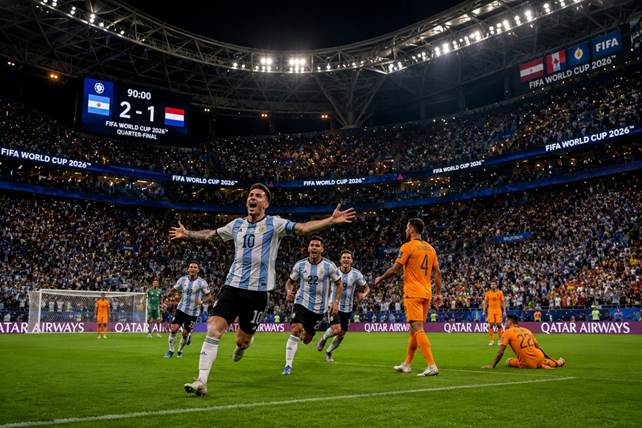
Figure 2. The knockout stage brought the tournament to its highest level of intensity, where every match became decisive.
North America was gearing up for the final four matches of the biggest World Cup in history. Excitement had reached fever pitch, and the footballing world was waiting for its new heroes.
.
9–13 July 2026 – Four teams, one trophy
There is a moment in every World Cup when football ceases to be merely a competition and becomes history in the making. For the 2026 edition, that moment began with the semi-finals. After a month of matches, travelling between the three host nations and hundreds of hours of football, only four teams still held onto their dream of becoming world champions.
The atmosphere surrounding the competition had changed noticeably. Whereas in the early weeks attention had been divided between dozens of teams and hundreds of players, now every training session, every press conference and every piece of information regarding a first-team player’s fitness was becoming a matter of international interest. The press were trying to decipher the slightest clues regarding team tactics, whilst millions of supporters were already beginning to imagine their ideal final.
The semi-finals pitted against each other teams that had reached this stage via different paths. Some had consistently confirmed their status as favourites right from the group stage, whilst others had grown in confidence from one match to the next, building their self-belief with every qualification. Beyond differences in style or track record, however, they all had one thing in common: they had managed to endure the longest and most gruelling World Cup ever organised.
In the stands, the atmosphere was different from that of the earlier stages. The supporters understood that every moment could become part of history. Every save by the goalkeeper, every free-kick and every set-piece was met with an intensity that only the approach to the final can generate. As the minutes ticked by, the tension became almost palpable.
The semi-finals demonstrated once again that major tournaments are not always won by the team that plays the most spectacular football, but by the one that manages the pressure of the moment best. Defensive organisation, patience and tactical maturity counted for just as much as attacking flair, and the experience gained in previous World Cups proved decisive at crucial moments.
As the two matches drew to a close, it became clear that the history of the 2026 World Cup was to be written by two teams that had successfully navigated all the challenges of an unprecedented tournament. The other two teams, although defeated, left the competition with the respect of the footballing world and the feeling that they had been part of one of the most spectacular editions of the World Cup.
Off the pitch, the final days of the tournament had transformed the host city of the final into a veritable hub of world football. Thousands of supporters continued to arrive from all corners of the globe, hotels were operating at full capacity, and the streets were dominated by the colours of the teams still in the competition. Regardless of nationality, everyone shared the same conviction: they were about to witness a moment that would go down in sporting history.
17 July 2026 – The penultimate match before the final
There is always a special day between the semi-finals and the grand final. It is not merely the time needed for physical recovery or tactical preparation. It is the period when the entire competition seems to hold its breath.
Coaches were trying to shield their players from media pressure, whilst analysts were poring over every statistic accumulated throughout the tournament. Discussions about current form, potential injuries and starting line-ups dominated the front pages of sports publications worldwide.
At the same time, the eliminated teams were contesting the third-place play-off, a match which, although it did not offer the top trophy, provided the chance to end the competition with a medal and the sense of having achieved something remarkable. Often, these matches produced some of the most spectacular football of the tournament, free from the pressure of qualification and driven by the players’ desire to end the World Cup on a high.
But all eyes were already on the following day.
19 July 2026 – The day the world stopped for football
There are few sporting events that manage to capture the attention of the entire planet at the same time. The World Cup final is one of them.
On the morning of 19 July 2026, millions of fans woke up with the same question: who would become the new world champions?
Around the stadium, the atmosphere was unlike anything seen at other competitions. Flags waved proudly, songs rang out, and emotions and hopes transformed every street into an extension of the stands. For some fans, it was the fulfilment of a lifelong dream; for others, yet another final experienced alongside different generations of the same team.
The opening ceremony of the final brought together the symbols of the three host nations and marked the conclusion of an unprecedented logistical and sporting endeavour. For nearly six weeks, Canada, Mexico and the United States had jointly hosted the largest competition in the history of football, and the final was the culmination of this collaboration.
On the pitch, the two finalists delivered a match worthy of the occasion. The intensity of every challenge, the precision of every pass and the attention paid to every detail showed that, after 103 matches played previously, the entire competition came down to ninety minutes.
As time ticked away, the excitement mounted. Every save by the goalkeepers was cheered as if it were a goal, every attack was met with the reactions of an entire stadium, and every passing minute brought one of the teams closer to world football’s most coveted trophy.
When the referee blew the final whistle, the stadium erupted in a joy impossible to put into words. The champions’ players collapsed onto the pitch, some laughing, others crying, aware that they had become part of a story that would be told to future generations.
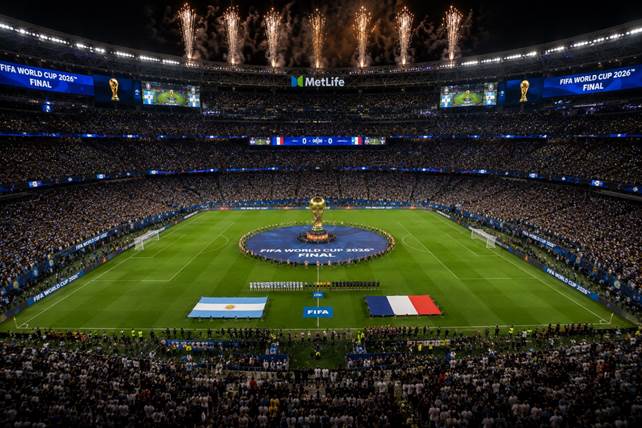
Figure 3. The FIFA World Cup 2026 Final—the defining moment of the tournament and the culmination of six weeks of football.
Lifting the World Cup represented not only the highlight of the competition, but also the conclusion of a tournament that had redefined the scale of the World Cup. Confetti, fireworks and images of the trophy raised towards the sky symbolically brought to a close six weeks in which football had united continents, cultures and millions of people around a shared passion.
Looking back, the final was not merely the last match of the competition. It was the conclusion of a story that began with 48 teams and thousands of hopes. Only one became champion, but all contributed to creating an edition that will go down in history for its scale, balance and spectacle.
The legacy of the 2026 FIFA World Cup
When the stadium lights went out and the trophy left the pitch for the last time, having been awarded to the new world champions, the 2026 FIFA World Cup had already become part of history. The results, goals and names of the winners remained recorded in the statistics. In the collective memory, however, the tournament would be preserved through images, emotions and moments that cannot be reduced to mere figures.
The 2026 edition represented one of the most significant transformations in the history of the World Cup. For the first time, the competition brought together forty-eight teams and was held simultaneously across three countries – Canada, Mexico and the United States of America. Organising an event of this scale required an unprecedented logistical effort, coordinating sixteen host cities, facilitating the travel of millions of fans and staging over a hundred matches in just over a month. Despite all the challenges it entailed, the new format proved its viability and confirmed that world football can evolve without losing its identity.
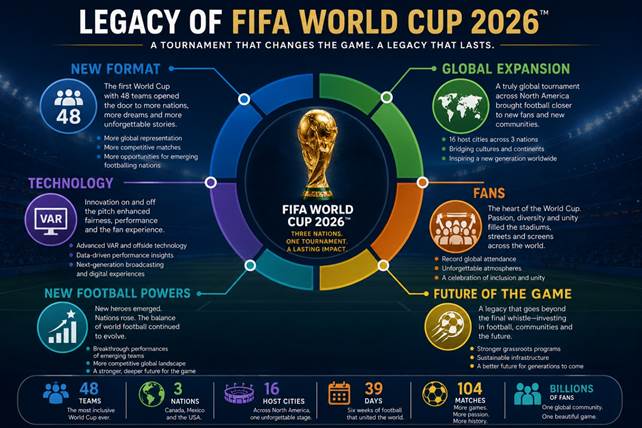
From a sporting perspective, the competition sent an equally powerful message. Expanding the number of participating teams did not diminish the standard of football, but gave more nations the chance to make their mark on the world’s most important sporting stage. Numerous teams considered underdogs have shown that the traditional gap between the major powers and the emerging sides is steadily narrowing . Their performances have confirmed the progress of football in regions which, just a few decades ago, played a secondary role in major international competitions.
The 2026 World Cup was also the tournament of a new generation of footballers. Whilst some of the big names of the past decade may well have played in their final World Cup, the competition brought to the fore players who will shape international football in the years to come. As in every World Cup, the emergence of new leaders on the pitch took place before a global audience, and their performances will remain associated with this North American summer.
Off the pitch, the 2026 tournament once again confirmed the universal appeal of football. Millions of fans travelled across continents to follow their national teams, hundreds of millions more watched the matches on television or via digital platforms, and social media turned every goal, every spectacular save and every moment of joy into a global phenomenon. No other sporting competition manages to capture, in such a short space of time, the attention of such a significant proportion of the world’s population.
Another defining feature of this edition was the consolidation of technology’s role in modern football. Video assistant referee systems, automatic offside detection technology and digital tools used for performance analysis have become integral parts of the competition. Although debates over the interpretation of certain incidents continued, the tournament demonstrated that technology can help to enhance the fairness and transparency of the game without detracting from its excitement.
Looking back, the 2026 FIFA World Cup can also be seen as a moment of transition. It preserved the traditions that have made the competition what it is, whilst at the same time ushering in a new era in the evolution of world football. The expanded format, the multinational organisation and the ever-increasing level of competitive balance will undoubtedly influence future editions of the World Cup.
Perhaps this is precisely the tournament’s most significant achievement. At the start of the competition, there were numerous questions regarding the wisdom of expanding the tournament to 48 teams and the impact this would have on the sporting spectacle. In the end, the answer came from the pitch itself. The World Cup has lost neither its intensity nor its charm. On the contrary, it has provided more stories, more memorable clashes and more nations involved in the great adventure of world football.
The history of every World Cup is ultimately written not just by the champions. It is shaped by every participating team, every packed stadium, every child dreaming whilst watching a match on television, and every supporter who crosses oceans to support their team. In this sense, the 2026 tournament belonged to everyone who was part of it, whether they lifted the trophy or were knocked out after their first match.
Today, as we look back on the six weeks of competition, what remains are the images that define any great World Cup: the emotion of the national anthems before the opening whistle, the explosion of the stands after a decisive goal, the embraces at the end of a dramatic qualification, the tears of those who have been knocked out and the boundless joy of the champions. These are images that go beyond statistics and explain why the World Cup continues to be one of the most powerful symbols of contemporary sport.
The World Cup in figures, records and moments that will go down in history
At the end of each edition of the World Cup, the statistics complete the story written on the pitch. They cannot convey the thrill of a decisive goal or the joy of a last-minute qualification, but they provide a true sense of the competition’s scale and allow it to be compared with all previous editions. From this perspective, the 2026 FIFA World Cup represents a landmark moment in the history of international football.
The first and most significant change was the expansion of the tournament to 48 participating teams, up from the 32 that had competed since the 1998 edition in France. The new format allowed a greater number of national associations to take part and ensured representation for all continental confederations, confirming the truly global nature of the competition.
A total of 104 matches were played, the highest number ever recorded at a World Cup. For 39 days, football took place almost without interruption, turning every day into a new stage in a competition watched by millions of fans around the world.
The tournament was held across 16 host cities in Canada, Mexico and the United States, making it the first World Cup to be hosted simultaneously by three countries and the most geographically extensive to date. The distances travelled by teams and supporters far exceeded those of previous editions, and organising such an event represented one of the most complex logistical operations in the history of sport.
The competition format introduced 12 groups, followed by the round of 32, a knockout stage that increased the number of decisive matches and prolonged the suspense until the final days of the competition. For the first time, the path to the trophy involved a greater number of knockout matches, and teams were forced to manage their physical and tactical resources over a longer period than in any previous edition.
Beyond the overall figures, the 2026 World Cup will also be remembered for the competitiveness of the tournament. Numerous favourites were forced to fight until the very last minutes to qualify, whilst several teams considered underdogs managed to spring major surprises. This balance demonstrated that the traditional gaps between the footballing powerhouses and the emerging nations continue to narrow.
The tournament also confirmed the importance of extended squads. In a competition lasting nearly six weeks, injuries, suspensions and player rotation became decisive factors. It was not just the starting eleven, but the entire team structure that influenced the final results, and teams with quality depth enjoyed a clear advantage in the knockout stages.
From an organisational perspective, the 2026 edition demonstrated football’s ability to integrate modern technologies into an event of this scale. The use of the VAR system, automated technology for identifying offside positions and digital performance analysis tools became a natural part of the competition, contributing to greater transparency and improved decision-making.
Another significant record set by the tournament was the scale of public participation. Stadiums across the three host nations welcomed millions of spectators, and the competition was watched by a global audience numbering in the billions via television broadcasts and digital platforms. For the first time in the history of the World Cup, the competition unfolded simultaneously in the stands, on television screens and online, transforming every match into a real-time global event.
Taken together, these figures illustrate the unprecedented scale of the 2026 FIFA World Cup. However, the true value of the tournament cannot be reduced to mere statistics. Beyond the number of teams, matches or host cities, the 2026 edition will go down in football history for the way it has managed to combine the tradition of the World Cup with a new competition format, ushering in a new era in the evolution of the world’s most important football competition.
Table 1. FIFA World Cup 2026 at a Glance
| Indicator | Value |
| Host countries | 3 |
| Host cities | 16 |
| Participating teams | 48 |
| Groups | 12 |
| Total matches | 104 |
| Competition period | 11 June – 19 July 2026 |
| Match days | 39 |
| Knockout stages | Round of 32, Round of 16, Quarter-finals, Semi-finals, Final |
| Tournament champion | (to be completed after publication if desired) |
A competition of great stories
World Cups are not remembered solely for their results. Years on, few supporters will be able to accurately recall all the scores from a tournament, but almost all will remember the goal that turned a match on its head, a goalkeeper’s save in the dying seconds, or the image of a player collapsing on the pitch after being sent off. The history of the World Cup is, above all, the story of the people who have turned ninety minutes of play into unforgettable moments.
The 2026 FIFA World Cup has also forged its identity through such stories. Every day brought a new hero, a new moment of inspiration or a new display of courage. Sometimes a single piece of skill was enough for a footballer to etch his name into the competition’s memory. At other times, a last-gasp save or a penalty saved in a dramatic shoot-out changed the fate of an entire team.
The tournament was also a meeting of generations. On the pitch were players who had taken part in several editions of the World Cup and young players experiencing the biggest stage in international football for the first time. For the veterans, every match could have been their final World Cup appearance. For those just starting out, every match became an opportunity to make their mark in front of a global audience.
This blend of experience and enthusiasm gave the competition a unique balance. Established players demonstrated once again why they had dominated world football for a decade, whilst the new generation confirmed that the future of the game is already in safe hands. By the end of the tournament, many of those who had started the competition as mere prospects had become household names across the globe.
The 2026 World Cup was also a tournament for goalkeepers. In numerous knockout matches, the difference between qualification and elimination was made by spectacular saves, extraordinary reflexes and the composure shown in the most difficult moments. Whilst the strikers were rewarded with goals and applause, the goalkeepers became the unsung heroes of teams that withstood the pressure and progressed to the next round.
But perhaps the most impressive lesson to be learnt from this World Cup was that of team spirit. In such a long and gruelling competition, success did not rest solely with the big stars. Balanced squads, players coming off the bench and each team’s ability to stick together in difficult moments often carried more weight than individual brilliance. On many occasions, the decisive goals were scored by players who had not started the tournament as first-team regulars, and qualification was achieved through the collective effort of the entire squad.
The revelations of a historic World Cup
Every World Cup produces teams that exceed all expectations. In 2026, the list of such revelations was longer than in many previous editions.
Morocco proved that their exceptional performance in Qatar in 2022 was no fluke. Moroccan football confirmed its maturity with another high-calibre campaign, built on organisation, discipline and confidence. For many supporters, the African side’s run was proof that consistent investment in the development of football can transform a talented generation into a permanent fixture amongst the world’s elite.
Norway provided one of the tournament’s most inspiring stories. Although few had tipped them as contenders for the knockout stages before the competition began, the Nordic side impressed with their balance, courage and efficiency. Their victory over Brazil was one of the defining moments of the World Cup and demonstrated that the traditional gaps between the major footballing powers and emerging teams are narrowing.
Other teams have also confirmed that the competition’s new format offers more opportunities to make their mark. For many nations, simply taking part in the first World Cup with 48 teams was a historic achievement. For others, reaching the knockout stages marked the most significant achievement in their footballing history.
These stories have given the competition a special charm. They have served as a reminder that football does not belong exclusively to the teams with the richest traditions, but to all those capable of believing in their own chances and turning that belief into performance.
Football beyond the pitch
Over the course of nearly six weeks of competition, the World Cup meant much more than the 104 matches played on the pitch. A true global community formed around the stadiums.
Supporters from all corners of the world shared the same stands, the same transport and the same public spaces. In every host city, the flags of different nations coexisted without off-pitch rivalries, and the chants of the supporters became the soundtrack to a summer dedicated to football.
In central squares, fan zones and around the stadiums, children dressed in the shirts of their idols played football before the matches, re-enacting the goals they were set to see a few hours later. Restaurants and cafés had become meeting places for supporters who, although backing different teams, shared the same passion.
Perhaps this was precisely where one of the greatest successes of the 2026 FIFA World Cup lay. At a time when the world often seems divided by political, cultural or economic differences, football has once again managed to create a shared space. For nearly six weeks, millions of people experienced the same excitement, watched the same footage and discussed the same moments. Few global events manage to create such a sense of belonging to a global community.
Three countries, one World Cup
The 2026 FIFA World Cup will go down in football history not only for its record number of participating nations or its new competition format, but also for the way it was organised. For the first time, world football’s most important competition was held simultaneously across three countries – Canada, Mexico and the United States – transforming North America into one vast stage for international football.
This decision represented more than just a logistical solution for hosting an expanded tournament. It symbolised sport’s ability to transcend political and geographical boundaries, bringing together three different countries in a joint project that involved years of planning, investment and institutional cooperation. From the opening match right through to the final, the World Cup functioned as a single event, regardless of whether the matches were played in Mexico City, Toronto, Dallas or New York.
Mexico brought to this tournament the experience of a country that lives and breathes football. Following the 1970 and 1986 editions, hosting another World Cup represented a natural continuation of a tradition that holds a special place in the history of the competition. The atmosphere in the Mexican stadiums once again confirmed the extraordinary passion of the local supporters, and the opening match presented the whole world with the image of a country welcoming its guests through football.
Canada was perhaps the most interesting organisational surprise. Although football has not long held the status that ice hockey enjoys in Canadian sporting culture, recent years have seen spectacular growth in the sport. Hosting the World Cup has become the embodiment of this transformation. Toronto and Vancouver have demonstrated that football can fill modern stadiums and mobilise entire communities around a world-class event. For many supporters, the scenes captured in Canadian cities were one of the most enjoyable discoveries of the tournament.
The United States offered the impressive scale of its infrastructure and organisational expertise. From the arena in Los Angeles to the stadium in New York–New Jersey, each venue illustrated the American ability to transform a sporting event into a multifaceted experience, where the spectacle began long before the kick-off and continued long after the final whistle. The impeccable organisation, transport infrastructure and modern facilities confirmed that the United States is ready to host sporting events on the grandest scale.
What was most impressive, however, was not the differences between the three countries, but the harmony with which they worked together. Despite the vast distances and the specific characteristics of each region, the competition maintained a constant sense of unity. Supporters crossed borders almost as a matter of course, delegations travelled swiftly between the host cities, and millions of television viewers watched the tournament without noticing the geographical boundaries between the organisers.
In many respects, the 2026 FIFA World Cup was also a demonstration of how modern infrastructure can support the organisation of global competitions. Airports, rail networks and motorways became an integral part of the tournament, and the mobility of teams and supporters represented one of the greatest logistical challenges successfully overcome during the competition.
As the tournament progressed, it became clear that each country had made its own contribution to the identity of the World Cup. Mexico offered passion and tradition, Canada offered the hospitality and enthusiasm of a rapidly developing market, and the United States impressed with the scale of its organisation and its ability to turn every match into a major event. Together, these elements created a balance that gave the 2026 edition a unique character in the history of the World Cup.
Perhaps the most important lesson from this joint organisation is that major sporting competitions can become projects of international cooperation. Beyond the rivalry on the pitch, the World Cup demonstrated that countries with different identities can collaborate effectively to achieve a common goal. At a time when the world is facing numerous geopolitical and economic challenges, this image of cooperation held symbolic value that went far beyond the realm of sport.
At the end of the tournament, the three countries were not merely the hosts of a successful competition. Together, they became part of the history of the World Cup. Whilst previous editions were associated with a single nation, the 2026 World Cup will always be remembered as the tournament in which three nations demonstrated that football can unite not only millions of fans, but also three organisers in a joint project of unprecedented scale.
The cities that became the capitals of world football
The 2026 FIFA World Cup was not held in a single city, nor even in a single country. It took place across an entire continent, and each of the sixteen host cities became, for a few days or a few weeks, the centre of attention for the whole world. Beyond the matches played in the stadiums, the tournament changed the rhythm of urban life and transformed squares, boulevards, airports and transport networks into meeting places for millions of supporters.
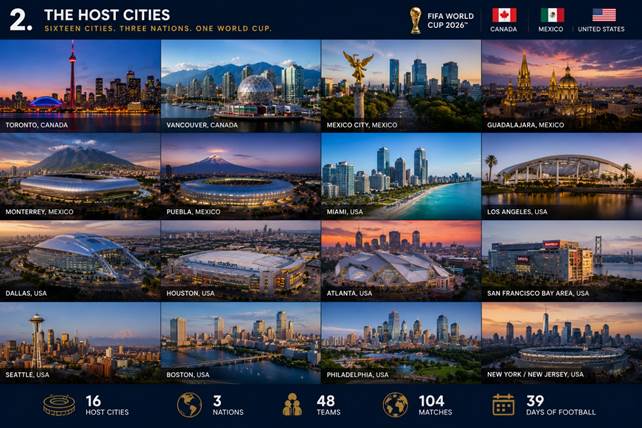
Figure 4. Sixteen host cities across Canada, Mexico and the United States became the world’s football capitals during the tournament.
In Mexico City, the city that has hosted some of the World Cup’s most memorable moments over the years, history and the present came together once again. Near the stadium, as well as in the historic centre, the national colours of the participating teams mingled with Mexican traditions, and the festive atmosphere was reminiscent of the previous tournaments that established Mexico as one of the great hosts of world football. For many supporters, the tournament’s opening in the Mexican capital marked the start of a journey that would take them across the entire continent.
Guadalajara and Monterrey rounded off this picture with the energy characteristic of northern Mexico. On match days, the streets became veritable football promenades. Restaurants and terraces showed the matches live, and supporters of different teams shared the same spaces without sporting rivalry casting a shadow over the festive atmosphere.
Further north, Toronto and Vancouver offered a different perspective on the World Cup. As cosmopolitan cities accustomed to cultural diversity, they welcomed the tournament with remarkable enthusiasm. In the central squares and fan zones, communities from almost every continent could be found, and for many Canadians this was their first direct experience of the scale of a men’s World Cup. For a few weeks, football became the common ground for a society already accustomed to multiculturalism.
The United States impressed with the variety and size of the cities involved in the organisation. Each left its mark on the competition, offering a different experience to supporters and teams alike.
In Los Angeles, the football spectacle blended seamlessly with the energy of one of the world’s most dynamic cultural hubs. In Miami, the Latin American atmosphere created a sense that football was at home, and the presence of numerous South and Central American communities turned every match into a true popular celebration.
Dallas and Houston demonstrated once again the strength of American sports infrastructure. The modern stadiums, impeccable organisation and impressive crowds of supporters confirmed the United States’ expertise in hosting major international events. At the same time, Atlanta, Philadelphia and Boston provided spectacular scenes of boulevards and squares dominated by the colours of the national teams, in a rare blend of American urban tradition and global football passion.
Seattle and San Francisco brought the distinctive West Coast atmosphere to the competition, whilst Kansas City – a city far removed from the major international tourist destinations – demonstrated that a passion for football is no longer confined to the major metropolises. Each match represented an opportunity for local communities to connect with a global event and to discover the cultural diversity brought by the competition.
Perhaps the most powerful symbol of the entire tournament, however, was the New York–New Jersey metropolitan area, the venue chosen for the World Cup final. In the final days of the competition, the city seemed to channel all the energy that had built up over the course of the six weeks. The flags of the finalists dominated the streets, the airports were operating at full capacity, and thousands of supporters had transformed Manhattan and the area around the stadium into a huge celebration of football. In a city accustomed to world-class events, the World Cup final nevertheless managed to create a special atmosphere, confirming the competition’s unique status.
But the true beauty of these cities lay not only in the stadiums. It could be seen in the mornings, in train stations and airports, where supporters wearing shirts of different colours were setting off on their journey to the next match. It could be found on the underground, where conversations flowed naturally between Spanish, English, French, Arabic, Japanese and Portuguese. It could be seen in restaurants where opponents on the pitch shared the same table before matches, and in the squares where children mimicked their idols’ goals regardless of nationality.
The World Cup temporarily transformed the identity of these cities. For nearly six weeks, they no longer belonged solely to their residents. They became shared spaces for a global community united by football. Each city had its own personality, its own rhythm and its own atmosphere, yet they all shared the same role: that of welcoming the whole world.
Looking back, it is hard to associate the 2026 tournament with a single location. This is precisely one of its most wonderful features. The World Cup did not have a single capital city. It had sixteen. And each of them contributed, in its own way, to creating one of the most spectacular tournaments in the history of football.
The Fans – The Heart and Soul of the World Cup
Whilst the FIFA World Cup trophy is the symbol of the competition, its true soul always lies in the stands. The 2026 FIFA World Cup has demonstrated once again that football is not built solely by players and coaches, but also by the millions of people who experience it with the same intensity from the first to the last minute.
Every morning, airports across North America became meeting points for supporters arriving from all corners of the globe. In the departure halls, you could see Argentina shirts alongside those of Japan, Moroccan scarves next to English flags, or whole families dressed in the colours of Mexico or Brazil. For a few weeks, geographical distances ceased to matter. All roads led to the same destination: the World Cup.
On trains, the Underground and buses, conversations often began with the same question: ‘Which match are you going to today?’ From that moment, language barriers vanished almost instantly. Football provided a shared vocabulary. Players’ names, scores and predictions were enough for two people who had never met before to strike up a conversation.
Near the stadiums, the hours leading up to the matches had a magic of their own. The streets were transformed into a spectacle of colour. Flags draped over shoulders, faces painted in national colours, songs echoed by thousands of voices, and children running with a ball amongst groups of supporters all painted a picture of a celebration that began long before the starting whistle.
One of the defining images of the tournament was the peaceful coexistence of the supporters. The rivalry remained on the pitch. Off the pitch, supporters took photos together, swapped scarves and shirts, or offered each other recommendations about the next city they were due to visit. In many places, the same table brought together people who, a few hours later, would be cheering on their teams from stands facing each other.
The World Cup also marked a meeting of generations. Grandparents who used to talk about the 1970 or 1986 tournaments were now watching the matches alongside their grandchildren, who were experiencing their first World Cup. Parents were trying to explain to their children why the national anthem sung before a match carries such powerful emotion, whilst the little ones were discovering, perhaps for the first time, that football can be more than just a game watched on television.
The excitement was the same regardless of the size of the country being represented. For supporters from nations with a long history in the competition, every World Cup represented the continuation of a story that began generations ago. For those from countries making their debut or returning after many years, simply being in the stands was already a source of pride. The joy was not measured solely by victories, but also by the sense of belonging to an event that brought the whole world together.
In the fan zones, the differences between teams almost completely disappeared. The matches were watched on giant screens by people who, under other circumstances, might never have met. Every goal provoked different reactions, but every spectacular moment was applauded regardless of the colours of the shirt worn. Football achieved what few other international events can: it created a temporary community in which passion was more important than origin.
The 2026 World Cup also provided numerous examples of mutual respect. After matches, winners and losers would often meet in the same public spaces, exchanging views and taking photographs. Children asked players for autographs regardless of which team they supported, and the applause given to opponents at the end of some dramatic matches demonstrated once again that sportsmanship can transcend competitive rivalry.
The thousands of volunteers also played a discreet but essential role. They were the first people supporters encountered at airports, near the stadiums or at the information centres. They provided directions, sorted out logistical issues and contributed to the atmosphere of hospitality that characterised the entire competition. Although they rarely appear on television, volunteers are part of the invisible machinery that makes a World Cup possible.
As the tournament drew to a close, a mixture of joy and nostalgia could be felt in the stands. The fans knew that every match played was one of their last moments spent together. At the final, many of them remained in the stands long after the award ceremony. Not because they were expecting anything else, but because they were trying to prolong that feeling that only the World Cup can create.
Perhaps this is football’s greatest victory. For nearly six weeks, millions of people demonstrated that they can sing together, travel together and share the same passion without being divided by differences in language, religion or culture. In a world often defined by borders and divisions, the World Cup offered a vision of a global community united by the same game.
At the end of the competition, the trophy went to a single country. The memories, however, remained in the hearts of everyone who was there. For millions of supporters, the summer of 2026 will be remembered not only for the results on the scoreboard, but for the people they met, the cities they discovered and the feeling that, for a few weeks, the whole world was part of the same team.
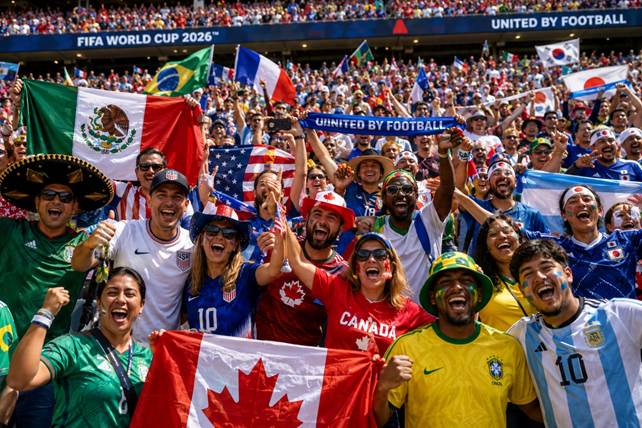
Figure 5. Supporters from every continent transformed the FIFA World Cup into a truly global celebration.
The World Cup in the digital age
Every World Cup reflects the era in which it takes place. Whilst the tournaments of the 1970s and 1980s were defined by the images broadcast on television, and those in the early decades of the 21st century marked the rise of the internet and social media, the 2026 FIFA World Cup will go down in history as the first tournament played in a world where digital technology and artificial intelligence have become an integral part of the football experience.
For millions of fans, the competition did not begin with the referee’s whistle, but long before each match. The official apps provided real-time updates, digital platforms featured detailed statistics on every player, and tactical analysis had become accessible almost instantly to any football fan. Within seconds of a goal being scored, footage was circulating around the world, accompanied by commentary, reactions and analysis from every continent.
Never before had a World Cup been followed simultaneously across so many communication channels. Matches were broadcast live to hundreds of millions of viewers, whilst statistics, video clips and analysis appeared constantly on mobile phones and digital platforms. The viewer’s experience was no longer limited to the ninety minutes of the match. It had become continuous, beginning with the build-up to the match and continuing long after the final whistle.
Social media transformed every match into a global conversation. During matches, millions of fans commented on key moments in real time, shared images and expressed their emotions almost simultaneously with the unfolding of the game. For the first time in the history of the World Cup, the reaction of the global audience could be observed almost instantly, regardless of continent or time zone.
This transformation also changed the way sporting performance was perceived. It was no longer just the goals and final scores that were analysed. Every pass, every sprint, every defensive intervention and every tactical decision could be assessed using a multitude of statistical indicators available almost immediately after the end of a phase of play. Football retained the same excitement, but was accompanied by an impressive volume of information that allowed for a much deeper understanding of the game.
Artificial intelligence and digital tools, in turn, began to influence the fans’ experience. Media platforms automatically generated highlights, selected the most spectacular moments and provided comparative analyses in a timeframe that would have been unimaginable in previous editions of the competition. Without replacing human commentary or expert analysis, these tools contributed to a much faster and more accessible dissemination of information.
The work of journalists also changed considerably. Press conferences, training sessions and official reactions became available almost instantly, whilst correspondents based in North America transmitted information in real time to newsrooms around the world. The public no longer had to wait for the next day’s newspapers to find out the results or important statements. The World Cup was followed moment by moment, in a continuous stream of information.
At the same time, technology also transformed the experience of those present at the stadium. Mobile apps provided quick access to information on transport, the competition schedule and available facilities, whilst constant connectivity allowed supporters to share images and the emotions they were experiencing in the stands almost instantly with family and friends back home.
However, the 2026 edition demonstrated that technology cannot replace the essence of football. No statistic can capture the thrill of a last-minute goal, and no algorithm can anticipate the spontaneous joy of a qualification achieved against all the odds. Data and images have become more accessible than ever, yet the excitement of the game has remained the same.
Looking back, the 2026 FIFA World Cup marks the beginning of a new era in the history of major sporting competitions. Football has shown that it can integrate technology without losing its authenticity. On the contrary, digital tools have brought the competition even closer to the fans, giving them the chance to participate in the event in a way that, just a few years earlier, seemed impossible.
Perhaps this is one of the most important legacies of the 2026 tournament. The World Cup was not merely watched by the whole world. It was experienced in real time by a constantly connected global community, in which the stadium, television and the digital sphere became part of the same experience. Football has retained its universal character, but has discovered new ways in which it can reach, almost instantly, the homes and hearts of millions of fans.
The World Cup and the future of football
Every four years, the World Cup brings one era to a close and ushers in another. The trophy is awarded to a single team, but the competition’s true legacy goes beyond the rankings and statistics. Each edition leaves behind trends, confirms transformations and offers the first clues as to what football will look like in the years to come. From this perspective, the 2026 FIFA World Cup represents more than just a successful tournament; it marks the beginning of a new phase in the evolution of the game.
Perhaps the most important conclusion is that world football has become more balanced than ever before. Whilst in the past the differences between the major powers and the so-called underdogs were evident, the 2026 tournament has shown that these gaps continue to narrow. Numerous national teams have shown that organisation, investment in player development and infrastructure can compensate for differences in tradition or resources. At many points during the competition, the result of a match could no longer be predicted solely on the basis of a team’s track record or position in the international rankings.
This trend reflects the profound changes taking place in world football. Information circulates more quickly, training methods are accessible to an ever-increasing number of football associations, and the experience gained in continental competitions is helping to raise the overall standard of the game. The 2026 World Cup demonstrated that the standard of football is now much more evenly distributed than it was two or three decades ago.
The tournament also highlighted the importance of continuity. Teams with a stable project, a clear identity and a core of players who had developed together over time demonstrated a superior ability to adapt throughout the competition. In a World Cup spanning nearly six weeks, success did not depend solely on a single match’s inspiration, but on the ability to maintain the same level of focus and performance over the long term.
Another aspect worth noting is the diversity of playing styles. Modern football no longer offers a single model for success. In 2026, teams that built their success on possession and control coexisted alongside sides that relied on defensive organisation, quick transitions or efficiency from set pieces. The World Cup demonstrated that there are many paths to success and that adapting to the opposition has become one of the most important qualities of the great teams.
Beyond the sporting aspect, the 2026 edition also confirmed the global expansion of football. The joint organisation of the competition by Canada, Mexico and the United States demonstrated that major sporting events can be the result of international cooperation, and the logistical success of the tournament opens up prospects for similar projects in the future. In an increasingly interconnected world, the World Cup is becoming not just a competition between teams, but also a demonstration of the capacity for collaboration between nations and communities.
At the same time, the experience of the 2026 edition suggests that technology will continue to influence the development of football. Performance analysis, video assistant refereeing, real-time monitoring and digital tools for supporters are likely to become permanent features of major competitions. The challenge of the future will not be the introduction of new technologies, but maintaining a balance between innovation and the authentic excitement of the game.
For fans, the 2026 World Cup also offered another important lesson. At a time when communication takes place almost instantaneously, football continues to create experiences that cannot be replaced by the digital world. Nothing can replicate the excitement of a packed stadium ahead of a decisive match, the silence that precedes a penalty kick, or the explosion of joy that follows a last-minute goal. It is precisely this combination of tradition and modernity that seems to define the future of the competition.
Looking ahead, it is likely that many of the changes that began in 2026 will continue. New generations of players will emerge, other nations will consolidate their position in world football, and technology will become an ever-greater part of the preparation and running of competitions. Nevertheless, the essence of the World Cup will remain the same. Beyond changes to the format, developments in infrastructure or technological progress, football continues to be the story of teams that dare to dream and of supporters who believe that the next match could change history.
Perhaps this is the most important legacy of the 2026 FIFA World Cup. Not merely that it was the largest tournament ever organised, but that it demonstrated football’s ability to evolve without losing its identity. The competition has become broader, more diverse and more representative of the entire international community, yet it has retained the very thing that has made it unique since 1930: the power to unite people, generations and continents around a simple game capable of stirring universal emotions.
Ultimately, the future of football will not be defined solely by more modern stadiums, more advanced technologies or larger competitions. It will continue to be shaped by the same passion that filled the stands across North America in the summer of 2026 and which, every four years, transforms the World Cup into an event that the whole world awaits with the same hope and enthusiasm. Thus, the 2026 edition represents not only the end of a memorable competition, but also the beginning of a new chapter in the history of world football.
The final page of the diary
Every diary has a final page. Not because the story has ended, but because the moment it describes has already become part of the past.
The 2026 FIFA World Cup took place at a time when the world needed, perhaps more than ever, events capable of bringing people together. For nearly six weeks, football succeeded in doing just that once again. It brought joy and disappointment, gave rise to heroes and revelations, confirmed champions and offered hope to those looking to the future.
As the last delegations left North America, the stadiums returned to the quiet places they had been before the tournament. The stands emptied, the fan zones were dismantled, and the colourful banners gradually disappeared from the host cities. Yet something far more important than the tournament’s trappings remained: the collective memory of a summer in which the world came together once more through football.
This diary was compiled as the tournament unfolded. Every day, as the competition unfolded, we followed the results, the standings, the surprises and the moments that shaped the story of the World Cup. Viewed individually, each day was just one stage. Taken together, they form the history of a competition that redefined the World Cup.
Years from now, the statistics will be easy to find, and the results will be available in any sports archive. It will be harder to recapture the excitement of the first day, the suspense of the final group stage matches, the joy of dramatic qualification, the silence that preceded the penalty shoot-outs, or the explosion of joy on the evening when the new world champions lifted the trophy. It is precisely these moments that we have sought to preserve within the pages of this diary.
The 2026 FIFA World Cup came to an end on the evening of 19 July. But, like all major sporting competitions, its true life begins only after the final whistle. It lives on in the memories of the fans, in the images that will resurface every time this edition is discussed, and in the stories that each generation will pass on to the next.
Because a World Cup does not belong solely to the team that lifts the trophy. It belongs to everyone who, for a few weeks, experienced every match with the same excitement and discovered once again that football can unite the world in a way that few other events can.
Epilogue – The summer when the world shared the same dream
On the evening of 19 July 2026, when the referee blew the final whistle, the 2026 FIFA World Cup officially came to an end. The trophy had found its new champion, the stadiums began to empty, and the lights that had illuminated every match for nearly six weeks gradually faded. For the organisers, the competition had come to an end. For millions of fans around the world, however, the story was only just beginning to become a memory.
What remained were images that no league table or statistic can ever fully capture. The excited gaze of a child visiting a World Cup stadium for the first time. The embrace between two supporters cheering on different teams. The silence before a decisive penalty kick and the explosion of joy following a goal scored in the dying moments of a match. These are moments that transcend football and explain why this competition continues to hold a special place in the world’s collective memory.
Throughout the tournament, football once again achieved what few other international events can. It created a shared space where differences in language, culture, religion or political affiliation took a back seat for a while. In the stands and in the squares of the host cities, people from all corners of the globe sang, hoped, suffered and rejoiced together. For nearly six weeks, the world shared the same emotion.
The 2026 FIFA World Cup was more than just the first tournament featuring forty-eight teams or the first edition organised simultaneously by three countries. It was proof that football continues to evolve without losing its essence. The competition has become bigger, more diverse and more representative of the international community, but it has remained true to the simple idea that has defined it for nearly a century: that, when the starting whistle blows, every team has the right to dream.
This journal was compiled in step with the tournament. Day by day, the competition was followed, documented and transposed onto pages that sought to capture not only the sequence of results, but also the atmosphere, the emotion and the transformations that made the 2026 edition one of the most significant in the history of the World Cup. Viewed separately, each day and each match represented just one stage of the competition. Viewed together, they form the story of a summer in which football once again became the world’s common language.
Years from now, many of the statistical details will have been forgotten. The results can be found in the archives, and the images will continue to circulate in documentaries and sports collections. What will truly remain, however, is the feeling experienced that summer: the excitement of a competition in which every day brought a new story, every match could change a team’s fate, and every stand confirmed that football has a power to unite people that few other social phenomena possess.
Perhaps this is the true value of the World Cup. It does not belong solely to the champions, nor merely to the official history of the sport. It belongs to everyone who experienced it: the players who proudly represented their country’s colours, the coaches who built teams capable of inspiring, the volunteers who made the competition possible, the journalists who documented every moment and, above all, the millions of supporters who filled the stadiums and watched the matches from every corner of the world.
Ultimately, every World Cup leaves us with a simple question: what will we remember years from now? In the case of the 2026 tournament, the answer lies not merely in the name of the team that lifted the trophy. It lies in the image of a continent transformed into a single football arena, in the courage of the teams that exceeded all expectations, in the respect shown between opponents, and in the genuine joy of people who, for a few weeks, discovered they shared the same passion.
The 2026 FIFA World Cup has come to an end, but its legacy will continue to inspire future generations. The next edition will bring new champions, new records and new stories. Nevertheless, the summer of 2026 will always hold a special place in the history of football. It was the summer when the competition became bigger than ever, whilst remaining deeply human.
And perhaps this is the most beautiful definition of the World Cup: not just the competition that crowns the world’s best team, but also the place where, every four years, the world is reminded that it can dream together.
MARITIME SECURITY FORUM