


Dear readers, we are launching a new international project in which we invite you to actively participate: the Maritime Security Forum – “Strategic Debate” Edition. We invite well-reasoned opinions from military personnel, diplomats, security experts, lawyers, economists, researchers, and maritime professionals, as well as from readers in general. This week’s topic will be: Could a widespread war in the Middle East block the Red Sea and reshape global maritime security?
How it works:
1. Introductory mini-analysis
2. 5–7 contextual questions for the community
3. Readers’ comments posted on the page
4. At the end of each weekly topic published, the following is prepared:
5. Weekly Strategic Summary with the forum’s conclusions based on comments posted by Romanian and international readers.
We invite you to comment on the topic in the dedicated section at the end In the website menu, you can find the topics under the Strategic Debate section
Could a Wider Middle East War Block the Red Sea and Reshape Global Maritime Security?
Extended Introduction
Escalating tensions across the Middle East once again highlight one of the most significant vulnerabilities of the international economic order: the world’s dependence on a limited number of strategic maritime passages through which vast volumes of trade, energy and essential logistics flows move every day. Among these decisive maritime spaces, the Red Sea holds a central position.
Located at the intersection of Europe, Asia and Africa, the Red Sea is one of the key commercial arteries of the modern world. Through its direct connection to the Suez Canal, it significantly shortens transit distances between Asian and European markets, reducing shipping costs, delivery times and pressure on global supply chains.
Large volumes of oil, LNG, grain, manufactured goods, industrial components, consumer products and high-value technological equipment transit through this route every year. For that reason, regional stability is not merely a local concern; it has direct consequences for inflation, energy security, goods availability and the pace of international commerce.
During periods of geopolitical calm, this maritime infrastructure operates almost invisibly and is often taken for granted as part of globalisation. During periods of crisis, however, it rapidly becomes a point of strategic pressure.
Recent developments have shown that modern maritime threats no longer require conventional fleet-on-fleet warfare. Attacks on commercial vessels, the use of drones, anti-ship missiles, naval mines, non-state actors and proxy operations demonstrate that relatively low-cost tools can generate disproportionately high economic disruption.
This is one of the defining realities of contemporary security: limited operational costs for the disruptive actor, very high economic costs for the wider international community.
Should current tensions evolve into a broader regional war, consequences could quickly move beyond the immediate military sphere. They may include large-scale rerouting around the Cape of Good Hope, global logistical delays, higher energy and consumer prices, rising insurance premiums and a sustained international naval presence.
More fundamentally, the present situation raises a critical question: has the global economy become excessively dependent on a small number of strategic maritime passages that are increasingly difficult to secure in an era of hybrid conflict?
In that sense, the debate surrounding the Red Sea extends far beyond the Middle East. It concerns the resilience of global trade, the future of freedom of navigation and the role of sea power in the international order of the twenty-first century.
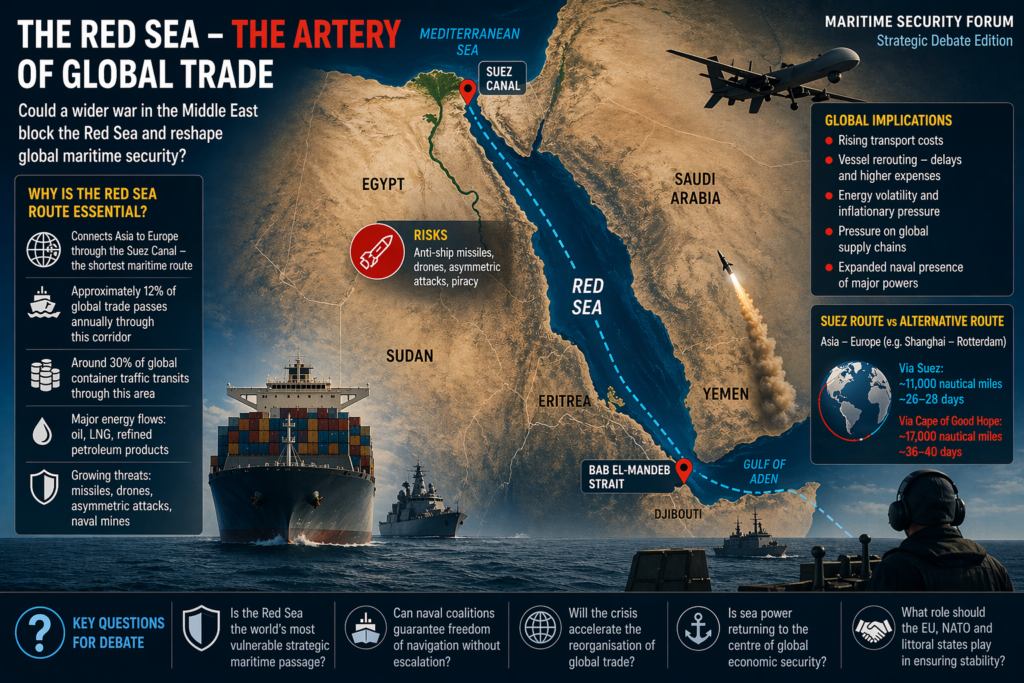
Questions for Debate
1. Is the Red Sea currently the world’s most vulnerable strategic maritime passage?
Given the proximity of regional conflicts, the density of commercial traffic and the range of military and hybrid threats, has this route become more exposed than the Strait of Hormuz, the South China Sea or the Panama Canal?
2. Can international naval coalitions effectively guarantee freedom of navigation?
Are traditional escort and patrol missions sufficient, or do emerging threats—drones, long-range missiles, coordinated attacks and cyber risks—require an entirely new maritime security model?
3. Could a prolonged crisis permanently reshape the geography of global trade?
If shipping operators avoid the area for an extended period, could alternative routes around the Cape of Good Hope, Eurasian land corridors or new regional port hubs gain lasting importance?
4. Is sea power returning to the centre of global economic security?
In a world shaped by strategic rivalry and geopolitical fragmentation, are navies once again becoming the principal guarantors of international commerce?
5. What role should the European Union, NATO and littoral states play?
Should priority be given to expanded naval missions, regional partnerships, maritime infrastructure protection or diplomatic de-escalation efforts?
We welcome informed contributions from naval officers, diplomats, analysts, academics, lawyers, economists and maritime professionals.
Is the Red Sea the world’s most vulnerable strategic sea lane?
The Red Sea has indeed become one of the most exposed chokepoints of global trade, but declaring it the “most vulnerable” route requires some qualification. Its current vulnerability stems from a specific set of circumstances: Houthi attacks with drones and anti-ship missiles, its proximity to the conflict in Yemen, and instability in the Horn of Africa have turned the Bab el-Mandeb Strait into a corridor of constant risk. Unlike the Strait of Hormuz, where the threat is concentrated on a single state actor (Iran), the Red Sea involves state, non-state, and proxy actors, making a classic military response far more difficult.
However, the Strait of Hormuz remains structurally more critical for the global energy economy (approximately 20% of the world’s oil), and the South China Sea concentrates geopolitical tensions with the potential for far more serious escalation, involving nuclear powers. The Panama Canal suffers from a different kind of vulnerability—climatic and hydrological. Therefore, the Red Sea is the most actively contested route at this time, but not necessarily the most vulnerable from a long-term systemic perspective.
2. Can international naval coalitions guarantee freedom of navigation?
The short answer is: not in their current form. Operations such as Prosperity Guardian or the EU’s Aspides mission have demonstrated both the utility and the limits of the classical approach. Intercepting drones and missiles is possible but economically unsustainable—the cost of an SM-2 missile far exceeds the value of a Shahed drone. This cost-benefit imbalance represents a paradigm shift in naval warfare.
The new maritime security model must integrate low-cost anti-drone capabilities (lasers, electronic warfare, small-caliber kinetic systems), cyber protection for navigation and communications systems, increased cooperation with the private sector (shipping companies), as well as preventive approaches that target not only the consequences but also the sources of the threat—logistics, financing, and launch infrastructure. Traditional escort remains necessary but insufficient in an environment where attacks are asymmetric, coordinated, and hybrid.
3. Could a prolonged crisis permanently alter the geography of global trade?
Yes, and this process is already underway. Redirecting a significant portion of containerized traffic via the Cape of Good Hope route has added 10–14 days to transit times and significantly increased transportation and insurance costs.
If this situation persists beyond a certain timeframe—likely 2–3 years—companies will recalibrate their supply chains, which could trigger irreversible structural effects.
Potential beneficiaries include African ports such as Durban, Walvis Bay, or those in Morocco, the China-Europe land corridor through Central Asia (though with serious capacity constraints), as well as projects such as the IMEC (India-Middle East-Europe Corridor). However, the economies of scale in maritime transport are so strong that no land-based alternative can truly replace the Suez Canal. What is most likely to change is the degree of route diversification and the emergence of new regional logistics hubs, rather than the replacement of the main artery.
4. Is naval power returning to the center of global economic security?
We can speak of a revelation rather than a return—naval power has never ceased to be the foundation of global trade, but the post-Cold War illusion of pacified oceans allowed many states to reduce their investments in naval forces. The current crisis exposes just how fragile that assumption was.
The phenomenon is evident in the growth of China’s naval budgets (now the world’s largest navy by number of ships), in British, French, and Japanese modernization programs, as well as in European discussions about rebuilding a credible naval capability. However, traditional naval power alone is no longer sufficient—it must be integrated with space (satellite, GPS), cyber, and artificial intelligence capabilities. The future guarantor of maritime trade will not be the aircraft carrier, but a complex technological ecosystem built around naval platforms.
5. What role should the EU, NATO, and coastal states play?
Each actor has a complementary role, and success depends on avoiding fruitless overlaps. The European Union, through the Aspides mission and its maritime strategy, can offer a model of civil-defense engagement with strong involvement in protecting its own trade. NATO has the advantage of interoperability and high-intensity capabilities, but must avoid turning the Red Sea into a new theater of confrontation with external actors that would further complicate the situation.
The coastal states—Saudi Arabia, Egypt, the United Arab Emirates, and Djibouti—are the most underestimated factor. Without their cooperation and investment, no external coalition can generate lasting stability. Priorities should include protecting critical maritime infrastructure (including undersea cables), investing in affordable anti-drone capabilities, diplomatic solutions addressing the conflict in Yemen as the source of the crisis, and building regional partnerships that empower the coastal states. A purely military approach, lacking diplomatic and development components, is doomed to fail in the long term.
6. Are we at the dawn of a new era of global maritime insecurity?
Probably yes, and this reflects a deeper transformation of the international order. The combination of the proliferation of cheap attack technologies (drones, low-cost missiles), geopolitical fragmentation, the erosion of international maritime law norms, and the emergence of non-state actors with quasi-state capabilities creates an environment fundamentally different from that of recent decades.
The implication is that economic security becomes inextricably linked to the ability to project power at sea—but not in the traditional sense of naval dominance, rather in terms of maritime resilience. The states that will prosper will be those that combine military capabilities, route diversification, logistical redundancy, and international partnerships. Paradoxically, the era of peaceful maritime globalization has created vulnerabilities precisely through its own efficiency: the concentration of traffic on a few critical routes has turned those routes into targets. Rebuilding a stable maritime order will likely require a combination of traditional hard power and new forms of technological and diplomatic cooperation—a difficult task in an increasingly polarized world.
Comments are closed.