


The Gulf’s fragile trade lifeline: Fujairah and Khor Fakkan as a ‘bypass’ for Hormuz
Analysis by the Maritime Security Forum
Context. The de facto closure of the Strait of Hormuz has led to a rapid reconfiguration of trade flows in the Gulf. The United Arab Emirates has pivoted towards two ports on the eastern coast, with direct access to the Indian Ocean: Fujairah (in the Gulf of Oman) and Khor Fakkan (Sharjah). In practice, these hubs have taken over a substantial part of the functions of the terminals within the Gulf, where ships have remained stranded.
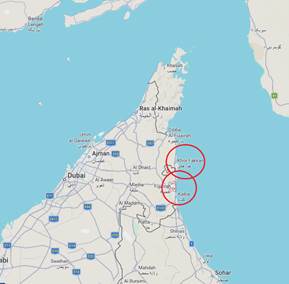
Location
Why it matters. The two ports have simultaneously become: (1) an energy gateway (loading of crude oil and petroleum products), (2) a container logistics hub (transhipment/land-bridge for the UAE and for the states ‘behind’ ) and (3) a critical import gateway (food, consumer goods, medical supplies), which makes them infrastructure of strategic, not just commercial, value.
The bypass mechanism. Fujairah’s advantage lies in its connection to the Abu Dhabi Crude Oil Pipeline (ADCOP / Habshan–Fujairah), which can transport approximately 1.5–1.8 million barrels per day to the Gulf of Oman, bypassing Hormuz. Thus, part of ADNOC’s exports can continue without transiting the strait, reducing the UAE’s immediate vulnerability to a maritime blockade.
Substitution and congestion effects. Shifting volumes eastwards has created a paradox: the ports have saved the flows, but have introduced congestion (queues of lorries, ships at anchor, waiting times) and increased the infrastructure’s ‘target value’. The more Fujairah and Khor Fakkan take on, the greater the shock their disruption would cause.
Key figures (from the Reuters report). Since the start of the war, crude oil exports via Fujairah have risen by 38%, whilst at Khor Fakkan the volume of containers handled has increased approximately 25-fold (from ~2,000 to ~50,000 containers/week). Meanwhile, Kpler data indicates an increase in average crude oil exports from Fujairah to around 1.62 million bpd at the end of March, compared to 1.17 million bpd in February.
| Indicator | Value / change | Significance |
| Crude oil exports via Fujairah | +38% (since the start of the war) | Maximising the bypass route; increasing dependence on ADCOP and the port. |
| ADCOP (Habshan–Fujairah) capacity | ~1.5–1.8 million barrels/day | The ‘ceiling’ of the UAE’s energy resilience in the absence of Hormuz. |
| Fujairah – average exports (Kpler) | ~1.62 million bpd (end of March) vs ~1.17 million bpd (Feb.) | Accelerated rerouting; high sensitivity to attacks on the hub. |
| Khor Fakkan – containers handled | ~2,000 → ~50,000/week (≈25×) | Structural shift in trade; the port becomes a regional ‘gateway’. |
Vulnerabilities and coercion. The drone attack on the Fujairah Oil Industry Zone (resulting in fire and injuries) highlighted that the ‘bypass’ is itself vulnerable. In geostrategic terms, striking infrastructure outside the Strait of Hormuz sends a message: Iran can project risk onto alternative routes as well, seeking to reduce the economic benefit of bypassing the strait.
The publication by the IRGC Navy of a map suggesting the extension of the “control zone” along the eastern coast of the UAE (including Fujairah and Khor Fakkan) serves as a tool for intimidation and for increasing the risk premium (insurance, port avoidance, rerouting). Even without an immediate halt to operations, this communication can have economic effects through market expectations and the decisions of shipping operators.
The UAE’s position. Public statements by the authorities have emphasised that freedom of navigation in the Strait of Hormuz is a critical priority and that the UAE reserves the right to respond to attacks on its territory. This stance aims to avoid two risks: (1) the perception of ‘giving in’ to coercion; (2) uncontrolled escalation that would turn the UAE into a direct theatre of confrontation.
In normative terms, the UAE has framed the dispute as one concerning the protection of international trade flows and supply routes, explicitly rejecting the right of any actor to disrupt global trade for political gain.
Critical infrastructure: ADCOP as the ceiling of resilience. Fujairah is the terminus of the ADCOP pipeline, designed precisely to reduce dependence on transit through the Strait of Hormuz. In the event of a prolonged crisis, however, this pipeline becomes both a solution and a constraint: its capacity (1.5–1.8 million bpd) limits how much the UAE can export via the secure route, whilst overuse increases the stakes for protecting the port, pumping stations and storage/loading facilities.
Structural change: Fujairah is transitioning to a mixed-use port. In addition to its energy role, shipping data shows that Fujairah has begun to regularly accept container ships, a sign that the port is expanding its function to general logistics chains (not just crude oil/bunkering). This ‘containerisation’ is an indicator that part of the commercial reconfiguration may persist even after a possible partial reopening of the Strait of Hormuz.
Khor Fakkan: accelerated transformation of a transhipment port
The transformation of Khor Fakkan is more dramatic than that of Fujairah in the containerised segment: the operator Gulftainer has reported an increase from ~2,000 to ~50,000 import/export containers per week. In terms of trade networks, this suggests that the port has rapidly shifted from a regional transhipment role to a gateway role for supply and redistribution in the Gulf.
Tracking data also indicated a roughly fourfold increase in call frequency (container ship calls per day) following the start of the war. The knock-on effect is pressure on capacity (berths, equipment, storage), which tends to increase dwell times and logistics costs even if the port remains operational.
Kpler data shows that daily container port calls to Khor Fakkan have increased fourfold since the start of the war.
Land logistics chain: the ‘land-bridge’ effect. According to Gulftainer management, Khor Fakkan has become a ‘critical national gateway’, playing a role in essential imports (food, medical supplies). This function is supported by a massive volume of road transport, indicating that resilience depends not only on cranes and docks, but on the entire ecosystem (roads, warehousing, workforce, customs).
In the same report, road traffic is said to have risen from ~100 lorries/day before the war to ~7,000 lorries/day, and the operator indicated the rapid recruitment of ~900 people at the start of the crisis. These figures suggest rapid adaptation, but also fragility: the system becomes dependent on the continuity of the workforce, the security of internal routes and the functioning of energy/IT infrastructure.
Operational status (at present). Despite the attacks, shipping data indicated that traffic at both ports remained robust, with ships at anchor and berthing capacity utilised to the full. The operational picture is one of continuous operation, but under congested conditions, which increases costs and the risk of delays.
A direct indicator of congestion is the number of container ships waiting: at Khor Fakkan, several ships were reported to be ‘in storage’ and others waiting, whilst Fujairah, with a smaller berthing capacity, had fewer ships at the quayside and at least one waiting. The interpretation is that ports can absorb the shock, but at increased costs in terms of time and capital.
Logistics operators have indicated that operations are continuing, and the main issue is congestion, not a complete shutdown. This distinction is critical: congestion is a ‘diffuse’ shock (costs and delays), whilst a shutdown would be an ‘abrupt’ shock (shortages and panic).
From the perspective of transport companies, Fujairah and Khor Fakkan have been described as the most direct port options for goods destined for the UAE in the event of a closure of the Strait of Hormuz, avoiding long road transits and border crossings through Saudi Arabia or Oman. In geopolitical terms, this increases the interdependence between the UAE’s infrastructure and the stability of regional land routes.
“These are currently the only direct port options in the United Arab Emirates for goods destined for the UAE to avoid long road transits and border crossings through Saudi Arabia or Oman,” he said.
Geographical factors: why some states can bypass Hormuz, whilst others cannot
Saudi Arabia has a similar structural advantage (two coastlines) and can redirect significant volumes via infrastructure that bypasses Hormuz to the port of Yanbu (Red Sea). However, reports indicate that Iran has also struck energy hubs along this route, suggesting that ‘bypasses’ do not eliminate the risk, but redistribute it to new critical points.
Thus, the geographical advantage reduces dependence on a single choke point, but introduces competition to protect new ‘hubs’ (exit ports, pumping stations, refineries) that can be targeted for disproportionate economic impact.
Qatar, Kuwait and Bahrain have a less favourable strategic geometry: their maritime outlet lies ‘behind’ the Strait of Hormuz, so that, following the logic described, they become dependent on alternative routes such as Khor Fakkan (for imports) or land corridors through Saudi Arabia and Oman, which are more costly and congested. The geopolitical implication is the growing importance of ‘transit’ states (Saudi Arabia, Oman) and border/customs infrastructure in stabilising regional trade.
Long-term effects: investment and logistical ‘lock-in’. Operators anticipate that the new architecture may persist: plans for an inland logistics hub in Al Dhaid (approx. 50 km from the port) indicate a trend towards ‘thickening’ the network (port → dry port → inland distribution). Such investments tend to create inertia: even if the Strait of Hormuz reopens partially, some of the flows may remain on the eastern route, for redundancy.
In the report, the project is described as a “dry port” covering over 100 hectares, connected by road and rail, with an investment of over $100 million in the first phase. The strategic significance is that the response to maritime coercion is becoming a programme of infrastructural resilience, not merely a temporary crisis measure.
Persistent exposure and the need for a regional backup. Reports of repeated strikes on infrastructure in Fujairah (including temporary suspensions of some operations) show that the new trade architecture is exposed. One resilience response mentioned is regional coordination that allows cargo to be routed via land corridors through Saudi Arabia and Oman, as a fallback option when maritime hubs are under pressure.
At the micro level, commercial actors acknowledge the uncertainty regarding when the strait will reopen and the long-term impact, which is typical of ‘choke point’ crises: even if transit resumes, the risk premium may remain high, and investment decisions are made under the pressure of operational continuity.
Overall, Fujairah and Khor Fakkan function as ‘ventilators’ for the regional economy: they maintain vital flows, but concentrate risk in a few hubs that can be targeted or congested.
Geostrategic and geopolitical implications
- The shift of coercion from straits to infrastructure. If Hormuz is blocked, the pressure shifts to alternative nodes (Fujairah, Khor Fakkan, Yanbu). In a war of attrition, attacking the ‘bypasses’ may be more effective than attempting to fully control the strait.
- Cascading ‘choke points’. Bypassing Hormuz via Fujairah shifts dependence to ADCOP; bypassing via Yanbu shifts dependence to Bab el-Mandeb and Suez. Resilience increases, but risk is redistributed across a network of critical points.
- Strengthening the role of transit states. For the states on the other side of the Strait of Hormuz (e.g. Qatar, Bahrain, Kuwait), land routes through Saudi Arabia and Oman are taking on strategic importance; from a political perspective, this amplifies the leverage that ‘corridor’ states have over the stability of regional trade.
- Signal to markets: increased exports via bypass routes do not signify ‘normalisation’; on the contrary, they indicate that the economy is operating in emergency mode, with congestion and higher costs, which maintains volatility in energy and transport prices.
- Militarisation of coastlines and infrastructure. Eastern ports are becoming targets for air defence, anti-drone measures and port security; this militarisation may increase the risk of incidents and raise operational costs in the medium term.
- Global relevance (EU/Asia): even if physical flows to Europe are indirect, the price and logistical effects are transmitted rapidly; for Asian importers, any deterioration in ‘bypasses’ reduces options and increases competition for cargoes and tonnage.
Outlook (development scenarios)
30–90-day horizon
- Continued operation with high congestion (base case). Ports remain open, but waiting times and logistics costs rise; storage and inland transport solutions expand.
- Worsening security risk. Isolated attacks on energy/port infrastructure or IRGC warnings increase insurance premiums and reduce the appetite of some shipping lines, without a total shutdown.
- Partial decongestion via land corridors. Better coordination with Saudi Arabia and Oman (road/rail routes, customs procedures) reduces pressure on ports, but increases dependence on border stability.
6–12-month outlook
- “Lock-in” through logistics investments: the development of dry ports and inland hubs may, in the medium term, lock in a portion of traffic on the eastern route, even if the Strait of Hormuz reopens partially.
- Rising security costs: anti-drone defences, hardening of energy infrastructure, stricter access and screening procedures for ships and lorries.
- Regional rebalancing of container traffic: Khor Fakkan could gain a structural share at the expense of terminals within the Gulf, as a “gateway” with direct access to the Indian Ocean.
- Energy redundancy, but with a ceiling: ADCOP provides continuity for some exports, but cannot fully replace the volume that would normally pass through Hormuz; this limitation preserves the strategic relevance of the strait.
Conclusions
- Fujairah and Khor Fakkan have become critical regional infrastructure, not merely alternative ports: they maintain energy exports and vital imports in the event of a blockage of the Strait of Hormuz.
- The ‘bypass’ does not eliminate vulnerability; it merely redesigns it. ADCOP’s capacity (1.5–1.8 million bpd) sets the ceiling for the UAE’s energy resilience; attacks on Fujairah show that alternative hubs can become priority targets.
- Containerisation and increased volumes may have structural effects. The ~25-fold increase at Khor Fakkan indicates the possibility of a lasting redistribution of shipping networks in the Gulf.
- Geopolitical pressure is shifting towards the protection of hubs and corridors. The security of ports, pipelines and land routes (borders, customs) is becoming as important as freedom of navigation in the straits.
- Regional interdependence is growing. States without maritime alternatives are becoming dependent on Khor Fakkan and land corridors through Saudi Arabia/Oman, which may reshape the political balance of power within the GCC.
- Indicators to monitor: (a) frequency of attacks on infrastructure in eastern UAE; (b) utilisation levels of ADCOP and any disruptions; (c) waiting times/vessels at anchor (congestion); (d) trends in insurance premiums; (e) investment decisions (dry port, terminal expansions).
Maritime Security Forum