


Romania’s Fleet and the Autonomous Naval Revolution: Toward NATO’s First Hybrid Fleet in the Black Sea
AUTHORS: Admiral (ret.) PhD Aurel POPA, Rear Admiral (ret.) PhD Sorin LEARSCHI
Maritime Security Forum
This article refers to equipment, systems, and ship types in a general sense, not as the optimal solutions. The aim is to create a generic framework necessary for understanding the concept of a hybrid fleet, not to provide guidance on the design of the Romanian Naval Forces’ equipment.
Methodological note.
The bibliography is selective, not exhaustive. For the four proposed levels, U.S. sources (CSBA, CNA, CRS, CSIS, Hudson) best cover hybrid doctrine and unmanned systems; British (RUSI) and Estonian (ICDS) sources—the implications of the Russian-Ukrainian war; official Romanian sources and those of the “Carol I” Naval Academy—the national and legal framework. For up-to-date technical data on procurement programs, we recommend consulting the Ministry of National Defense press releases and the specialized publications mentioned, as contractual parameters change frequently.
The Black Sea Lesson
In April 2022, the cruiser Moskva, the flagship of the Russian Black Sea Fleet, was sunk by two Neptune missiles launched from the shore by Ukraine, which at the time no longer even had a fleet in the traditional sense. In the years that followed, Magura V5 and Sea Baby-class naval drones—surface maritime drones costing several hundred thousand dollars each—effectively drove the Russian fleet out of the western Black Sea basin, struck bases in Sevastopol and Novorossiysk, and altered the operational geography of an entire sea. U.S. Navy estimates predict that by 2045, approximately 45% of surface forces will consist of unmanned systems.
For Romania—the only NATO state with a Black Sea coastline that has neither submarines, nor truly modern corvettes, nor naval drones in service—the question is no longer whether the fleet must be transformed, but in which direction. This essay argues that the traditional model, focused exclusively on a few large and expensive platforms, no longer meets the needs of the security environment; the solution is a transition to a hybrid fleet, combining a small core of combat ships, fully equipped to NATO standards, with a dense and inexpensive layer of unmanned systems, coastal missile defense, and electronic and underwater warfare capabilities.
In reality, the naval transformation taking place in the Black Sea is not an isolated regional phenomenon, but rather the expression of a global doctrinal shift. The American concept of distributed lethality, the development of autonomous maritime operations in the Indo-Pacific, and strategic preparations for a potential confrontation in the Taiwan Strait all point to the same conclusion: 21st-century naval superiority no longer derives exclusively from tonnage, but from the ability to distribute sensors, effects, and autonomous platforms across a flexible and resilient network. From this perspective, the Black Sea becomes for NATO what the Taiwan Strait represents for the United States—an operational laboratory for distributed naval warfare, digitally saturated and dominated by autonomous systems.
What is a hybrid fleet?
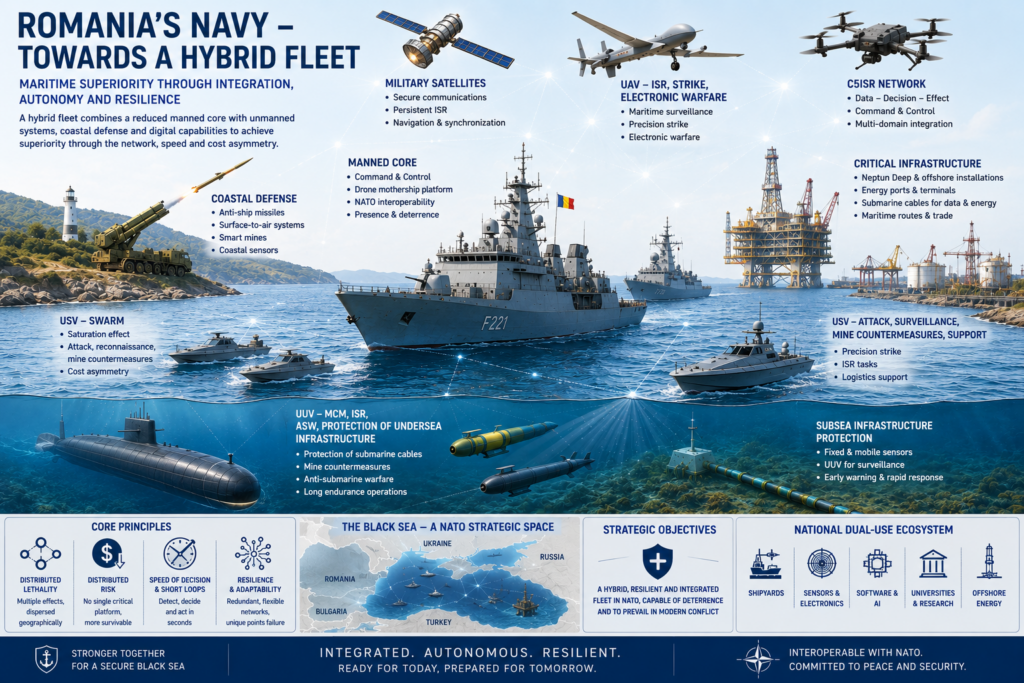
A hybrid fleet is a naval force built on the principle that superiority at sea is no longer achieved by amassing a large number of heavy and expensive platforms, but by intelligently combining a few manned ships with a dense layer of unmanned systems, coastal defense, and digital capabilities. The term refers to the architecture of the force—to how different types of capabilities, human and machine, hardware and software, integrate into a single combat entity.
Why the concept emerged
Three simultaneous developments have pushed naval thinking toward this model over the past decade.
The first is the precision-strike revolution: modern anti-ship missiles, launched from distances of hundreds of kilometers, make any surface vessel, no matter how expensive, vulnerable to an adversary with sufficient sensors and munitions.
The second is the declining cost of unmanned platforms: a high-performance naval drone costs 1/2000th of the cost of a frigate and can sink that same frigate.
The third is the empirical demonstration in the Black Sea (2022–2026), where a Ukraine without a conventional fleet effectively drove the Russian Black Sea Fleet out of the western part of the basin using only coastal missiles and naval drones.
The operational conclusion was that the traditional model—a few frigates and destroyers patrolling the area—no longer guarantees either control of the sea or deterrence. You need more, but something different.
The Four Layers
A hybrid fleet is built on four overlapping layers, each with a distinct role and none self-sufficient.
The human-operated core remains, but it is reduced and reoriented. A few modern frigates and corvettes, optimized not so much to strike as to direct the strike: mother ships for drones, communications nodes, vectors of political presence and allied interoperability. The loss of such a ship remains a catastrophe—hence the need to protect it with the other three layers.
Unmanned systems are the revolutionary element. Surface drones (USVs) for attack, reconnaissance, and mine clearance; underwater drones (UUVs) for cable protection, mine clearance, and anti-submarine operations; aerial drones (UAVs) for reconnaissance, strike, and electronic warfare. The philosophy is distributed lethality: instead of ten expensive platforms, a thousand inexpensive launchers, geographically dispersed, that saturate the adversary’s defenses and impose asymmetric neutralization costs.
Coastal defense shifts some of the firepower from ships to land, but can collaborate with ships. Mobile anti-ship missile batteries, medium-range air defense systems, smart mines, coastal sensors. A missile launched from a mobile chassis in the forests of Dobrogea has the same effect as one launched from a ship’s deck—but costs ten times less, is much harder to neutralize, and cannot be “sunk.”
The C5ISR pillar is the brain that connects the other three: command, control, communications, cyber, and computers; and intelligence, surveillance, and reconnaissance. Without this digital infrastructure, ships, drones, and missiles remain disparate tools; with it, they become a single system capable of detecting, deciding, and striking within seconds.
Underlying Principles
Three ideas underpin the model.
Quantity is back in the equation: after three decades in which Western navies relied on “less, but better,” the war in Ukraine has demonstrated that a thousand cheap drones beat ten expensive ships.
Risk is distributed: there is no longer a single flagship whose loss would bring down the campaign; the loss of a USV or a battery is painful, but not decisive.
The adversary’s cost increases exponentially: to counter a hybrid fleet, the adversary must deploy sensors, missiles, and anti-drone defenses in far greater numbers than to counter a conventional fleet of the same nominal firepower.
What a hybrid fleet is not
The model is often misunderstood.
1. It does not mean a fleet without large ships — the human-operated core remains indispensable for NATO missions, for presence in other theaters, and for the protection of the drones themselves.
2. It does not mean an exclusively defensive fleet — long-range attack drones have demonstrated that the offensive is perfectly possible.
3. It does not mean a cheap fleet — the overall cost remains significant, but it is distributed differently and produces capabilities that a conventional fleet, with the same budget, cannot achieve.
Applicability to the Black Sea
The geography of the Pontic basin—enclosed, with shallow waters in the northwest, short distances, and dense critical infrastructure (Neptun Deep, submarine cables, ports)—is nearly ideal for the hybrid model. This is also the difference between the Black Sea and, for example, the Western Pacific, where distances and depths still favor aircraft carriers and nuclear-powered submarines.
The strategic importance of the Black Sea is amplified by its transformation into a critical energy space for the European Union. The exploitation of offshore resources in the Neptun Deep area, the development of regional LNG infrastructure, and the expansion of submarine data and power cable networks are fundamentally altering the geoeconomic status of the Romanian coastline. Consequently, maritime defense is no longer exclusively about border protection or freedom of navigation, but also about European energy security, the resilience of critical infrastructure, and the continuity of digital and commercial flows. In such a context, hybrid attacks on undersea infrastructure—whether through autonomous drones, covert sabotage, or cyber operations—are likely to become more strategically important than conventional naval confrontation.
For a small navy from a NATO state on the eastern flank, the hybrid model is not just one of several options—it is the only one that allows for credible deterrence against Russia, at an affordable budgetary cost.
Where Will the Romanian Navy Stand in 2026
The Romanian Navy operates two ex-British Type 22R frigates (King Ferdinand, Queen Maria) currently undergoing modernization with American sensors and weaponry, the older frigate Mărășești, four Tetal-I and Tetal-II class corvettes with over three decades of service and outdated capabilities, and three Zborul-class missile ships slated for modernization with Naval Strike Missiles (NSM). In March 2025, the Supreme Council for National Defense approved the multi-year program for a light HISAR-class corvette, and the contract with Turkey was signed at the end of 2025, for approximately 223 million euros, with entry into service in 2026. Of the four desired European corvettes, the first is expected to join the Romanian Navy in 2030, followed by one per year until 2035. TvrinfoRomania Military
So, looking ahead to 2026–2035, we have a human-operated core that looks decent on paper: 2 modernized frigates, 1 HISAR corvette, 4 European corvettes (EPC), and 3 modernized missile ships.
But, for now, the unmanned layer is almost completely missing. The paradox is that the first European aircraft carrier dedicated to drones was built at Damen Galați for the Portuguese Navy, launched in April 2026—and Bucharest has not ordered anything similar for itself. Romania exports hybrid platforms that it does not use. Jurnalul
This situation reveals a profound strategic contradiction: Romania possesses industrial capabilities capable of participating in the European autonomous naval revolution, but has not yet built its own integrated operational ecosystem. Given that modern warfare increasingly depends on military software, artificial intelligence, autonomy, and multi-domain integration, naval power can no longer be reduced to the mere acquisition of platforms. It requires a dual-use ecosystem connecting shipyards, the sensor industry, software companies, university research, offshore energy security, and the development of autonomous capabilities. Without this domestic technological and industrial infrastructure, Romania risks remaining a peripheral production supplier for others, lacking the ability to control its own strategic cycle of naval innovation.
Why the classic model is no longer sufficient
The Black Sea is a closed theater, with shallow depths in the northwest, short distances (Constanța–Sevastopol: approximately 320 km), and a high density of critical maritime infrastructure (the Neptun Deep platform, submarine cables, port terminals). This is the geography where drones excel. A frigate costs as much as 500 naval drones; its loss is political, not just military. A small navy, such as Romania’s, cannot afford to stake everything on three or four large platforms, no matter how modern they may be. It must spread the risk.
But, in addition, NATO requires contributions to combined operations (Sea Guardian, MCM Black Sea Task Force) for which conventional frigates remain indispensable—but defending its own EEZ, deterring Russian incursions, and protecting the platforms at Neptun Deep are tasks that autonomous systems and coastal missiles, alongside OPV-class vessels, can perform more effectively.
A Proposed Force Structure (Horizon 2030–2035)
Level I. The Human-Operated Core
The function of this level is no longer, as in classical doctrine, to ensure control of the seas on its own. In the hybrid architecture, the human-operated core has three specific roles: to represent the Navy’s political signature (presence, parades, port visits, command of NATO task forces), to provide mother ships for unmanned systems, and to ensure the technological interface with allied navies. The loss of one of these ships would be a political catastrophe—hence the logic of protecting them with a hybrid layer, not of multiplying them.
The proposed composition includes three frigates, four European corvettes, one or two HISAR light corvettes, and, as a transitional measure, the three Zborul-class missile ships, modernized with the Naval Strike Missile. The Regele Ferdinand and Regina Maria must emerge from their current modernization with an American combat system (AN/SPS-77 radar or equivalent), 16–24 Mk 41 VLS cells, ESSM anti-aircraft and NSM anti-ship missiles, modern shipborne sonar, and a complete suite of electronic warfare systems; anything less would condemn them to an expensive patrol role. The third frigate—whether a Type 23 from the Royal Navy’s surplus (if still available), a second-hand FREMM from the Italians or French, or an FDI (Frégate de Défense et d’Intervention)—would fill the capability gap until the EPCs are delivered.
The European corvettes (EPC) are the most sensitive element. The OCCAR program, signed in October 2025, calls for the first delivery in 2030. The configuration must be firmly negotiated: a minimum of 16 VLS cells, a hangar for a 10-ton helicopter, the capacity to operate at least one 12-meter USV and two organic UAVs, plus a launch ramp for a UUV. Without hybrid modularity built into the design, these corvettes will be last-generation platforms by the time they enter service.
The Turkish HISAR corvette, already contracted, falls into a different category—approximately 99 meters, 2,300 tons, standard NATO initial armament, to which anti-ship missiles are to be added. Its natural role is not front-line combat, but patrolling critical infrastructure (Neptun Deep, the Midia–Constanța terminals, submarine cables), crew training, and convoy protection—exactly the type of mission that would have absurdly consumed a frigate.
Operationally, the doctrine must be reversed: large ships are no longer the primary instrument of attack. The attack comes from drones, coastal missiles, and submarines. The manned ship commands, directs, protects, and maintains a presence. In a direct confrontation with a rebuilt Russian force, the flagship should retreat westward, under the umbrella of NATO air defense from Fetești and Mihail Kogălniceanu, launching its swarms from a distance. This is the lesson of the Moskva’s sinking.
The aggregate cost of the human-operated core, for the 2026–2035 timeframe, ranges between 3.5 and 4.5 billion euros, of which 1.6–2 billion is for the four EPCs, about 600 million for the modernization of the two Type 22R frigates, and the remainder for the new frigate, HISAR, and the Zborul modernizations.
Level II. Unmanned Systems
This is the qualitative leap that distinguishes a hybrid fleet from a merely modern fleet. The northwestern Black Sea has depths ranging from 50 to 200 meters, short distances (Constanța–Crimea: 320 km, Constanța–Neptun Deep platform: 170 km, Constanța–Odessa: 290 km), and a high density of critical infrastructure. It is an ideal geography for unmanned systems. The Ukrainian doctrine from 2022–2025 confirmed this on a real-world scale.
The surface component (USV) should be organized into a Squadron of Autonomous Naval Systems with three sub-units. The first, the strike unit, would operate 80–120 strike-type USVs—5–7-meter platforms with a range of 800–1,000 km, a 200–300 kg explosive payload, at a unit cost of 250,000–500,000 euros. The reference models are the Ukrainian Magura V5 and Sea Baby or the American MARTAC platforms; ideally, a variant produced domestically, under license, or through a partnership with Ukraine, to ensure volume and sovereign maintenance. The second sub-unit, for reconnaissance and mine clearance, would comprise 40–60 USVs equipped with side-scan sonar systems, magnetometers, and ROVs for mine detection, derived from projects such as Atlas ARCIMS or Thales Halcyon. The third, for infrastructure patrol, would consist of 20 –30 units optimized for long endurance (5–7 days at sea), equipped with multibeam sensors for the protection of submarine cables and the platforms at Neptun Deep.
The underwater component (UUV) is likely the most underdeveloped area of the Romanian Navy and, at the same time, the one with the best cost-effectiveness ratio. Three categories: small UUVs (REMUS 100 or Iver class, under 100 kg) for hydrography and port surveying, 30–40 units; medium UUVs (REMUS 600, Bluefin-12) for cable protection and deep-water mine clearance, 15–20 units; large UUVs (Bluefin-21, XLUUV derivatives) for long-endurance missions in the EEZ, 4–6 units. Key point: Romania already has the capacity to integrate these platforms—the order just needs to be placed.
However, the development of autonomous underwater systems does not eliminate the relevance of the conventional submarine, but rather redefines its role. In the architecture of a hybrid surface fleet, the submarine component remains essential not because of its numbers, but because of the disproportionate strategic effect it has on the adversary’s operational calculations. Even two modern conventional submarines, equipped with air-independent propulsion and integrated into the C5ISR network, would force any adversary to allocate significant resources to anti-submarine warfare throughout the northwestern Black Sea basin. Looking ahead, the combination of conventional submarines and XLUUV systems could provide Romania with a credible maritime denial capability at costs incomparably lower than the classic model based on surface naval groups.
The air component (UAV) relies on the Air Force’s existing Bayraktar TB-2 fleet, but the Navy needs its own systems. Three tiers: tactical ship-based drones (ScanEagle or Schiebel S-100 Camcopter class, 6–8 units per mother corvette), MALE maritime patrol drones (navalized TB-2 or, ideally, AKINCI with a range of 1,000+ km, 12–16 units in total), and a layer of Switchblade 600-type loitering munitions or equivalent, for opportunistic strikes (quantities in the hundreds, unit cost under 100,000 euros).
The dedicated mother ship is the missing element. Romania is building the NRP D ship in Galați. João II for Portugal in Galați, a 107-meter platform capable of simultaneously operating UUVs, USVs, and UAVs, with a 96×11-meter hangar and underwater ramp, contracted for approximately 130 million euros. An identical ship for the Romanian Navy would cost the same—less than three percent of the total budget for the ten-year naval program—and would provide the operational mobility lacking in a fleet of drones based exclusively onshore.
The doctrine is based on three principles: swarming (dozens of drones attacking simultaneously to overwhelm the enemy’s defenses), distributed lethality (many inexpensive launchers instead of a few expensive platforms), and human–machine coupling (a human-operated ship controlling 10–20 autonomous systems in real time). The division’s command center must be capable of simultaneously managing multi-domain operations and transmitting data to allied ships via Link 22.
The aggregate cost of Level II, over the 2027–2032 period, is estimated at 700 million–1.1 billion euros—that is, less than a quarter of the cost of Level I, for a potentially superior strike capability. This is the decisive economic argument for the hybrid transition.
Level III. Coastal Defense
The Russian Bastion-P model in Crimea and Ukraine’s use of the Neptune missile have transformed coastal defense from an auxiliary capability into a strategic pivot of maritime defense in the Black Sea basin. An anti-ship missile on a mobile chassis, launched from the forests of Dobrogea, has the same ability to sink a ship as one launched from a deck—but costs ten times less and is infinitely harder to neutralize.
The core of this tier is the Naval Strike Missile system, already contracted from Kongsberg/Raytheon. The three initial systems (one donated, two purchased) are not sufficient to cover the 245 kilometers of coastline and the EEZ of approximately 30,000 km². A realistic configuration would require five to eight batteries, arranged in three sectors. The Northern Sector (Sulina–Sfântu Gheorghe–Jurilovca) covers the mouths of the Danube, the gas platforms in Neptun Deep, and the northern flank toward Crimea—at least two batteries, plus coastal radars. The Central Sector (Năvodari–Constanța–Eforie) protects the port and oil terminals—two batteries, with redundancy. The Southern Sector (Mangalia–Vama Veche) secures the Bulgarian flank and coordinates with any Bulgarian batteries—one or two batteries. Added to these is a mobile reserve echelon, capable of redeploying between sectors within a few hours, with firing positions prepared in advance in Southern Dobrogea and along the Cernavodă–Murfatlar line.
In addition to NSM, coastal defense also requires a dedicated anti-aircraft component. It is not enough to have anti-ship missiles if the batteries are struck by Lancet or Shahed drones before the first salvo. The minimum solution is a SHORAD/VSHORAD network (Mistral 3 and Iris-T SLM would be optimal), integrated with ground-based air defense — Patriot for protecting critical points, such as the ports of Constanța and Cernavodă, and Iris-T SLM for covering anti-ship missile batteries and port infrastructure. The V-Bat vertical launch systems, already mentioned by the Ministry of National Defense, should be integrated into this framework.
Less spectacular, but equally critical, is the shore-based mine warfare component. Modern smart mines (Italian MANTA class or equivalent), selectively deployed in approach channels, multiply the cost of any opposing amphibious operation. The Romanian Navy operates four Musca-class mine sweepers—old, but reusable for deployment; modernizing this segment requires the acquisition of dedicated mine planters and portable MCM systems on USVs.
Geographically, the deployment must exploit the cover provided by the Dobruja terrain—forests, valleys, farmland—for alternative firing positions, following the Ukrainian model of Snake Island. Fixed batteries are vulnerable targets; mobility is survival.
Aggregate cost of Level III: 800 million–1.2 billion euros for the ensemble of anti-ship missiles, coastal air defense systems, mines, and sensors, plus approximately 200 million euros for strengthening the command -control infrastructure in Mangalia. Compared to the cost of a single modern frigate (approximately 800 million), the coastal defense belt likely offers the best deterrence-to-cost ratio in the entire program.
Level IV. C5ISR, electronic warfare, and cyber
This is the brain that connects the other three levels. Without it, the human-operated core, drones, and coastal missiles remain disparate tools; with it, they become an integrated system capable of responding in seconds and overwhelming an adversary.
The C2 (command -control) is built around a modernized Maritime Operations Center, integrated into the NATO BICES and MCCIS architecture, with direct access to the allied air-maritime picture (Recognized Maritime Picture). The physical equipment—servers, consoles, crisis rooms—is the easy part. The hard part is integration: the ability to receive data from USVs, UUVs, UAVs, coastal radars, commercial satellites (as Ukraine does with ICEYE and Maxar), and allied ships, and to return orders in real time. This network must be capable of withstanding the failure of one or two nodes (cyberattack, electromagnetic attack) without losing functionality.
Communications (C3/C4) require the entire fleet to be equipped with Link 16 and Link 22, plus a redundant satellite communications network (militarized Starlink or a European equivalent, such as IRIS²), long-range tactical communications of the HF/VLF type, for jamming resistance, and data links for the drone swarm. The current weak point of the Romanian Navy is the interoperability of sensors on older ships; modernization must address this before any other acquisition.
ISR (intelligence, surveillance, reconnaissance) relies on four pillars: long-range coastal radars (TPS-77 or equivalent, with coverage extending beyond the center of the Black Sea), a fleet of MALE maritime patrol drones (discussed in Level II), a contract with a commercial satellite imagery provider (Planet, Maxar, or ICEYE) for daily updates of the area of interest, and a modernized ELINT/SIGINT capability—ideally a dedicated ship, or at least modules on the EPC corvettes. Integration with the reactivation of an MPA capability (maritime patrol aircraft—second-hand P-8s or ATR-72MPs) would fully close the ISR loop.
Electronic warfare is the area where the Romanian Navy is likely most vulnerable. Russia operates one of the world’s densest EW suites in the Black Sea—Murmansk-BN, Krasukha-4, Leer-3—capable of jamming GPS and communications over distances of hundreds of kilometers. The response requires: onboard EW systems on every major platform (RSS or European Naval EW Suite), capabilities to geolocate enemy transmitters, alternative navigation systems (high-precision inertial, e-Loran) to operate in a GPS-degraded environment, and—crucially—its own drones capable of jamming and suppressing enemy air defenses (SEAD). Without this component, the entire swarm of Level II USVs is vulnerable.
At the same time, the hybrid model should not be idealized. Structurally dependent on communications, satellites, and continuous data streams, autonomous systems are vulnerable to electromagnetic jamming, GPS spoofing, cyberattacks, and degradation of space infrastructure. An adversary capable of disrupting the sensor and communications network can quickly turn the advantage of autonomy into a major operational vulnerability. Furthermore, drone-based attrition warfare entails a constant industrial consumption of munitions, electronic components, and production capabilities that only states with robust industrial bases can sustain in the long term. The Ukrainian lesson thus demonstrates that the autonomous revolution does not eliminate the importance of strategic industry; on the contrary, it brings it back to the center of military power.
The cyber component has two sides: defensive (protecting weapons systems, sensors, and command networks against intrusions) and offensive (capabilities to degrade the adversary’s sensor and command chains). In practice, we need a Naval Cyber Unit integrated with the SRI’s CYBERINT and COMCYBER, staffed with personnel recruited and retained under conditions competitive with the private sector—a sore point, because cyber officers are the most expensive human resource in the entire equation.
Counter-UAS rounds out the level. In an era where $500 drones can strike billion-dollar ships, every major platform—and every coastal battery—must have its own anti-drone umbrella: medium-power laser systems (the British DragonFire class, already tested), directed-energy microwaves, automated cannons with smart ammunition (30 mm with programming), and dedicated EW capabilities (DroneGun or equivalent). These systems are undergoing rapid technological evolution; any contract signed now must provide for upgrades every 5–7 years.
Aggregate cost of Level IV: 500–800 million euros, plus substantial recurring operating costs (personnel, software, data contracts) . This is the level with the highest recurring cost component—and, at the same time, the one where every euro invested yields the greatest capability multiplier for the other levels.
Integration of the four levels
The actual sum is not arithmetic, but synergistic. A €300,000 UUV from Level II, guided by a coastal radar and a Level IV MALE drone, launched from a Level I corvette under the cover of Level III anti-aircraft missiles, targets and strikes an enemy ship worth $500 million. That is the equation. No single level achieves this on its own; all four, integrated, do.
For Romania, the critical threshold is 2028–2030: if the unmanned systems and the second tranche of NSMs are not ordered by then, the entire architecture remains in the planning stage. If they are, then by the middle of the next decade the Romanian Navy could be the first hybrid fleet of a NATO state on the eastern border—a model, not a follower.
Conclusion
The question in the title is no longer rhetorical. The security environment, the geography of the Black Sea basin, the lessons of the Russian-Ukrainian war, and the pace of global technological advancement all converge on the same answer: the future of the Romanian Navy is not a larger version of the current fleet, but a structurally different one. A small but interoperable human-operated core, embedded in a dense layer of unmanned systems, anchored by a belt of coastal missiles, and complemented by at least one submarine—this is the plausible form of a Black Sea fleet for the 2030s. We have the shipyards that build for others what we lack; we have the allied doctrine that points the way; we have an adversary that has brutally demonstrated that the old model is dead. For now, all we lack is the decision.
The expansion of autonomous maritime systems is also creating an unprecedented legal and operational gray area in contemporary international law. The distinction between civilian and military infrastructure, between commercial platforms and dual-use capabilities, is becoming increasingly difficult in the context of the proliferation of autonomous maritime and underwater drones. In the event of hybrid attacks on submarine cables, offshore energy platforms, or port infrastructure, the issue of legal attribution and the activation of collective defense mechanisms may become more complex than the attack itself. In this regard, Romania’s future hybrid fleet will have to operate not only in a militarily contested environment, but also in a deeply fluid legal and strategic space.
Selected Bibliography
I. Strategic Doctrine and Hybrid Naval Warfare
· Clark, Bryan; Walton, Timothy. Taking Back the Seas: Transforming the U.S. Surface Fleet for Decision-Centric Warfare. Center for Strategic and Budgetary Assessments (CSBA), Washington, 2019.
· Clark, Bryan; Patt, Dan; Schramm, Harrison. Mosaic Warfare: Exploiting Artificial Intelligence and Autonomous Systems to Implement Decision-Centric Operations. CSBA, 2020.
· Hendrix, Jerry. To Provide and Maintain a Navy: Why Naval Primacy Is America’s First, Best Strategy. Focsle LLP, 2020.
· Krepinevich, Andrew F. Maritime Competition in a Mature Precision-Strike Regime. CSBA, 2014.
· Hammes, T.X. Technologies Converge and Power Diffuses: The Evolution of Small, Smart, and Cheap Weapons. Cato Institute, 2016.
· McGrath, Bryan. Distributed Lethality and the Future of the Surface Navy. U.S. Naval Institute Proceedings, 2016.
· Till, Geoffrey. Seapower: A Guide for the Twenty-First Century, 4th ed. Routledge, London, 2018.
II. The Black Sea and the Russian Fleet
· Delanoë, Igor. The Russian Black Sea Fleet: A Naval Instrument of Global Strategy. IFRI – Russia/NIS Visions, Paris, 2014 and subsequent updates.
· Gorenburg, Dmitry. Russia’s Naval Strategy and the Russian Navy in the Mediterranean. CNA, Arlington, 2019.
· Kofman, Michael; Edmonds, Jeffrey; et al. Russian Navy: A Historic Transition. CNA Russia Studies Program, 2020.
· Polmar, Norman; Brooks, Thomas A. Navies in the Nuclear Age: Warships since 1945. Naval Institute Press, 2019.
· Sanders, Deborah. Maritime Power in the Black Sea. Routledge, 2014.
· Toucas, Boris. The Geostrategic Importance of the Black Sea Region: A Brief History. CSIS, Washington, 2017.
· Wezeman, Siemon T. Russia and the Black Sea Region: Naval Capabilities and Implications. SIPRI Background Paper, Stockholm (annual reports).
III. Lessons from the War in Ukraine (2022–2025)
· Bronk, Justin; Reynolds, Nick; Watling, Jack. The Russian Air War and Ukrainian Requirements for Air Defense. RUSI Special Report, London, 2022.
· Kaushal, Sidharth. The Sinking of the Moskva: Lessons for Surface Combatant Survivability. RUSI Commentary, May 2022.
· Kaushal, Sidharth; Rose, Jack. The Use of Maritime Drones in the Black Sea. RUSI Occasional Paper, 2024.
· Mongilio, Heather; LaGrone, Sam et al. Naval News and USNI News — series of analyses on Ukrainian USV attacks, 2022–2025.
· Bowen, Andrew S. Russia’s War in Ukraine: Military and Intelligence Aspects. Congressional Research Service, Washington, successive reports 2022–2025.
· Kofman, Michael; Lee, Rob; et al. War on the Rocks — articles on naval operations in the Black Sea, 2022–2025.
· Stoicescu, Kalev; Lebrun, Maxime. The Black Sea After the Invasion of Ukraine. International Centre for Defence and Security (ICDS), Tallinn, 2023.
IV. Unmanned Naval Systems
· U.S. Department of the Navy. Unmanned Campaign Framework. Washington, 2021.
· U.S. Office of the Chief of Naval Operations. Navigation Plan 2024: Project 33. Washington, 2024.
· NATO Allied Command Transformation. Maritime Unmanned Systems Initiative — Final Report. Norfolk, 2021.
· Eckstein, Megan. The Pentagon’s Push to Field Unmanned Vessels at Scale. Defense News, articles 2023–2025.
· CSIS Maritime Security Program. Unmanned and Autonomous Systems at Sea: A Review. Washington, recent reports.
· Hudson Institute. Distributed Maritime Operations and the Future of the Surface Fleet. Washington, 2022.
· Naval News (specialized online publication). Saab, Kongsberg, Anduril, MARTAC — technical data sheets and interviews, 2022–2026.
V. Coastal Defense, Anti-Ship Missiles, Mine Warfare
· O’Rourke, Ronald. Navy Anti-Ship Missile Programs: Background and Issues for Congress. CRS, Washington, periodic updates.
· Kongsberg Defence & Aerospace. Naval Strike Missile — Coastal Defence System. Technical documentation and press releases, 2020–2025.
· Cordesman, Anthony H. Russia, Iran, and the Future of A2/AD in the Eastern Mediterranean and Black Sea. CSIS Burke Chair, Washington, 2019.
· Truver, Scott C. Taking Mines Seriously: Mine Warfare in China’s Near Seas. Naval War College Review, Newport.
· Friedman, Norman. Seapower as Strategy: Navies and National Interests. Naval Institute Press, 2001 (reference for coastal defense doctrine).
VI. C5ISR, Electronic Warfare, Cyber, and Counter-UAS
· Bryen, Stephen D. Technology Security and National Power: Winners and Losers. Routledge, 2022.
· Bronk, Justin. Modern Russian Electronic Warfare: Capabilities and Lessons. RUSI Whitehall Reports, 2023.
· McLeary, Paul; Insinna, Valerie. Pentagon Counter-Drone Programs — Breaking Defense and Defense News, 2023–2026 reports.
· NATO Cooperative Cyber Defence Centre of Excellence (CCDCOE). Cyber Threats and NATO 2030. Tallinn, 2023.
· Center for Naval Analyses. Electronic Warfare in the Maritime Domain. CNA Occasional Papers.
VII. Romanian Sources — Official and Specialized
· Ministry of National Defense. National Defense Strategy 2020–2024. Bucharest, Presidential Administration.
· Ministry of National Defense. White Paper on Defense, successive editions (2017, 2021).
· General Staff of the Romanian Naval Forces. Naval Forces Doctrine. Mangalia / Bucharest, internal editions.
· Romanian Naval Forces. Romanian Navy — official monthly magazine.
· “Mircea cel Bătrân” Naval Academy. Scientific Bulletin — Constanța, academic periodical.
· Chifu, Iulian. Hybrid War, Lawfare, Information Warfare. The Wars of the Future. Published by the “Ion I.C. Brătianu” Institute of Political Science and International Relations, Bucharest, 2022.
· Maior, George Cristian. Uncertainty. Strategic Thinking and International Relations in the 21st Century. RAO Publishing House, Bucharest, 2009 (and subsequent editions).
· Dolghin, Nicolae; Văduva, Gheorghe. The War of the Future, the Future of War. “Carol I” National Defense University Press, Bucharest.
· Frunzeti, Teodor. Geostrategy. Army Technical-Editorial Center Publishing House, Bucharest.
· Mureșan, Mircea; Văduva, Gheorghe. The War of the Future. The Future of War. “Carol I” National Defense University Press, Bucharest, 2004.
· Tătaru, Marius-Adrian. Studies in the History of the Romanian Navy. National Museum of the Romanian Navy, Constanța.
VIII. Official Documents and Institutional Strategies
· NATO. NATO Strategic Concept 2022. Madrid Summit.
· NATO. Alliance Maritime Strategy. Brussels, 2011 (under review post-2022).
· European Union. A Strategic Compass for Security and Defence. Council of the EU, Brussels, March 2022.
· European Union. EU Maritime Security Strategy (revised 2023) and Action Plan.
· European Defence Agency. European Patrol Corvette (EPC) Programme — PESCO Project Documentation. Brussels.
· OCCAR. European Patrol Corvette — Programme Updates. Bonn, 2024–2026.
· European Commission. SAFE — Security Action for Europe Regulation. Brussels, 2024–2025.
IX. Periodicals and Online Reference Resources
· IISS Military Balance — International Institute for Strategic Studies, London (annual).
· Jane’s Fighting Ships and Jane’s Defence Weekly — Jane’s Information Group.
· Naval Forces — Mönch Publishing Group, Bonn.
· USNI Proceedings — U.S. Naval Institute, Annapolis.
· Naval News (navalnews.com) — technical analyses of global naval programs.
· DefenseRomania (defenseromania.ro) — specialized Romanian publication, Navy reports 2022–2026.
· Monitorul Apărării și Securității — specialized online publication, based in Bucharest.
· Romania Military (rumaniamilitary.ro) — independent technical analyses.
· Defense Express (defence-ua.com) — Kiev, Ukrainian analyses of operations in the Black Sea.
· The Maritime Executive and gCaptain — daily maritime operational news.