


Strategic Debate Series – New Edition
Could Escalation in the Middle East Trigger a Structural Shift in Global Maritime Trade?
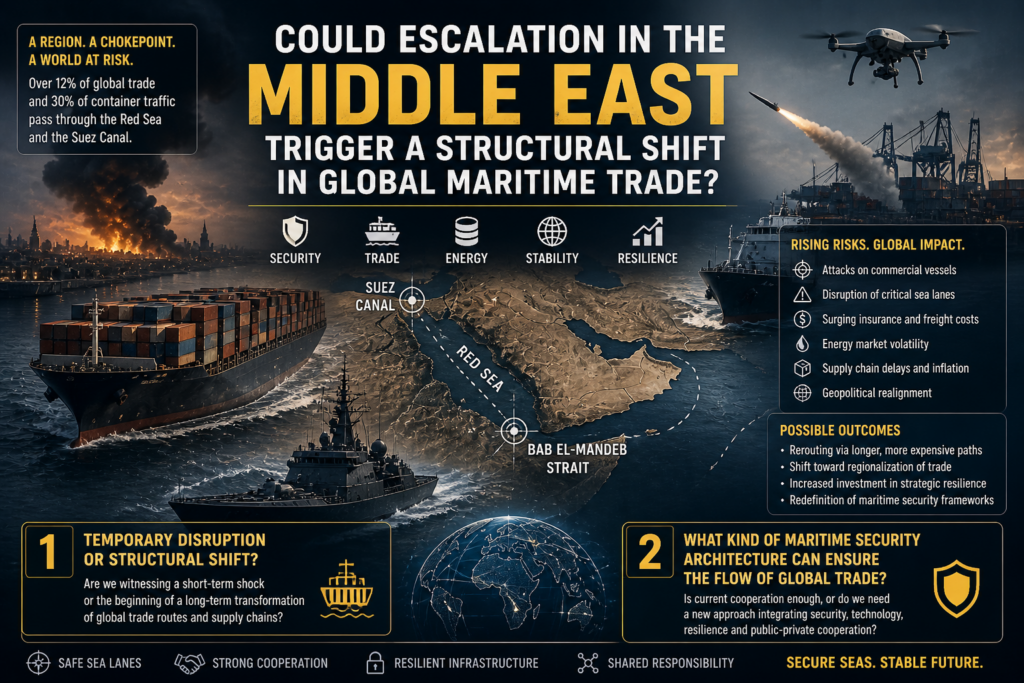
Introduction to the Topic
The escalation of tensions in the Middle East brings one of the global economy’s most sensitive vulnerabilities back into the spotlight: its critical dependence on a small number of strategic maritime corridors. At the heart of this equation lies the connection between the Red Sea, the Suez Canal, and the Bab-el-Mandeb Strait—a maritime transport system that ensures the rapid flow of goods, energy, and resources between Asia, Europe, and Africa.
Under stable conditions, this system operates almost invisibly, supporting a significant portion of global trade. In times of crisis, however, it becomes a strategic pressure point, where relatively limited disruptions can generate disproportionate global economic effects. A total blockade is not necessary to produce major consequences; an increased perception of risk is sufficient for maritime operators to alter their behavior and for logistics costs to rise rapidly.
Recent developments point to a significant transformation in the nature of maritime risks. Threats are no longer exclusively conventional in nature. Aerial and maritime drones, anti-ship missiles, proxy operations, sabotage, and pressure on critical infrastructure create an environment of diffuse insecurity, difficult to control through conventional means. In this context, the security of trade routes can no longer be fully guaranteed, but only managed in terms of probability and cost.
This shift has direct implications for how globalization operates. The dominant economic model of recent decades has been built on maximum efficiency, minimum cost, and continuous flow. Any persistent disruption of a key corridor such as the Red Sea may prompt economic actors to reevaluate this model.
The first reactions are already visible: rerouting ships via the Cape of Good Hope, rising insurance premiums, logistical delays, price pressures, and supply chain adjustments. In the short term, these adjustments are costly. In the long term, however, they may lead to structural transformations, including the regionalization of production, diversification of routes, and investments in logistical redundancy.
At the same time, energy security is becoming inseparable from maritime security. The transport of oil, liquefied natural gas, and refined products through these corridors means that any instability is immediately reflected in the volatility of energy markets. Thus, maritime risks are no longer merely logistical, but also macroeconomic.
In this context, the fundamental question is no longer whether the current crisis will temporarily affect global trade, but whether we are witnessing the beginning of a structural reconfiguration of how it functions. If economic actors lose confidence in the stability of key routes, the consequences may far exceed the duration of the conflict that generated them.
Moreover, this situation raises a deeper strategic issue: can the globalized economy continue to function efficiently in an environment where maritime security is becoming increasingly contested? Or are we at a turning point, where efficiency will need to be balanced with resilience, and the “just-in-time” approach will gradually be replaced by the “just-in-case” approach?
Questions for discussion
1. Are we facing a temporary disruption of global maritime trade or the beginning of a structural transformation driven by the persistent insecurity of strategic routes?
To what extent can current developments in the Middle East and the Red Sea prompt companies and states to reconfigure supply chains, trade routes, and dependence on traditional corridors in the long term?
2. What kind of maritime security architecture can keep global trade functioning in an environment characterized by hybrid risks, geopolitical fragmentation, and strategic competition?
Is strengthening existing naval presence and international cooperation sufficient, or is a new approach needed that integrates critical infrastructure security, economic resilience, technology, and coordination mechanisms between states and the private sector?
Closing
We invite informed contributions from maritime professionals, policymakers, economists, legal experts, and analysts.