


Maritime Security Forum – Is the Black Sea Becoming Europe’s Most Dangerous Maritime Region?
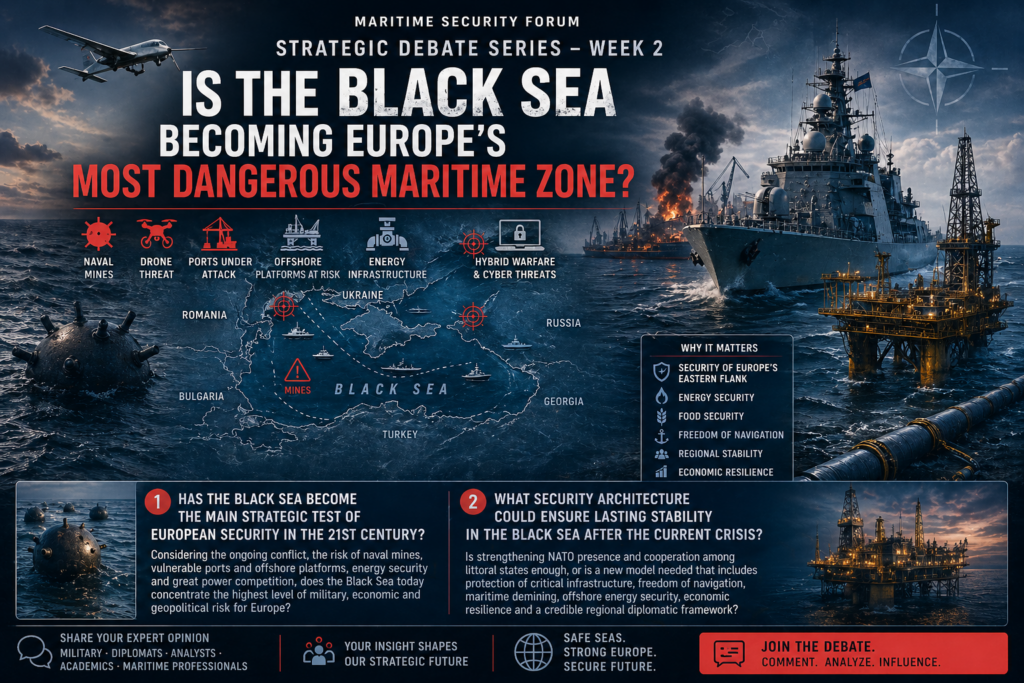
Introduction to the Topic
In recent years, the Black Sea has undergone one of the most rapid and profound strategic transformations in contemporary Europe. From a sea primarily associated with regional trade, tourism, economic cooperation, and energy connectivity, the Black Sea has become a complex theater where military conflict, geopolitical competition, critical infrastructure security, and the future of Europe’s strategic balance intersect.
The war in Ukraine has radically altered the region’s status. What was once often perceived as a peripheral space of Europe is today a central hub of continental security. Military developments in the Black Sea basin directly influence the stability of NATO’s eastern flank, freedom of navigation, global agricultural exports, regional energy security, and the strategic relationship between Russia and the Euro-Atlantic community.
One of the most serious and persistent threats is posed by sea mines. In the context of the conflict, the presence of drifting or defensively laid mines has turned certain maritime areas into high-risk zones for commercial navigation and maritime economic activities. Mines affect not only military vessels but also civilian transport, fishing, port access, and routine logistics operations. Even after hostilities cease, the complete clearance of a sea may take years, meaning that the effects of war can linger long after the guns fall silent.
At the same time, the conflict has shown that port infrastructure can become a strategic target. Ports essential for the export of grain, industrial products, and energy flows have been directly or indirectly affected by attacks, blockades, or persistent threats. In an interdependent global economy, the disruption of a major Black Sea port can have consequences for food prices, logistics chains, and international maritime transport markets.
Another increasingly relevant dimension concerns offshore platforms and maritime energy infrastructure. The Black Sea hosts significant natural gas resources and strategic energy projects for the diversification of European supply. Offshore platforms, subsea pipelines, port terminals, and related facilities thus become targets of major economic and geopolitical value.
For Romania, the development of offshore resources is of particular importance, including in terms of reducing external dependencies and strengthening regional energy security. In this context, the protection of maritime infrastructure is no longer merely an economic issue, but one of national and European security.
Risks to offshore infrastructure do not involve only conventional attacks. They may include sabotage, cyber incidents, hostile surveillance, operations below the threshold of declared conflict, or strategic intimidation. The lessons of recent years show that subsea and offshore energy infrastructure must be treated as critical infrastructure of the highest priority.
Furthermore, the Black Sea has become a testing ground for new forms of naval warfare. The use of maritime drones, coastal missiles, integrated intelligence operations, and anti-access capabilities has demonstrated that maritime dominance no longer depends exclusively on fleet size. Large and expensive ships can be threatened by relatively inexpensive, mobile, and hard-to-predict systems.
This doctrinal shift has major implications for all European navies. If asymmetric methods can limit the freedom of maneuver of a conventional fleet, then traditional naval strategies must be revised.
For riparian states such as Romania, Bulgaria, and Turkey, maritime security has become a direct component of national security. For the European Union, the region is significant in terms of energy, trade, transport, and broader stability. For NATO, the Black Sea raises essential questions regarding deterrence, military mobility, surveillance, and the defense of the eastern flank.
Furthermore, the Black Sea is strategically linked to the Caucasus, the energy corridors in the Caspian region, and relations between Europe and Central Asia. Its instability affects not only the coastal states but the entire regional system of Euro-Asian connectivity.
Economically, maritime insecurity generates invisible but considerable costs: higher insurance premiums, postponed investments, commercial reluctance, increased logistics costs, and pressure on energy markets. Thus, even in the absence of a dramatic escalation, the mere perception of risk can produce concrete effects.
In this context, the question is no longer whether the Black Sea is strategically important. The real question is whether this sea has become the European maritime space where the highest level of military, economic, energy, and geopolitical risk is concentrated.
If the answer is yes, then the future of European security will depend to a considerable extent on what happens in the Black Sea.
Questions for discussion
1. Has the Black Sea become the main strategic test of European security in the 21st century?
In the context of regional conflict, the risk of sea mines, the vulnerability of ports and offshore platforms, energy security, and geopolitical competition among major powers, does the Black Sea today encompass the entire spectrum of military, economic, and strategic challenges facing Europe?
2. What security architecture could guarantee the Black Sea’s lasting stability following the current crisis?
Is strengthening NATO’s presence and cooperation among littoral states sufficient, or is a new model needed that includes critical infrastructure protection, freedom of navigation, maritime demining, offshore energy security, economic resilience, and a credible regional diplomatic framework?
Maritime Security Forum