


Maritime infrastructure and global systemic risks. Why the fragility of global trade is the strategic challenge of the 21st century
Admiral (ret.) PhD. Aurel POPA, President of the Maritime Security Forum[1]
Rear Admiral (ret.) PhD Sorin Learschi, Director of the Maritime Security Forum
Article published in the World Academy of Art and Science in August 2026-https://worldacademy.org/extra-monthly-articles/
The strategic objective of the 21st century is no longer to protect maritime infrastructure as individual assets, but to ensure the continuity of the global functions that they support.
Abstract
Globalisation depends on a complex maritime infrastructure that sustains the circulation of goods, energy, information and capital. The growing interdependence between ports, maritime routes, submarine cables, energy systems, logistics networks and digital infrastructures has fundamentally transformed the nature of contemporary vulnerabilities, making local disruptions capable of generating global systemic risks. This article argues that these transformations cannot be adequately explained through traditional sectoral approaches to maritime security or critical infrastructure protection. It introduces the concept of the Strategic Maritime Ecosystem as a new analytical framework for understanding the functional interdependence of maritime infrastructures and develops the concept of Strategic Maritime Convergence to explain how local disruptions propagate across interconnected systems through cascading effects. Building on these concepts, the article argues that the strategic objective of the twenty-first century is no longer merely the protection of individual infrastructures, but the safeguarding of the continuity of the global functions they support. Consequently, maritime infrastructure security should be understood as a fundamental condition for global resilience and anticipatory governance in an increasingly interconnected world.
- Globalisation has transformed infrastructure
Globalisation is usually explained in terms of trade liberalisation, market integration, global supply chains or the development of digital technologies. Far less attention is paid to the infrastructure that enables these processes to function. In reality, the global economy depends on a complex system comprising ports, maritime routes, submarine communications cables, energy terminals, offshore platforms, logistics centres and digital infrastructure, which support the flow of goods, energy, information and capital.
In recent decades, the maritime domain has ceased to be merely the geographical setting for navigation or naval competition. It has become the critical infrastructure of globalisation, where international transport, energy security, digital communications and economic connectivity converge. In this context, ports, energy terminals, subsea pipelines, communications cables and digital coordination systems do not operate independently, but as elements of a deeply interdependent system.
This interdependence fundamentally alters the nature of contemporary vulnerabilities. A disruption to a single component no longer produces effects limited to the sector in which it occurs, but can successively affect transport, energy, communications, supply chains and economic stability. The fragility of world trade thus stems not only from the existence of critical infrastructure, but from the density of the functional relationships that connect them into a single system.
When maritime infrastructure is disrupted, the consequences are not limited to delays in maritime transport. They are reflected in energy prices, food availability, the functioning of digital services, the cost of consumer goods and the stability of national economies. In a deeply interdependent world, maritime infrastructure directly influences the daily lives of billions of people, even though it remains largely invisible to the public.
- Why traditional explanations are no longer sufficient
The transformation of globalisation’s infrastructure has also profoundly altered the nature of the risks affecting it. Nevertheless, maritime security analysis continues to rely, to a large extent, on conceptual models developed at a time when the maritime domain was viewed primarily through the prism of navigation, trade and naval competition. These approaches remain relevant for understanding freedom of navigation, the protection of maritime routes and the law of the sea, but they are no longer sufficient to explain the complexity of contemporary maritime infrastructure.
Today, the strategic value of the maritime domain no longer derives exclusively from control of trade routes or the capacity to project naval power, but from the integrated functioning of smart ports, energy terminals, submarine cables, offshore platforms, digital systems and global logistics networks. Consequently, vulnerabilities can no longer be analysed at the level of each individual piece of infrastructure, as they manifest and propagate through the functional relationships between infrastructures. A disruption at a single critical point can successively affect trade, energy, digital communications, financial services and global supply chains.
Figure 1. The figure illustrates the evolution of the concept of the maritime domain from the predominantly geopolitical and sectoral perspective of the 20th century – centred on naval power, freedom of navigation and state sovereignty – towards the systemic understanding specific to the 21st century, in which the maritime space is recognised as a critical infrastructure of globalisation. This conceptual shift highlights the integration of maritime, energy, digital, logistical and institutional infrastructures into an interdependent system that underpins the functioning of the world economy and global resilience.
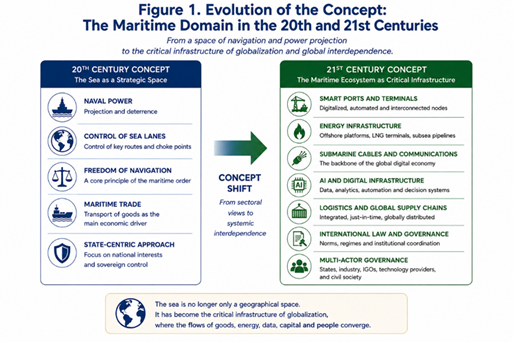
In these circumstances, the transformation of globalisation’s infrastructure also necessitates a change in the fundamental unit of analysis. Instead of a sectoral perspective centred on individual infrastructures, a conceptual framework is required that is capable of capturing the interdependencies which define the functioning of the system as a whole. This constitutes the starting point for introducing the concept of the Strategic Maritime Ecosystem.
- The Strategic Maritime Ecosystem – a new unit of analysis for systemic risks
Changes to global infrastructure require a re-examination of how the maritime domain is understood. In a context characterised by ever-deeper interdependencies between physical, digital, energy, economic and legal infrastructures, a fragmented analysis of each component is no longer sufficient to explain contemporary vulnerabilities. A conceptual framework is needed that can capture the functional relationships between these infrastructures and the way in which they collectively contribute to the functioning of the global economy.
From this perspective, the concept of the Strategic Maritime Ecosystem, which we propose, suggests a shift in the fundamental unit of analysis. Maritime infrastructure is no longer viewed as a mere sum of ports, submarine cables, energy terminals, offshore platforms or logistics systems, but as a dynamic system of functional relationships, in which the strategic value of each component derives from its connectivity and interdependence with the others. Ports, energy infrastructure, digital communications, logistics chains and the international legal framework thus function as elements of the same strategic whole.
Figure 2 schematically illustrates the Strategic Maritime Ecosystem as an integrated network of physical, digital, energy, logistics and institutional infrastructures that are in a state of constant interdependence. The strategic value of the system does not stem exclusively from the importance of each component, but from their ability to function coherently and to jointly sustain the continuity of global functions.
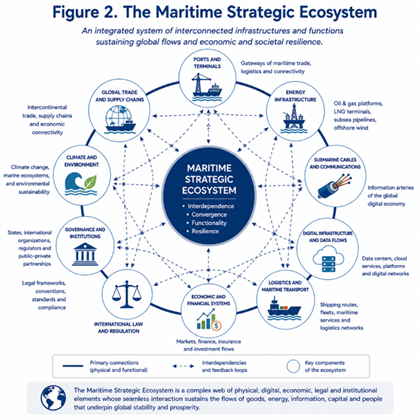
This approach goes beyond the limits of traditional sectoral analyses and enables an understanding of how local disruptions propagate throughout the entire system. The fragility of global trade does not stem solely from the existence of vulnerable infrastructure, but from the density of the functional relationships that connect them. The more numerous and complex these interdependencies are, the greater the likelihood of cascading effects and systemic risks.
Consequently, the Strategic Maritime Ecosystem is not merely a concept for maritime studies, but a new analytical framework for understanding the infrastructure of globalisation. It explains how seemingly local incidents can generate economic, energy-related, digital and institutional consequences on a global scale, and provides the conceptual basis for analysing systemic risks in the contemporary economy.
- The fragility of world trade: when vulnerabilities become systemic
Global trade has never been as extensive and efficient as it is today, but neither has it ever been so dependent on the simultaneous functioning of critical infrastructures. As the interdependencies between maritime, energy, digital and logistics infrastructures have intensified, the vulnerability of the global system has increased accordingly. The fragility of global trade no longer stems exclusively from the exposure of individual infrastructures to risks, but from the entire system’s dependence on the continuity of their operation.
Recent events have illustrated this transformation. The blockage of the Suez Canal, attacks on commercial shipping in the Red Sea, the disruptions caused by the conflict in the Black Sea, and incidents affecting undersea communications cables have demonstrated that a local disruption can have global economic and logistical repercussions. Although different in nature, all these situations highlight the same structural vulnerability: the global economy’s dependence on the continuous operation of maritime infrastructure.
This represents the key difference between traditional risks and systemic risks. Whilst the former affect a specific infrastructure or sector, systemic risks extend beyond the boundaries of the domain in which they arise and spread successively to energy, transport, communications, financial markets and global supply chains. Consequently, the fragility of global trade must be assessed in terms of the entire system’s ability to maintain its essential functions even when one of its critical components is disrupted.
- Strategic Maritime Convergence: the mechanism by which vulnerabilities propagate
Understanding the fragility of global trade involves more than simply identifying critical infrastructure and assessing its vulnerabilities. It is necessary to analyse the functional relationships between infrastructure and the mechanisms through which a local disruption can affect the functioning of the entire system. The defining characteristic of contemporary systemic risks is their ability to generate cascading effects. A local disruption does not remain local, but spreads successively to energy, digital, logistics and financial infrastructures, amplifying as the system attempts to redistribute its functions.
It is against this backdrop that we introduce the concept of Strategic Maritime Convergence. This describes the process by which maritime, energy, digital, economic, legal and institutional infrastructures cease to function as autonomous domains and become components of the same strategic ecosystem. Under these circumstances, a decision, a disruption or an incident occurring in a single sector generates simultaneous effects on all the others, transforming individual vulnerabilities into systemic vulnerabilities.
Figure 3 illustrates the mechanism by which a local incident produces a cascade of effects on interdependent infrastructures, transforming a localised disruption into a global systemic risk. It highlights the fact that the propagation of vulnerabilities does not depend exclusively on the severity of the initial incident, but on the density of the functional relationships between the infrastructures that make up the Strategic Maritime Ecosystem.
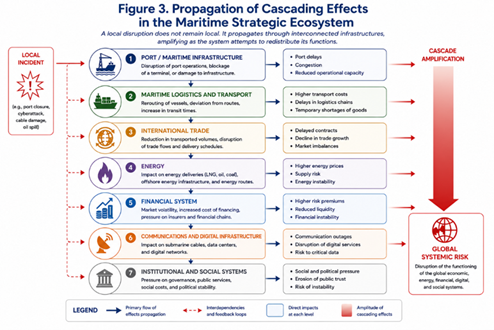
From this perspective, the security of a port, a submarine cable or an energy infrastructure can no longer be analysed in isolation. It depends simultaneously on cyber security, the continuity of communications, the stability of logistics chains, the international legal framework and the capacity of institutions to cooperate. Vulnerability is no longer an isolated characteristic of a single piece of infrastructure, but an emergent property of the entire system.
Maritime Strategic Convergence thus explains why the strategic objective can no longer be limited to protecting each piece of infrastructure individually. In an ecosystem characterised by deep interdependencies, what needs to be protected is the system’s ability to absorb shocks, redistribute functions and maintain its operational coherence. The continuity of global trade ultimately depends on the resilience of the relationships between infrastructures, not merely on the robustness of each component considered in isolation.
- From protecting infrastructure to safeguarding the continuity of global functions
If the fragility of global trade stems from the interdependence of critical infrastructures, then the strategic objective of protecting them must also be reconsidered. In recent decades, security policies have focused primarily on protecting individual infrastructures – ports, energy terminals, submarine cables or logistics centres. Although this approach remains necessary, it is no longer sufficient in an ecosystem characterised by connectivity and systemic interdependence.
From this perspective, maritime infrastructure should no longer be viewed solely as a collection of physical and digital assets, but as the backbone of functions that are essential to the global economy. International trade, energy security, digital communications, financial services and logistics chains are global functions whose continuity underpins the stability of the international system. Consequently, the strategic objective is no longer to protect each piece of infrastructure individually, but to ensure the continuity of the functions they support.
This shift in perspective also alters the criteria for assessing resilience. In a strategic ecosystem, the risk of incidents cannot be completely eliminated, but their effects can be limited by the system’s ability to absorb shocks, redistribute functions and maintain operational coherence. Thus, the temporary unavailability of a port, damage to a submarine cable or disruption to a maritime route does not automatically lead to a systemic crisis, provided the infrastructure has effective mechanisms for redundancy, adaptation and the rerouting of flows.
Following this logic, the resilience of maritime infrastructure can no longer be measured solely by the ability of each component to withstand an incident, but by the ability of the entire ecosystem to maintain the continuous functioning of global trade, energy flows, digital communications and global supply chains. Safeguarding the continuity of global functions thus becomes the new strategic objective of critical infrastructure security.
- Proactive governance and global maritime resilience
The complexity of the Strategic Maritime Ecosystem also necessitates a change in the way security and governance policies are designed. Traditional models, predominantly geared towards responding to incidents and managing their consequences, are proving insufficient in a system characterised by deep interdependencies and the rapid propagation of vulnerabilities. Under these circumstances, the governance of maritime infrastructure must become proactive, based on continuous monitoring of the ecosystem and the early identification of systemic risks.
Artificial intelligence, predictive models and the integration of data from maritime, energy, digital and logistics infrastructures offer the possibility of developing mechanisms capable of anticipating disruptions before they trigger a cascade of effects. However, technology is merely a tool. Its effectiveness depends on genuine cooperation between states, international organisations, economic operators and critical infrastructure managers, as well as on the development of common mechanisms for risk assessment and management.
From this perspective, resilience should no longer be understood solely as a return to the state prior to a disruption, but as the ability of the entire Strategic Maritime Ecosystem to anticipate, absorb and adapt the operation of critical infrastructure so that the continuity of global functions is maintained even under conditions of uncertainty. Proactive governance thus becomes the essential prerequisite for strengthening the resilience of maritime infrastructure and for reducing the systemic vulnerabilities generated by the interdependencies inherent in globalisation.
Conclusions
The analysis presented demonstrates that maritime infrastructure has become the critical infrastructure of globalisation, and its vulnerabilities can no longer be understood through sectoral approaches or through the isolated analysis of individual infrastructures. The interdependencies between maritime, energy, digital, logistical and legal infrastructures transform local disruptions into systemic risks with an impact on the functioning of the global economy.
In this context, the article proposes two complementary conceptual contributions. The concept of the Strategic Maritime Ecosystem[2] redefines the fundamental unit of analysis, whilst the concept of Strategic Maritime Convergence explains the mechanism by which vulnerabilities propagate through cascade effects within this ecosystem. Together, they provide a new framework for analysing the infrastructure of globalisation and contemporary systemic risks.
From this perspective, the strategic objective of the 21st century is no longer to protect maritime infrastructures as individual assets, but to ensure the continuity of the global functions they support. Trade, energy, digital communications and logistical connectivity are not merely distinct economic sectors, but vital functions of the global system. Protecting them requires proactive governance, capable of understanding and managing the interdependencies that define the new architecture of globalisation.
[1] https://www.forumulsecuritatiimaritime.ro/home/
[2] https://www.forumulsecuritatiimaritime.ro/the-maritime-strategic-ecosystem-and-the-transformation-of-the-euro-atlantic-security-architecture/