


“The Stratified Conflict: Multidomain Warfare and Iran’s Strategic Dynamics in the Middle East”
STUDY
AUTHORS: Admiral (rtr) PhD. Aurel POPA, Cam. Fl. (ret.) PhD. Sorin LEARSCHI
The theoretical basis of multidomain warfare
The transformations of the international strategic environment in recent decades indicate a profound change in the nature of armed conflicts. While in the 20th century war was predominantly analysed through the prism of conventional military confrontation between states, technological, economic and informational developments have led to the emergence of much more complex forms of conflict. These involve the simultaneous and coordinated use of various instruments of power – military, economic, informational, cybernetic and diplomatic – in an integrated system of strategic pressure. In this conceptual context, contemporary literature in the field of strategic studies and international security has begun to use concepts such as hybrid warfare, multi-domain warfare, grey zone conflict or network-centric warfare to describe this structural transformation of conflict.
The concept of multi-domain warfare lies at the intersection of these analytical elements and can be understood as an evolution of the traditional model of warfare towards a systemic form of strategic confrontation. Unlike conventional warfare, which favours the use of direct military force, multi-domain warfare involves the coordinated integration of several operational domains into a complex strategic architecture. Thus, conflict is no longer limited to the physical battlefield, but extends to domains such as the information space, digital infrastructure, the global economy, and international institutional systems.
In contemporary military doctrine, this transformation is reflected in the concept of multi-domain warfare, developed in particular in the strategic environment of NATO and the United States. According to this perspective, operational success depends on the ability of a strategic actor to simultaneously coordinate actions in multiple domains – land, air, sea, cyber and space – to produce cumulative effects on the adversary. This approach emphasises the interdependent nature of the domains of conflict and the need to synchronise instruments of power within a coherent strategic framework.
At the same time, the concept of hybrid warfare has become central to the analysis of contemporary conflicts. Hybrid warfare is characterised by the combination of conventional military operations with irregular tactics, clandestine actions, cyber operations and information influence campaigns. The defining element of this type of conflict is strategic ambiguity, which allows the actors involved to operate below the formal threshold of declared war, thus reducing the risks of direct escalation or international legal responsibility.
Another dimension relevant to the conceptualisation of multidomain warfare is the notion of grey zone conflict, which describes coercive activities carried out between a state of peace and open armed conflict. In these situations, actors use political, economic, technological and informational tools to alter the balance of power without resorting to large-scale conventional military operations. This intermediate zone of conflict is characterised by legal and strategic uncertainty, which complicates both the military response and the legal assessment of the actions taken.
Therefore, the concept of multidomain warfare can be defined as an integrated system of strategic actions carried out simultaneously in multiple operational domains – military, cyber, informational, economic and diplomatic – with the aim of influencing the adversary’s decision-making capacity, internal stability and strategic position. This definition highlights three essential elements: the interdependence of the domains of conflict, the synchronisation of instruments of power, and the simultaneous involvement of state and non-state actors.
The interdependence of conflict domains is one of the central characteristics of multidomain warfare. In contemporary conflicts, actions taken in one domain can have significant effects in other domains. For example, a cyber attack on energy infrastructure can have major economic consequences, affect internal political stability, and create favourable conditions for subsequent military operations. This interconnection of domains transforms conflict into a complex system of strategic interactions.
A second defining element is the synchronisation of instruments of power. Unlike conventional warfare, where military operations are the main instrument of coercion, multidomain warfare simultaneously employs a wide range of strategic mechanisms. These include economic sanctions, diplomatic pressure, information influence campaigns, cyber operations, and the use of proxy actors. Coordinating these instruments allows the actors involved to create cumulative effects on the adversary, amplifying the strategic impact of individual actions.
Another central element is the plurality of actors involved. In multidomain warfare, states are no longer the only relevant actors in the conflict. Paramilitary organisations, non-state armed groups, technology companies and even hacker networks can become significant actors in the dynamics of the conflict. This diversification of actors contributes to the increasing complexity of the strategic environment and complicates the attribution of legal responsibility for certain actions.
In addition, recent technological developments have amplified the ability of state and non-state actors to operate simultaneously in multiple domains of conflict. The development of digital technologies, autonomous systems, artificial intelligence, and global communications infrastructures has significantly expanded the operational space of conflict. Thus, contemporary warfare is no longer limited to the traditional geography of the battlefield, but includes virtual spaces, information networks, and global economic infrastructures.
From a strategic perspective, this transformation of conflict generates new challenges for international security analysis. Traditional models of analysis, focused exclusively on the military capabilities of states, are insufficient to explain the dynamics of contemporary conflicts. Instead, a multidisciplinary approach is needed that integrates elements from strategic studies, international political economy, technological analysis and international law.
In conclusion, multidomain warfare represents an evolutionary form of contemporary conflict, characterised by the simultaneous integration of several operational domains and the coordinated use of various instruments of power. This transformation reflects the adaptation of strategic actors to the complexity of the current international environment and the opportunities offered by new technologies. Understanding this type of conflict is essential for the analysis of contemporary regional conflicts, including the assessment of strategic dynamics in the Middle East and Iran’s role in the regional security architecture.
The operational dimensions of multidomain warfare
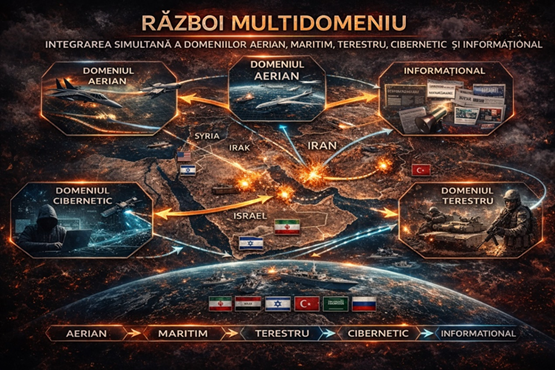
After establishing the conceptual framework of multidomain warfare, the analysis must identify the operational domains through which this type of conflict manifests itself in practice. Contemporary literature in the field of strategic studies shows an analytical convergence around the idea that modern warfare is conducted simultaneously in several interdependent operational spaces. These domains do not function in isolation, but are integrated into a complex strategic architecture in which actions in one domain can amplify or facilitate the effects generated in other domains.
To enable a systematic analysis of contemporary conflicts, including those in the Middle East, multidomain warfare can be structured into six main operational dimensions: the military dimension, the proxy dimension, the cyber dimension, the information dimension, the economic dimension, and the diplomatic-legal dimension. These dimensions represent distinct instruments for exercising strategic power, but they function synergistically within an integrated conflict strategy.
The first dimension is the military dimension, which remains the traditional core of armed conflict. Even though contemporary warfare includes numerous non-military instruments, the use of armed force continues to be a central element of state strategy. In the context of multidomain warfare, however, military operations are not conceived as autonomous actions, but are integrated into a broader set of strategic operations. These may include precision air strikes, the use of ballistic or cruise missiles, special operations carried out by clandestine units, and the use of autonomous systems and military drones. The development of modern military technologies has expanded states’ ability to project power from a distance, while reducing the need for massive troop deployments on the ground.
A second fundamental dimension is the proxy dimension, which involves the use of intermediary actors to carry out military or paramilitary operations. Proxy wars are a defining feature of contemporary conflicts, particularly in regions marked by intense geopolitical rivalries. By supporting non-state armed organisations, states can extend their strategic influence without directly engaging in open military conflict or open . This strategy reduces the political and military costs of direct intervention and creates a high degree of ambiguity regarding responsibility for the actions carried out. Proxy actors may include paramilitary organisations, insurgent groups, local militias or hybrid political-military organisations.
The third dimension of multidomain warfare is the cyber dimension, which has become one of the most dynamic components of contemporary conflicts. Cyberspace offers significant strategic opportunities for state and non-state actors, as it allows for sabotage, espionage or disruption of critical infrastructure without resorting to conventional military force. Cyber attacks can target energy systems, communications networks, financial infrastructure or military command and control systems. The impact of these operations can be comparable, in certain situations, to the effects of traditional military operations, which raises complex legal issues regarding their classification under international law.
The fourth dimension is the informational dimension, which aims to influence public perceptions and decision-making processes through strategic communication and psychological operations. In the digital age, control of information narratives has become a central element of geopolitical competition. Disinformation campaigns, social media manipulation, digital propaganda and psychological operations are used to shape public opinion, erode trust in institutions and create political divisions in adversaries’ societies. The informational dimension of conflict is closely linked to the evolution of communication technologies and the role of global digital platforms in the circulation of information.
The fifth dimension is the economic dimension, which reflects the use of economic instruments as mechanisms of strategic coercion. In the context of economic globalisation, financial sanctions, trade restrictions, embargoes and the manipulation of energy markets can become extremely effective tools for exerting pressure on adversaries. States can use these mechanisms to weaken an adversary’s economic capacity, limit its access to strategic technologies, or generate internal economic instability. The economic dimension of conflict is often coordinated with diplomatic and legal actions, creating a complex system of institutional and financial constraints.
Finally, the sixth dimension of multidomain warfare is the diplomatic and legal dimension, which involves the use of international institutions, legal mechanisms, and diplomatic negotiations as instruments of strategic competition. In the contemporary international environment, international law and multilateral institutions can be used both for conflict management and as instruments of political pressure. States can resort to multilateral sanctions, resolutions of international organisations, international litigation or mechanisms of diplomatic isolation to limit the freedom of action of their adversaries. This dimension highlights the complex interaction between legal power and political power in the structure of contemporary conflicts.
The defining feature of multidomain warfare is not only the existence of these distinct domains, but especially their strategic interaction and synchronisation. In many situations, actions in one domain are designed to prepare for or amplify operations in another domain. For example, a cyber attack on communications infrastructure may precede a military operation, reducing the adversary’s ability to coordinate its defence. Similarly, an information campaign may be used to justify certain military or economic actions politically or morally.
This integration of operational domains transforms multidomain warfare into a complex system of strategic interactions. The effects of conflict are no longer generated exclusively by direct military confrontation, but by the gradual accumulation of pressures exerted in multiple domains. For this reason, the analysis of contemporary conflicts requires a holistic approach, capable of integrating the military, economic, technological and legal dimensions of strategic competition.
In the context of the Middle East, this multidimensional architecture of conflict becomes particularly visible. Regional rivalries, competition for geopolitical influence and recent technological developments have created a strategic environment in which states simultaneously use a wide range of instruments to promote their interests. The analysis of conflicts involving Iran must therefore take into account the interaction of these operational dimensions in order to fully understand the strategic dynamics of the region.
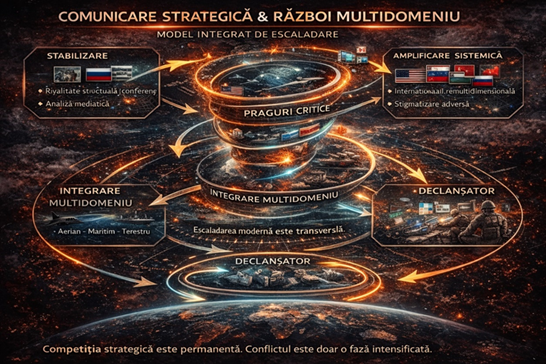
Identifying and analysing the operational dimensions of multidomain warfare is therefore an essential step in constructing an analytical framework applicable to the study of contemporary conflicts. In the next chapter, this conceptual framework will be used to examine in concrete terms how these dimensions manifest themselves in the regional conflict involving Iran, highlighting the strategic interdependencies between the different domains of confrontation.
Applying the multidomain warfare model to the conflict involving Iran
The theoretical analysis of multidomain warfare becomes scientifically relevant only to the extent that it can be empirically applied to concrete conflict situations. The Middle East region provides a particularly relevant field of analysis for this type of research, as the strategic dynamics of the region are characterised by the simultaneous interaction of multiple forms of geopolitical competition. In this context, the conflict involving the Islamic Republic of Iran is a significant example of how the various dimensions of multidomain warfare manifest themselves in practice.
Iran occupies a central position in the security architecture of the Middle East, both through its military and technological capabilities and through its extensive network of regional alliances and partnerships. Its security strategy is characterised by a complex combination of military, political and economic instruments designed to consolidate the state’s strategic influence in the region and counterbalance the pressures exerted by adversarial actors. In this sense, the conflict involving Iran is not limited to direct military confrontations, but includes a wide range of operations carried out in multiple operational areas.
From a military perspective, Iran has developed a strategy in recent decades based on strengthening its asymmetric deterrence capabilities. Given that the technological and military superiority of some regional or global actors would make a direct conventional confrontation difficult, Iran’s strategy has focused on developing alternative capabilities. These include ballistic missile programmes, the development of military drones and the modernisation of air defence systems. These capabilities are designed to create a high level of potential costs for adversaries in the event of open military conflict.
At the same time, the military dimension of the conflict is complemented by a regional strategy based on the use of proxy actors. Over time, Iran has built a complex network of partnerships with political-military organisations in various states in the region. These relationships allow Iran to extend its strategic influence beyond its own borders and contribute to the consolidation of a regional architecture of indirect deterrence. Through these actors, Iran can exert pressure on its adversaries without directly engaging in conventional military conflict, which helps to maintain a certain degree of strategic ambiguity.
The cyber dimension of the conflict is another important component of Iran’s multidomain strategy. Over the past two decades, cyberspace has become an arena for strategic competition between states involved in regional rivalries. Cyber operations can include digital espionage, computer sabotage or disruption of critical infrastructure. Both Iran and its regional adversaries have invested significantly in developing cyber capabilities, making this domain a central element of contemporary conflict.
The information dimension is also essential to understanding the conflict. In the context of the development of digital media and the expansion of social networks, competition for control of public narratives has become an important element of geopolitical strategy. Actors involved in the conflict use strategic communication tools to influence public perceptions, mobilise domestic or regional support, and delegitimise the actions of their adversaries. Information influence campaigns can include both traditional propaganda tools and sophisticated digital mechanisms for disseminating political messages.
The economic dimension of the conflict is also particularly relevant in the case of Iran. The Iranian economy has been repeatedly subjected to extensive international economic sanctions, which have aimed to limit the state’s ability to develop certain strategic programmes and expand its regional influence. Economic sanctions have significantly affected sectors such as energy exports, access to the international financial system and the transfer of advanced technologies. At the same time, Iran has sought to develop alternative mechanisms for economic adaptation, including regional trade partnerships and strategies to reduce its dependence on Western financial systems.
Finally, the diplomatic and legal dimension is an essential component of the multidomain conflict. International negotiations on Iran’s nuclear programme have been a relevant example of how diplomatic and legal instruments can become an integral part of strategic competition. International agreements, nuclear monitoring mechanisms and sanctions regimes have been used as instruments to manage regional tensions, but also as means of exerting political pressure on the actors involved.
The analysis of the conflict involving Iran thus highlights how the six dimensions of multidomain warfare interact in a complex strategic system. Military operations, cyber actions, the use of proxy actors, economic pressure and information competition do not function independently, but are integrated into a strategic framework in which each dimension contributes to reinforcing the effects generated by the others.
This interdependence of operational domains transforms the conflict into a continuous process of strategic competition, often below the threshold of declared conventional warfare. The actors involved seek to maximise their strategic advantages without triggering a full-scale military escalation, which explains the persistent and complex nature of tensions in the region.
Therefore, applying the multidomain warfare model to the conflict involving Iran demonstrates the usefulness of this analytical framework for understanding contemporary conflicts. The multidomain approach allows for the integration of various forms of strategic competition into a coherent perspective and provides appropriate analytical tools for assessing the geopolitical dynamics in the Middle East.
The interaction of the dimensions of multidomain warfare and the impact on regional stability
Analysis of contemporary conflicts shows that the defining element of multidomain warfare is not only the existence of several distinct operational domains, but above all the interaction and strategic synchronisation between them. In the case of the conflict involving Iran, the military, proxy, cyber, informational, economic and diplomatic-legal dimensions do not function independently, but form a complex system of coordinated actions, in which each instrument of power contributes to strengthening the strategic effects of the others.
This interdependence of the areas of conflict generates a specific strategic architecture, characterised by a combination of direct and indirect military pressure, economic coercion mechanisms and intense information competition. In this context, conflict is no longer defined exclusively by open armed confrontation, but by a continuous process of strategic competition conducted in multiple operational spaces.
One of the main forms of interaction between the dimensions of multidomain warfare is sequential interaction, in which actions carried out in one domain prepare or facilitate subsequent operations in another domain. For example, in the contemporary strategic environment, cyber operations can be used to disrupt an adversary’s communications infrastructure or military command systems, creating favourable conditions for the conduct of conventional military operations. Similarly, information campaigns can be used to prepare the political and media ground ahead of major strategic decisions, such as the adoption of economic sanctions or the launch of limited military operations.
A second form of interaction is simultaneous interaction, which involves the simultaneous deployment of actions in several operational areas. In the regional conflict involving Iran, this simultaneity is evident in the way that indirect military operations through proxy actors are correlated with international economic pressure, cyber competition and information campaigns. This synchronisation allows the actors involved to maximise the strategic impact of their actions, amplifying the pressure exerted on their adversaries.
A third form of interaction is cumulative interaction, which reflects how the effects of actions in different areas accumulate over time to produc ly significant changes in the regional balance of power. In the context of the conflict involving Iran, the economic pressures generated by international sanctions, combined with regional military tensions and intense information competition, contribute to the creation of a strategic environment characterised by persistent instability and geopolitical uncertainty.
The impact of this multidomain architecture on regional stability is complex and ambivalent. On the one hand, multidomain strategies can help avoid direct escalation into large-scale conventional military conflicts. The use of proxy actors, cyber operations or economic pressure allows state actors to promote their strategic interests without triggering direct military confrontations that could have devastating consequences for the entire region.
On the other hand, this form of conflict can generate long-term structural instability. Strategic ambiguity, the difficulty of assigning responsibility for certain actions, and the proliferation of actors involved can contribute to an increased risk of unintended escalation. In the absence of effective crisis management mechanisms, actions taken in one domain can trigger disproportionate reactions in other domains, amplifying regional tensions.
Another important effect of multidomain warfare is the regionalisation of conflict. In the case of the Middle East, geopolitical rivalries between regional states are often interconnected through complex networks of alliances and partnerships. Proxy actors, paramilitary organisations and transnational political-military networks contribute to the geographical expansion of the conflict, transforming bilateral tensions into regional confrontations with multiple indirect fronts.
In addition, multidomain warfare profoundly affects the region’s economic and energy environment. The Middle East is one of the most important regions for global energy production and export, and regional instability can have significant consequences for international energy markets. Attacks on energy infrastructure, disruptions to maritime transport, or economic sanctions can cause major fluctuations in energy prices and influence global energy security.
The informational dimension of the conflict also contributes to amplifying regional tensions. In today’s digital environment, geopolitical narratives circulate rapidly through online platforms, influencing public perceptions and political mobilisation. Disinformation campaigns and digital propaganda can exacerbate political polarisation and fuel existing identity or religious tensions in the region.
From a strategic perspective, this complexity of interactions between the domains of conflict requires the development of analytical models capable of integrating multiple dimensions of geopolitical competition. Traditional approaches, which treat the military, economic, and informational dimensions of conflict separately, are insufficient to explain the dynamics of multidomain warfare. Instead, a systemic perspective is needed to analyse how different instruments of power are integrated into a coherent strategy of strategic competition.
In conclusion, the regional conflict involving Iran illustrates how the interaction between the various dimensions of multidomain warfare can transform the security environment into a complex system of interdependent strategic pressures. This conflict architecture generates both indirect deterrence mechanisms and significant risks of regional instability. The next chapter will analyse the legal implications of these developments, focusing on the challenges that multidomain warfare poses for contemporary international law and the legal regime governing the use of force.
The legal implications of multidomain warfare in contemporary international law
The evolution of contemporary conflicts towards multidomain forms of strategic confrontation raises a number of significant challenges for international law. The international legal system was largely built in a historical context in which armed conflict was predominantly understood as a direct military confrontation between states. The fundamental rules on the use of force, state responsibility and the application of the law of armed conflict reflect this traditional conception of war. In contrast, multidomain warfare introduces forms of strategic action that often take place below the threshold of conventional armed conflict, thus generating significant legal uncertainties.
One of the main legal issues raised by multidomain warfare concerns the legal classification of the use of force in the context of non-conventional operations. According to Article 2(4) of the Charter of the United Nations, states are obliged to refrain from the threat or use of force against the territorial integrity or political independence of other states. At the same time, Article 51 of the Charter recognises the inherent right of states to self-defence in the event of an armed attack. In the context of multi-domain warfare, however, the distinction between the use of force and other forms of strategic coercion is becoming increasingly difficult.
Cyber operations are a relevant example in this regard. Cyber attacks can have significant effects on a state’s critical infrastructure, including energy, financial or military systems. In certain situations, the impact of such operations can be comparable to that of conventional military operations. However, international law does not yet provide a clear consensus on the conditions under which a cyber attack can be classified as “use of force” or “armed attack” within the meaning of the UN Charter. This legal uncertainty creates difficulties both in assessing the legality of such operations and in determining the legitimacy of possible self-defence measures.
Another important legal issue relates to the attribution of responsibility to states for the actions of proxy actors. In many contemporary conflicts, including those in the Middle East, states use non-state armed organisations to carry out military or paramilitary operations. This strategy allows states to exert strategic influence without directly engaging in open military conflict. From a legal perspective, however, the use of proxy actors raises complex issues regarding the attribution of international responsibility for their actions.
According to international law on state responsibility, an action can be attributed to a state if the actors involved are acting under its instructions, direction or control. In practice, however, demonstrating such a level of control can be difficult, especially in the context of informal or indirect relationships between states and non-state armed organisations. This difficulty contributes to the creation of a space of legal ambiguity in which states can avoid taking direct responsibility for certain actions carried out by intermediary actors.
Multidomain warfare also poses challenges for the application of international humanitarian law. The rules of armed conflict law are designed to regulate the conduct of parties involved in an armed conflict and to protect civilians and other protected persons. In the context of multidomain conflicts, however, the distinction between situations of peace and armed conflict is becoming increasingly difficult. Cyber operations, economic sanctions or information influence campaigns can have significant effects on civilian populations without necessarily falling within the legal category of military operations governed by international humanitarian law.
The economic dimension of multidomain warfare also has important legal implications. Economic sanctions have become one of the most frequently used instruments of strategic pressure in international relations. They can be adopted unilaterally by states or collectively through international organisations. However, the use of economic sanctions sometimes raises issues of compatibility with certain principles of international law, including rules on international trade or obligations to protect human rights.
In the case of Iran, the economic sanctions regimes adopted over time have generated legal debates regarding their impact on the civilian population and on economic and social rights. Although sanctions are designed as instruments of political coercion, their effects can indirectly affect key sectors of the economy and influence the living conditions of the population. This situation raises questions about the balance between international security objectives and respect for the fundamental principles of international law.
The information dimension of multidomain warfare also generates emerging legal challenges. Disinformation campaigns and information manipulation can influence the internal political processes of states, including democratic elections or public debates. At present, international law does not yet provide a clear regulatory framework for these forms of transnational influence, which creates a space for strategic competition in the information domain.
Overall, the evolution of multidomain conflicts highlights the need to adapt international law to the new realities of the contemporary strategic environment. Existing norms continue to provide a fundamental legal framework for regulating the use of force and protecting the civilian population. However, the emergence of new areas of conflict, such as cyberspace or the digital information environment, requires the development of legal interpretations and regulatory mechanisms capable of responding to these changes.
In the context of the regional conflict involving Iran, these legal challenges become particularly visible. The interaction between the military, economic, cyber and information dimensions of the conflict generates a series of situations that do not easily fit into traditional legal categories. Therefore, the legal analysis of multidomain warfare must adopt a flexible and interdisciplinary perspective capable of integrating technological and strategic developments in the international environment.
Conclusions and analytical perspectives on multidomain warfare
The analysis carried out in this study sought to highlight how transformations in the contemporary strategic environment have led to the emergence of forms of conflict characterised by the simultaneous integration of multiple instruments of power. The concept of multidomain warfare provides an appropriate analytical framework for understanding these developments, as it allows for the integration of military, economic, cyber, informational and diplomatic dimensions into a coherent perspective on contemporary strategic competition.
Firstly, theoretical analysis has highlighted that multidomain warfare represents a structural evolution of modern conflict. Unlike the classic model of direct military confrontation between states, contemporary conflicts are characterised by the simultaneous use of various instruments of strategic influence and coercion. This transformation is closely linked to recent technological developments, global economic interdependencies and the growing importance of the information and digital space in geopolitical competition.
Secondly, the study highlighted the existence of distinct operational dimensions of multidomain warfare. The military dimension remains a central element of conflict, but it is complemented by the use of proxy actors, cyber operations, information campaigns, and economic coercion tools ( ). Integrating these dimensions into a coherent strategy allows state actors to exert strategic pressure on adversaries without necessarily resorting to large-scale conventional military confrontations.
Applying this analytical model to the regional conflict involving Iran has demonstrated the empirical relevance of the concept of multidomain warfare. Geopolitical rivalries in the Middle East are characterised by a complex combination of military tensions, regional competition through proxy actors, economic pressures and intense information competition. This strategic configuration clearly reflects the multidomain logic of contemporary conflict.
An important aspect highlighted by the analysis is the interdependence between the different dimensions of the conflict. Military operations, cyber actions, economic pressures and information competition do not operate independently, but are integrated into a complex system of strategic interactions. The effects produced in one domain can amplify the impact of actions carried out in other domains, thus generating a cumulative process of strategic pressure on the adversary.
At the same time, this multidomain structure of conflict generates both strategic opportunities and significant risks for regional and global stability. On the one hand, multi-domain strategies can help maintain a certain level of indirect deterrence, reducing the likelihood of large-scale conventional military conflicts. On the other hand, strategic ambiguity and the proliferation of actors involved can increase the risk of unintended escalations or prolonged regional crises.
The legal analysis carried out in the study also highlighted that multidomain warfare poses significant challenges for contemporary international law. Existing rules on the use of force, state responsibility and the application of the law of armed conflict were designed in a different historical context, in which conflict was predominantly understood as direct military confrontation. Today, the emergence of new areas of conflict, such as cyberspace or the digital information environment, is creating situations that do not always fit into traditional legal categories.
In this sense, the development of legal interpretations adapted to new strategic realities becomes essential for maintaining the relevance of international law. The problem of the legal classification of cyber operations, the difficulty of attributing responsibility to states for the actions of proxy actors, and the impact of economic sanctions on civilian populations are just some of the emerging legal challenges associated with multidomain warfare.
From a methodological perspective, the study proposes an analytical model that can be used to analyse other contemporary conflicts. The concept of multidomain warfare is not limited to the Middle East, but can also be applied to other geopolitical contexts characterised by complex strategic competition. Conflicts in Eastern Europe, the Indo-Pacific region or other areas of geopolitical rivalry can be analysed using the same conceptual framework, highlighting its usefulness for contemporary strategic studies.
At the same time, the development of research in this field requires an interdisciplinary approach. Understanding multidomain warfare involves integrating perspectives from strategic studies, international law, international political economy, and technological analysis. Only through such an integrated approach can the true complexity of contemporary conflicts be captured.
In conclusion, multidomain warfare represents one of the most important transformations of conflict in the contemporary era. Analysis of regional conflict involving Iran highlights how states simultaneously use a variety of strategic instruments to promote their geopolitical interests in an international environment characterised by complex interdependencies and intense competition. Understanding these dynamics is essential both for the academic analysis of international security and for the development of effective policies for conflict management and regional stability.
Applying the multidomain warfare model to Iran
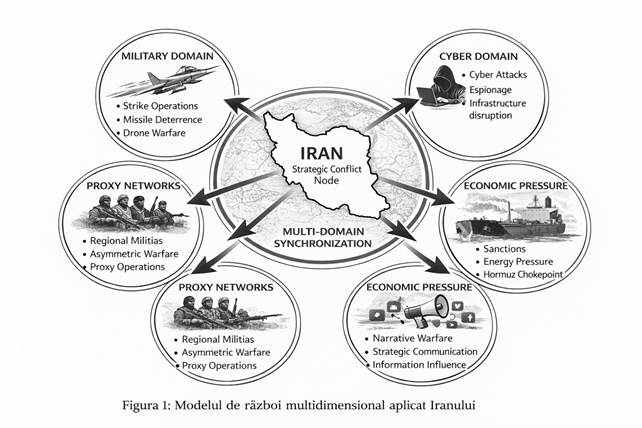
Applying the proposed analytical model to the case of Iran confirms that it cannot be adequately understood through an exclusively military lens. Iran represents, in the strategic architecture of the Middle East, a paradigmatic case of multidomain conflict, as military, cyber, economic, informational, proxy and diplomatic-legal pressures operate simultaneously on it and through it. The empirical relevance of the model became even more evident after the escalations of 2025–2026: in June 2025, Israel struck Iranian nuclear and military targets, including facilities associated with the nuclear programme, and Iran responded with missile attacks; In early March 2026, the Security Council and European leaders were already warning of the risk of a wider regional war and its destabilising effects on the entire Middle East.
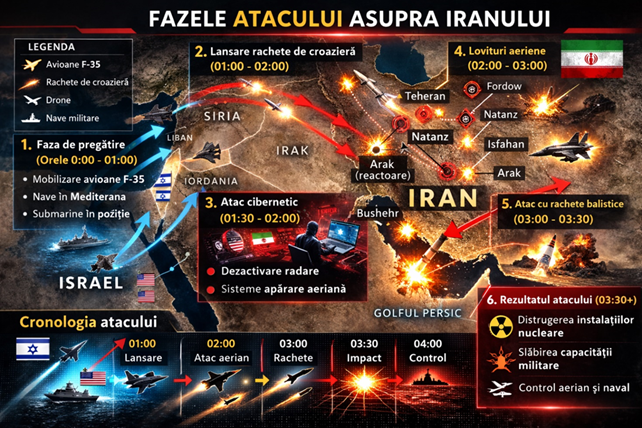
In the military dimension, the model applies by observing the shift from the logic of indirect deterrence to a much more visible and direct confrontation. The Israeli attacks of 13 June 2025 targeted Iranian nuclear and military infrastructure, and the International Atomic Energy Agency subsequently confirmed the damage to some facilities and maintained special monitoring of the situation in Iran. This is methodologically essential: the military dimension no longer consists solely of conventional strikes on conventional targets, but of attacks with strategic effect on dual-use infrastructure — military, technological and symbolic. Consequently, Iran becomes not only an actor in multi-domain warfare, but also a space for its materialisation, where military, nuclear and command targets are inserted into a broader matrix of strategic pressure.
The proxy dimension remains, however, one of the defining components of the model’s application in the Iranian case. Iranian networks in the Middle East have been analysed by CSIS as instruments of regional influence, and Reuters showed in March 2026 that some of the Shiite militias in Iraq, although cultivated for years by Tehran, reacted cautiously to the recent escalation, precisely because the proxy network does not function mechanically, but is affected by local calculations, internal competition and the strategic wear and tear of pro-Iranian organisations in the region. From an academic perspective, this means that the proxy dimension should not be treated simplistically as an automatic extension of the Iranian state, but as an area of variable control, useful for projecting influence, but also generating operational and legal uncertainty.
The cyber dimension also confirms the validity of the model. In April 2025, Iranian authorities announced that they had repelled a major cyber attack on infrastructure, and in June 2025, the US government warned that actors associated with Iran could target critical American companies and infrastructure, particularly defence organisations. In March 2026, Reuters reported that the US financial sector was on high alert for possible cyber attacks associated with the conflict with Iran. At the same time, Microsoft noted in its Digital Defence Report 2025 that state actors are increasingly combining cyber operations and influence operations, including through the use of AI- . Applied to Iran, the model shows that the cyber domain is not auxiliary, but organically integrated into the logic of coercion, deterrence and retaliation.
The informational and cognitive dimension is particularly important in the Iranian case, as the conflict is also about controlling perceptions. Microsoft has highlighted that state actors are using increasingly advanced influence operations, and UN experts reported on 4 March 2026 that the current telecommunications blackout in Iran increases the risk of serious abuses and drastically reduces the possibility of external control. This observation has major methodological value: in the case of Iran, the information space is simultaneously an external battlefield and an internal mechanism for securing the regime. Therefore, the application of the model must include both external propaganda and regional narrative competition, as well as internal control of the internet, communication filtering, and coercive management of information flows.
The economic dimension is almost didactically clear in the case of Iran. Energy and maritime transport transform the Iranian conflict into a systemic problem for the global market. The U.S. Energy Information Administration has highlighted the strategic importance of the Strait of Hormuz for oil flows, and Reuters reported in March 2026 that severe disruptions to traffic through the strait had fuelled fears of a supply crisis, sharp increases in oil prices and extraordinary insurance and reinsurance measures for maritime transport in the Gulf. From the perspective of the proposed model, the economy is not just the “backdrop” to the conflict, but one of its weapons: global energy vulnerability amplifies Iran’s strategic power and, conversely, causes military pressure on Iran to have economic effects far beyond the region.
Diplomatically and legally, the case of Iran illustrates how multidomain warfare operates through institutions, not just weapons. The IAEA maintains a special monitoring and verification regime in Iran, and UN documents from 2025 show that the Iranian nuclear dossier has remained connected to the legal and political mechanisms of Resolution 2231, even in the context of disputes over the effects of the expiry of certain restrictions. Thus, pressure on Iran is not limited to military strikes or economic sanctions, but is also expressed through international technical monitoring, multilateral forums, disputes over the legality of sanctions, and debates on the legitimacy of the use of force. In terms of the model, this confirms that the diplomatic-legal dimension is not external to the conflict, but one of its constituent components.
Applying the model to Iran therefore allows us to draw a firm analytical conclusion: the conflict associated with Iran is not a conflict ‘about’ a single issue — nuclear, military or regional — but a strategic ecosystem in which each area of confrontation enhances the other. Strikes on nuclear infrastructure influence diplomacy; proxy networks influence the military calculations of adversaries; energy pressure affects global markets; cyber and information operations shape both state behaviour and public perception. It is precisely this convergence that justifies the use of the concept of multidomain warfare as a central analytical tool for Iran.
Methodologically, the Iranian case also suggests a refinement of the proposed model. Not all dimensions have the same intensity at all times. In certain phases, the proxy dimension predominates; in others, the direct military or economic dimension becomes decisive. Therefore, the application of the model in Iran must be carried out dynamically, in temporal sequences, and not statically. In this sense, Iran offers a reference case for contemporary strategic studies: it shows how a state simultaneously under pressure, under surveillance and in regional competition can use and support, at the same time, all the registers of multidomain warfare.
Applied case study: the operational matrix of multidomain warfare in Iran
For the theoretical model of multidomain warfare to acquire full analytical relevance, it must be transposed into an operational matrix capable of capturing not only the existence of multiple dimensions of conflict, but also the concrete way in which they articulate themselves in time, space and at the decision-making level. The case of Iran is particularly useful in this regard, as it allows us to observe a conflict in which strategic pressure is not exerted exclusively through direct military force, but through the convergence of military strikes, energy vulnerabilities, proxy networks, cyber operations, narrative competition and international monitoring mechanisms. It is precisely this overlap of registers that justifies the use of an operational matrix and confirms that Iran is one of the clearest contemporary cases of multidomain warfare.
Methodologically, the operational matrix applied to Iran can be understood as an analytical device consisting of three axes. The first axis is that of the domains of conflict, namely military, proxy, cyber, informational, economic and diplomatic-legal. The second axis is that of strategic functions, namely deterrence, coercion, attrition, influence and legitimisation. The third axis is the temporal one, which distinguishes between phases of latent tension, limited escalation, intensified confrontation and post-escalation. By applying these three axes to the Iranian case, it becomes possible to observe not just a conflict, but a dynamic system of interdependent pressures, in which each dimension produces its own effects and, at the same time, amplifies the others. This reading is compatible with both the analysis of Iranian networks in the region and recent assessments of the combination of military, economic and informational instruments in the current conflict.
On the military axis, Iran appears simultaneously as a deterrent actor and as an object of coercion. The June 2025 strikes on Iranian nuclear and military facilities showed that the state’s strategic infrastructure can become a target in a logic of selective degradation of its capabilities, while the IAEA’s March 2026 statements confirm the maintenance of exceptional international attention to the safety and integrity of Iranian nuclear facilities. From this perspective, the military dimension can no longer be treated in isolation, as a simple kinetic confrontation, because it is inseparable from the nuclear infrastructure, the strategic symbolism of the Iranian programme and the diplomatic repercussions of each strike. In the operational matrix, the functional role of the military domain is twofold: it produces immediate effects of degradation and, at the same time, reconfigures the entire political and legal calculation of the actors involved.
The proxy dimension must be placed, in this matrix, at the intersection between regional projection and strategic flexibility. CSIS analyses of Iranian networks in the Middle East and Reuters investigations on 6 March 2026 into Shiite militias in Iraq show that Iranian influence continues to rely on an infrastructure of indirect armed relations, but also that this infrastructure has become less homogeneous and less predictable than in previous phases. Some groups remain deeply connected to the logic of the “axis of resistance,” while others are increasingly concerned with domestic political capital, economic resources, and avoiding involvement that could destroy them. Applying the model to Iran thus shows that the proxy dimension is not only an instrument of strategic extension, but also an area of internal friction, where the local interests of affiliated actors can reduce Tehran’s indirect command capacity. In terms of the matrix, this dimension serves to wear down adversaries regionally, but also to disperse responsibility and maintain ambiguity.
The cyber dimension plays a special role in Iran’s case, as it operates at the intersection of sabotage, intimidation and preparation for other types of action. Reuters reported in April 2025 on Iran’s repulsion of a major cyber attack, and Microsoft noted in its 2025 report that state actors are increasingly combining cyber operations with informational influence and extensive use of artificial intelligence. Furthermore, Reuters’ March 2026 assessments of the US financial sector’s alertness to possible Iranian attacks confirm that cyberspace is not marginal, but one of the main registers of the current conflict. Within the operational matrix, the cyber domain performs functions of disruption, testing the adversary’s resilience, and strategic signalling without immediately escalating to large-scale conventional hostilities. This is precisely where one of the most sophisticated features of multidomain warfare can be seen: the ability to produce major strategic effects below the classic threshold of declared war.
In Iran’s case, the informational and cognitive dimensions operate both externally and internally. Externally, the conflict is accompanied by intense narrative competition, in which each actor attempts to define the legitimacy of its own conduct and undermine the image of its adversary. Internally, control of communications and information flows becomes an integral part of securing the regime. The Microsoft report on the influence operations of state actors highlights the expansion of digital tactics and synthetic content, and combining this general framework with data on political and military pressure on Iran shows that the information space is, in fact, an operational theatre. In the proposed matrix, the information dimension has the function of legitimising, mobilising and shaping the perception of risk, which means that it not only accompanies the conflict, but also structures it.
The economic dimension is perhaps the most clearly quantifiable component of the operational matrix. Reuters data from 6 March 2026 shows that oil tanker traffic through the Strait of Hormuz has plummeted to near zero since the outbreak of the new phase of the conflict, and Reuters’ analysis of the oil shock shows that the blockage of flows through this critical point has affected global markets, calling into question previous estimates of excess supply. At the same time, the structural importance of the Strait of Hormuz for energy flows is consistently recognised by institutions specialising in energy analysis. Therefore, in the case of Iran, the economy and energy are not mere side effects of the war, but its constituent elements. The function of this dimension in the matrix is systemic coercion: the pressure exerted on Iran produces global shock waves, and Iran’s ability to affect one of the world’s most sensitive energy arteries gives it strategic leverage disproportionate to its gross economic power.
The diplomatic-legal dimension closes the matrix, but not as a simple external framework, but as an active mechanism for producing conflict. The IAEA’s official platform on monitoring and verification in Iran, as well as the Director General’s statement of 2 March 2026, show that the Iranian nuclear dossier remains at the centre of an institutional architecture of international surveillance and response. This means that Iran is caught in a normative field in which every military or technological development generates echoes in multilateral forums, verification regimes and discourse on the legality of the use of force. In the operational matrix, this dimension serves to validate, contest and internationalise the conflict. It shows that multidomain warfare is not only waged with material means, but also through the continuous definition of the legality, responsibility and international status of the actors involved.
The combination of these dimensions leads to an essential analytical conclusion: in Iran, multidomain warfare cannot be described linearly, as a succession of events, but must be understood as a network of operational convergences. A military strike on a sensitive facility simultaneously produces diplomatic effects, informational reverberations and economic recalibrations. A disruption of energy traffic through Hormuz is not just a commercial incident, but an act of strategic pressure with political and military effects. A cyber operation is not just a technical attack, but a strategic signal and an element of deterrence modelling. This simultaneity explains why Iran is an exemplary case for studies on multidomain warfare and why the proposed model has high explanatory value in its analysis.
The methodological conclusion is as important as the empirical one. Applying the model to Iran shows that conflict analysis must be carried out on integrated levels and in distinct time sequences. Not all dimensions have the same intensity at every moment, but no major dimension can be excluded without distorting the strategic reality of the case. Iran is not only a theatre of regional confrontation , but also a contemporary laboratory where the transition from conventional warfare to stratified, distributed and systemic conflict can be observed in almost pure form. In this sense, the operational matrix applied to Iran is not just a descriptive exercise, but a research tool that can be transferred to other areas of geopolitical rivalry.
Critical assessment of the model and the limits of its application in the case of Iran
Applying the analytical model of multidomain warfare to Iran provides a coherent perspective on the complexity of contemporary conflict in the Middle East. However, any theoretical model used to analyse a complex geopolitical phenomenon must be subject to critical evaluation. A conceptual framework, however useful it may be for organising analysis, risks oversimplifying reality or overestimating the strategic coherence of the actors involved. Therefore, examining the limitations of the proposed model is essential to understanding both its explanatory value and its methodological constraints.
The first important limitation of the model stems from the tendency to assume a high level of strategic coordination between the different dimensions of the conflict. The multidomain warfare model starts from the idea that military, economic, cyber and information actions are integrated into a coherent strategy of geopolitical competition. In practice, however, state policies are often influenced by internal institutional factors, competition between government agencies, and internal political constraints. In the case of Iran, the complex structure of the power system – which includes religious institutions, the military apparatus of the Revolutionary Guards, government structures and various informal centres of influence – can generate differences in strategy and priorities among internal actors.
This institutional reality sometimes reduces the coherence of the state’s external actions and makes certain strategic initiatives the result of fragmented decision-making processes. From this perspective, the multidomain model risks overestimating the degree of coordination between the different operational domains of the conflict. Some actions may occur simultaneously in several domains, not necessarily because they are planned as part of an integrated strategy, but because regional developments generate rapid and partially independent reactions in various sectors of the state apparatus.
A second methodological limitation relates to the problem of attributing actions in the context of multidomain conflicts. A central element of the model is the role of proxy actors and indirect operations. However, attributing responsibility for actions carried out by non-state armed organisations or cyber groups remains extremely difficult. In many situations, relations between states and proxy actors are characterised by strategic ambiguity and varying degrees of control. In the case of Iran, relations with various armed organisations in the region have evolved over time and cannot be described exclusively in terms of a strict hierarchical command relationship.
This ambiguity creates difficulties not only for strategic analysis but also for the legal assessment of the conflict. If responsibility for certain actions cannot be established with certainty, the multidomain model risks attributing greater influence to states than they actually exert in certain situations. Therefore, the analysis must remain attentive to the distinction between political influence, indirect support and effective operational control.
A third limitation of the model is related to the temporal dynamics of the conflict. Multidomain warfare does not always manifest itself through the simultaneous activation of all operational domains. In reality, the various dimensions of the conflict tend to intensify or diminish depending on the regional context, internal political changes or developments in the international system. In the case of Iran, periods of intense military tension may be followed by ph ly dominated by diplomatic or economic dimensions. This variability makes it difficult to establish a static model of interaction between the domains of conflict.
From an analytical point of view, this means that the multidomain model must be used as a flexible tool, capable of capturing the temporal evolution of the conflict. A rigid analysis, which assumes the simultaneous activation of all dimensions at any given moment, could lead to simplified or erroneous interpretations.
Another important limitation is related to the role of perceptions and strategic uncertainty. In contemporary conflicts, the decisions of state actors are influenced not only by the objective realities of the strategic environment, but also by perceptions of their adversaries’ intentions. In the case of Iran, perceptions of external threats, the legitimacy of strategic programmes, or the intentions of other regional actors play an essential role in the formulation of security policies. These perceptions can amplify or diminish the importance of certain dimensions of the conflict and influence how the actions of adversaries are interpreted.
The multidomain model tends to favour a structural analysis of instruments of power, but does not always adequately capture the cognitive dimension of decision-making processes. Its application must therefore be complemented by an analysis of the strategic perceptions and political discourses that influence the behaviour of the actors involved.
Finally, a conceptual limitation of the model is related to the risk of overgeneralisation. Although the concept of multidomain warfare provides a useful framework for analysing the conflict involving Iran, not all contemporary conflicts can be adequately explained by this model. Some conflicts remain predominantly military or political, and the mechanical application of a multidomain grid could lead to forced interpretations of empirical reality.
Therefore, the model must be used with caution and adapted to the specifics of each case analysed. In the case of Iran, the complexity of the regional environment and the multiplicity of actors involved justify the use of a multidomain framework. In other geopolitical contexts, however, other analytical models may offer more appropriate explanations.
In conclusion, a critical assessment of the model confirms that multidomain warfare is a valuable analytical tool for studying conflicts involving Iran, but that its use requires a flexible and contextualised approach. The model provides a useful conceptual structure for integrating the various dimensions of strategic competition, but it must be supplemented by institutional, political and cognitive analyses in order to capture the true complexity of the phenomenon.
This critical assessment also opens up perspectives for future research directions that can deepen the relationship between multidomain warfare, technological transformations and developments in international law. In this sense, the study of the conflict involving Iran remains a privileged field for analysing how contemporary forms of geopolitical competition are redefining both the strategic practices of states and the normative framework of the international order.
Identifying operations in each domain, analysing the synchronisation between domains, and assessing the cumulative strategic effects of the action in Iran
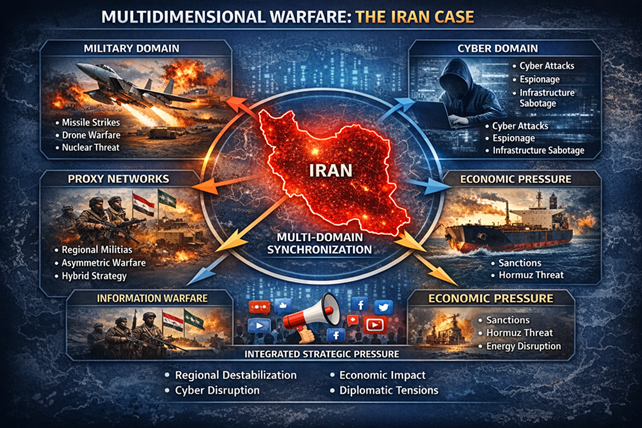
Applying the multidomain warfare model to the case of Iran becomes truly relevant when the analysis goes beyond the general descriptive level and accurately identifies the operations carried out in each domain of conflict, the logic of their synchronisation, and the cumulative strategic effects produced. The Iranian case is particularly instructive because it illustrates not only the coexistence of several registers of confrontation, but also their integration into a process of layered strategic pressure. Developments in 2025–2026, including strikes on Iranian targets, tensions over nuclear facilities, reactions from proxy actors, alerts about cyber activity, and severe disruptions in the Strait of Hormuz, confirm that Iran is not only a contested regional actor, but also a space where kinetic, economic, informational, and legal-diplomatic operations converge simultaneously.
| Field | Operations | Strategic function |
| Military | attacks on infrastructure | coercion |
| proxy | regional militias | usury |
| cyber | attacks on infrastructure | disruption |
| information | propaganda | legitimisation |
| economic | sanctions | pressure |
| diplomatic | negotiations | validation |
In the military sphere, operations sought to degrade Iran’s strike and deterrence capabilities, particularly in relation to strategic infrastructure, sensitive facilities and command and control assets. Assessments in the early days of the March 2026 escalation indicated that the combined strikes sought to diminish Iran’s ballistic missile and drone capabilities, while the IAEA’s maintained a special monitoring regime for nuclear facilities, signalling their centrality to the conflict equation. Even when not all facilities were confirmed to have been hit, the mere placement of nuclear and military infrastructure under operational pressure produced a major strategic effect: Iran was forced to redistribute its attention between defending its territory, protecting its nuclear programme and preserving its retaliatory capabilities.
In the proxy domain, operations consisted not so much in the uniform activation of all networks aligned with Iran, but in their use as potential regional pressure infrastructure. However, recent data show that this dimension has become less homogeneous than in the past. Reuters reported on 6 March 2026 that numerous Shiite militias in Iraq, cultivated for years by Tehran, were unwilling to fully enter the new phase of the conflict, citing organisational degradation, the loss of secure supply lines, and the prevalence of local political and economic interests. CSIS had already described Iranian networks as extensive but differentiated and adaptive, not simply mechanical extensions of the Iranian decision-making centre. Therefore, in Iran’s case, the proxy operation functioned primarily as a tool for latent regional deterrence and for multiplying uncertainty for adversaries, rather than as an automatic mechanism for total mobilisation.
In the cyber domain, operations had both a defensive and an offensive or pre-emptive offensive function. Iranian authorities announced in April 2025 that they had repelled a major cyber attack on the country’s infrastructure, indicating the existence of persistent digital competition over critical systems. At the same time, Microsoft showed in its Digital Defence Report 2025 that state actors have sophisticated their combination of cyber operations and influence operations, including through the use of AI for more scalable and targeted campaigns. In March 2026, Reuters also reported on the high alert status of the US financial sector in the face of the risk of cyber attacks associated with the confrontation with Iran. Thus, the cyber domain has functioned as a space for potential sabotage, intimidation, testing resilience, and indirectly preparing other forms of strategic action.
In the informational and cognitive domain, operations have focused on controlling the narrative of the conflict, shaping external perceptions, and managing the internal space of legitimacy. Microsoft has highlighted that state actors are increasingly using digitally supported influence operations, including synthetic content and campaigns to manipulate public perception. In the Iranian case, this dimension is twofold: externally, it manifests itself through competition to define mutual legitimacy between Iran and its adversaries; internally, through control of information, reducing the regime’s vulnerability to challenge and securing the national narrative under conditions of military and economic pressure. In terms of the model, this is not propaganda as a secondary element, but an operation of internal stabilisation and external contestation carried out concurrently with the other areas.
In the economic sphere, the operations were most visible in their effects on energy flows and maritime transport. Reuters reported in early March 2026 that traffic through the Strait of Hormuz had been severely affected, with prolonged blockages, the suspension or cancellation of war risk coverage by insurers, and increased pressure on oil and gas flows. Reuters also pointed out that these disruptions called into question market scenarios based on excess supply and signalled the risk of a real supply crunch. In the logic of the multidomain model, this means that the economic operation was not limited to sanctions or collateral trade costs, but functioned as an instrument of systemic coercion, with an impact beyond the regional theatre.
In the diplomatic-legal sphere, operations consisted of technical monitoring, institutional pressure, defining international legitimacy and keeping the Iranian dossier in multilateral frameworks. The IAEA explicitly maintained a special monitoring and verification platform for Iran, and the Director General’s statement on 2 March 2026 confirmed that the Agency remained in constant contact with regional security networks and closely monitored any possible impact on facilities. At the same time, European and Western political reactions framed the conflict in a discourse linking military action to the nuclear programme, the missile programme and Iran’s relationship with proxy groups. As a result, the diplomatic-legal sphere operated not as a mere normative backdrop, but as a mechanism for validating, contesting and internationalising strategic action.
An analysis of the synchronisation between these domains shows that the action in Iran cannot be understood as a series of separate episodes. There is a direct synchronisation between the military and diplomatic-legal domains: any strike on sensitive infrastructure immediately triggers monitoring reactions, institutional statements and international political repositioning. There is functional synchronisation between the military and cyber domains: kinetic pressure is accompanied by digital alerts, anticipation of sabotage or cyber retaliation, and the strengthening of critical infrastructure resilience. There is indirect synchronisation between the economic and proxy domains: the activation or mere possibility of activation of networks aligned with Iran contributes to amplifying the perceived risk to energy and trade routes. Finally, the informational dimension cuts across all other domains, as each operation must be justified, contested or reinterpreted narratively in near real time.
This synchronisation is neither perfectly linear nor absolutely centralised. This is precisely where Iran’s specificity lies. The domains are not always activated simultaneously at the same intensity, but they are mutually dependent. For example, the fact that the proxy networks in Iraq responded cautiously did not negate their strategic function; on the contrary, it showed that their mere existence, even without maximum mobilization, continues to affect the calculations of their adversaries. Similarly, the absence of confirmation of catastrophic damage to all nuclear facilities did not diminish the importance of the military domain, as the major effect was also produced by the pressure exerted on the Iranian decision-making framework and on the international surveillance architecture. The synchronisation between domains must therefore be understood as a process of strategic convergence, not as perfect mechanical orchestration.
An assessment of the cumulative strategic effects confirms the validity of the model. The first cumulative effect was the degradation of Iran’s strategic freedom of manoeuvre: the state had to simultaneously manage its military vulnerability, the security of sensitive infrastructure, cyber risk, economic pressure and the diplomatic cost of escalation. The second effect was the extensive regionalisation of the crisis: even when certain proxy networks were not fully activated, the conflict remained connected to Iraq, Syria, Lebanon and the Gulf maritime space, which prevented its strict territorial localisation. The third effect was the globalisation of the economic consequences, through the disruption of energy and maritime transport, with repercussions on prices, insurance and risk perception in international markets. The fourth effect was the intensification of international surveillance and regulatory pressure on Iran, particularly through the continued centrality of the nuclear issue.
Conclusion
Analysis of the operations carried out in each domain, the synchronisation between these domains and the cumulative strategic effects confirms the usefulness of the multidomain warfare model for studying the conflict associated with Iran. In this case, the decisive strategic effects do not result from a single military or economic action, but from the convergent accumulation of pressures exerted simultaneously in several domains.
Iran thus illustrates one of the clearest contemporary forms of multidomain conflict: a system of layered strategic competition in which military, economic, cyber, informational, and legal instruments reinforce each other, generating a continuous process of pressure on the actors involved. In this sense, the Iranian case study offers a relevant contribution to understanding the transformations of conflict in the contemporary international environment.
MARITIME SECURITY FORUM
Bibliography
- Hoffman, Frank G., ‘Hybrid Warfare and Challenges’, Joint Force Quarterly 52 (2009): 34–39.
- Johnson, Rob, Hybrid War and Its Countermeasures: A Critique of the Literature (London: King’s College London, 2018).
- Kilcullen, David, The Dragons and the Snakes: How the Rest Learned to Fight the West (Oxford: Oxford University Press, 2020).
- Lanoszka, Alexander, Military Alliances in the Twenty-First Century (Cambridge: Polity Press, 2022).
- Lanoszka, Alexander, Cyber War and Conflict (Cambridge: Polity Press, 2019).
- Mazarr, Michael J., Mastering the Gray Zone: Understanding a Changing Era of Conflict (Carlisle: US Army War College Press, 2015).
- Nye, Joseph S., The Future of Power (New York: Public Affairs, 2011).
- Sloan, Elinor C., Modern Military Strategy: An Introduction (London: Routledge, 2017).
- Valeriano, Brandon and Ryan C. Maness, Cyber War versus Cyber Realities (Oxford: Oxford University Press, 2015).
Institutional documents and reports
- Center for Strategic and International Studies (CSIS), Iranian Networks in the Middle East (Washington DC: CSIS, 2023).
- International Atomic Energy Agency (IAEA), Monitoring and Verification in Iran (Vienna: IAEA, 2024).
- Microsoft, Digital Defense Report 2025 (Redmond: Microsoft Security, 2025).
- NATO, Multi-Domain Operations Concept (Brussels: NATO Allied Command Transformation, 2021).
- RAND Corporation, Iran’s Strategy in the Middle East (Santa Monica: RAND, 2019).
- Reuters, ‘Hormuz Shutdown Worsens After Attacks in Gulf’, 4 March 2026.
- Reuters, ‘Iran Spent Years Fostering Proxies in Iraq’, 6 March 2026.
- United Nations Security Council, Resolution 2231 (2015).
- US Department of Defence, Summary of the National Defence Strategy (Washington DC: DoD, 2022).
Legal sources
- Dinstein, Yoram, War, Aggression and Self-Defence, 7th ed. (Cambridge: Cambridge University Press, 2021).
- Gray, Christine, International Law and the Use of Force, 4th ed. (Oxford: Oxford University Press, 2018).
- Schmitt, Michael N. (ed.), Tallinn Manual 2.0 on the International Law Applicable to Cyber Operations (Cambridge: Cambridge University Press, 2017).