


Romania’s Exclusive Economic Zone and Neptun Deep: a strategic pillar to be protected within the Black Sea Strategic Maritime Ecosystem
Admiral (ret.) PhD. Aurel POPA[1]
Comm. Fl. (ret.) PhD. Sorin LEARSCHI[2]
Abstract
This article analyses Romania’s Exclusive Economic Zone as a strategic pillar requiring protection and examines how the development of Neptun Deep enhances its national and European significance. The analysis applies the concept of the Maritime Strategic Ecosystem and two relevant concepts derived from it: Maritime Strategic Convergence and Maritime Strategic Resilience. The final assessment uses an adapted Integrated Maritime Security Architecture (IMSA) to relate the findings to protection requirements. It examines the relationships between resource exploitation, offshore infrastructure, connections to the shore, gas transmission and institutional protection capabilities. Particular attention is paid to the legal regime of the EEZ, where Romania’s sovereign rights and jurisdiction coexist with the freedoms enjoyed by other states. This legal framework shapes surveillance, the assessment of suspicious activities and the legal basis for intervention. The scenarios considered relate to component unavailability, loss of confidence in operational data, repeated ambiguous incidents and coordination difficulties. European and Allied responses in October 2026 are assessed in terms of their potential contribution to protecting maritime activities, distinguishing between political positions, announced measures and national responsibilities. The article argues that protecting Neptun Deep requires arrangements centred on the continuity of essential functions, clearly defined powers and responsibilities, and cooperation between operators and public authorities. The project’s potential contribution to European energy supply reinforces the need for this approach.
Keywords: Romania’s Exclusive Economic Zone; Neptun Deep; Maritime Strategic Ecosystem; Maritime Strategic Convergence; Maritime Strategic Resilience; critical offshore infrastructure; European energy security; law of the sea; Black Sea.
- Introduction
Romania’s Exclusive Economic Zone is a strategic pillar, the protection of which concerns the exercise of rights over resources, the safety of economic activities and the defence of national interests in the Black Sea. The development of the Neptun Deep project amplifies the importance of this area through the link between natural gas extraction, subsea infrastructure, transport to shore and the supply of consumers. In these circumstances, the protection of Romania’s interests must encompass both maritime installations and the operational relationships on which the exploitation of resources depends.
From a legal perspective, the analysis involves distinguishing between the rights exercised within the Exclusive Economic Zone and those relating to the continental shelf. Within the EEZ, the coastal state enjoys sovereign rights regarding the exploration, exploitation, conservation and management of resources, as well as jurisdictional powers in the areas provided for by the United Nations Convention on the Law of the Sea. The mineral resources of the seabed and subsoil are subject to the continental shelf regime. These rights coexist with the rights
and freedoms recognised for other states; the EEZ does not have the legal status of national territory. The protection of offshore activities must be organised in accordance with this distinction.[3]
Neptun Deep lends this issue particular significance in terms of energy. According to the operator’s announcement of 28 September 2026, first production is expected in the first half of 2027, and peak annual production is estimated at approximately 8 billion cubic metres. These figures are project estimates, the realisation of which depends on the completion of development and operational performance.[4] From the perspective of this article, the additional production capacity can support Romania’s supply and the diversification of sources available on the European market. The scale of the regional contribution will depend on the availability of gas for trade, on demand, and on transport and interconnection capacities.
The project’s European significance heightens the stakes regarding its protection. A prolonged disruption could affect operators’ interests, public revenues, supply and confidence in the continuity of deliveries. The extent of these effects must be examined in relation to the duration of the disruption, the available alternatives and the market situation. The value of the investment and the estimated volume of production must therefore be analysed alongside the dependencies generated by the project and the possibilities for mitigating any disruption.
To explain these links, the article uses the concept of the Strategic Maritime Ecosystem, developed in the study *The Strategic Maritime Ecosystem and the Transformation of the Euro-Atlantic Security Architecture. Ankara 2026 – The Turning Point in the Evolution of Contemporary Maritime Security*, authored by Aurel Popa, Sorin Learschi, Constantin Ciorobea and Ioan Crăciun. The proposed framework enables an examination of the relationships between infrastructure, actors, norms, technologies and strategic interests. Its application to the Neptun Deep case aims to explain how these relationships influence the protection and operation of the system under analysis.[5]
The subject of the analysis is the system comprising the Neptun Deep offshore field, the infrastructure linking it to the shore, and the connections necessary for its transport, operation and protection. The EEZ constitutes the relevant maritime and jurisdictional framework, though it should not be confused with the project’s perimeter. Port infrastructure, response capabilities and the relevant institutions are examined insofar as they contribute to the operation of this system.
Of the concepts derived from the Strategic Maritime Ecosystem, the article highlights Strategic Maritime Convergence and Strategic Maritime Resilience. The former enables the tracing of the links through which a decision or disruption in one area produces consequences in the others. The latter directs the assessment towards maintaining essential functions and restoring them following an incident[6] . The usefulness of these concepts will be assessed by their ability to explain concrete interdependencies and to underpin protective measures.
The central question of the article is as follows: how should the protection of Romania’s interests in the EEZ be organised, given the links between Neptun Deep, its supporting infrastructure and the project’s contribution to European energy security?
The article is based on the premise that the effective protection of this strategic pillar depends on the ability of authorities and operators to identify critical dependencies, limit the spread of disruptions and maintain essential functions. The physical protection of facilities, the security of digital systems, the continuity of transport, the clarity of responsibilities and institutional cooperation must be assessed collectively.
The analysis combines an examination of the legal framework and relevant documents with an assessment of disruption scenarios. For each scenario, the affected function, relevant dependencies, possible consequences and the means of mitigating them are examined. A distinction is made between documented facts, operators’ estimates and working assumptions. The aim is to formulate recommendations whereby the protection of the EEZ and Neptun Deep supports Romania’s strategic interests and the continuity of its contribution to European energy security.
2. The Strategic Maritime Ecosystem: the link between resources, infrastructure and protection
Applying the concept of the Strategic Maritime Ecosystem to Romania’s EEZ involves identifying the relationships through which offshore resources can be utilised safely and sustainably. The importance of a deposit is linked to the possibility of its exploitation, the transport of production and access to consumers. Each of these activities depends on infrastructure, technologies, regulations and institutions that must function in tandem.
In the study by Popa, Learschi, Ciorobea and Crăciun, the Strategic Maritime Ecosystem enables these relationships to be examined within a common framework. The strategic value of its components stems both from their individual functions and from their links with the other components. For the purpose of this article, this perspective enables an explanation of the interdependencies between resource exploitation, energy infrastructure and the capacity for protection[7] .
2.1. Delimitation of the analysed framework
Romania’s EEZ constitutes the area in which the rights and powers provided for by the law of the sea are exercised, whilst Neptun Deep represents a specific energy project. The protection of Romanian interests in the EEZ extends beyond the protection of this project. It concerns resources, economic activities, installations and the marine environment, whilst respecting the rights of other states.
Neptun Deep is regarded as a key component of this area. The project’s configuration comprises wells, subsea production systems, gathering pipelines, an offshore platform, a pipeline to Tuzla and a gas metering station. These elements form a technical chain whose operation enables the transfer of the resource from the reservoir to the transport infrastructure.
The proposed analysis focuses on three categories of links:
- Production and transmission links, between fields, offshore installations, the onshore connection point and the transmission network.
- Operational and support links, which ensure communications, the supply of equipment, maintenance and technical interventions.
- Protection and coordination links, between operators and the authorities responsible for maritime affairs, energy, defence, cyber security and environmental protection.
This classification allows for the inclusion of relevant infrastructure and institutions without implying that they all have the same function or the same degree of importance. The role of each component must be determined by its contribution to the functioning of the system as a whole and by the consequences of its unavailability.
The figure below illustrates the links between Neptun Deep, the onshore connection infrastructure, and the support and protection functions. The delineation of the offshore segment highlights the legal specificity of the system as a whole: the infrastructure is situated in an area where Romania’s rights coexist with the freedoms recognised for other states. The continuity of the energy function depends on the coordination of the maritime and land-based components, which are subject to distinct legal regimes.
“Figure 1 illustrates the components of the complex under analysis, the links between them and the legal framework of the offshore segment.”
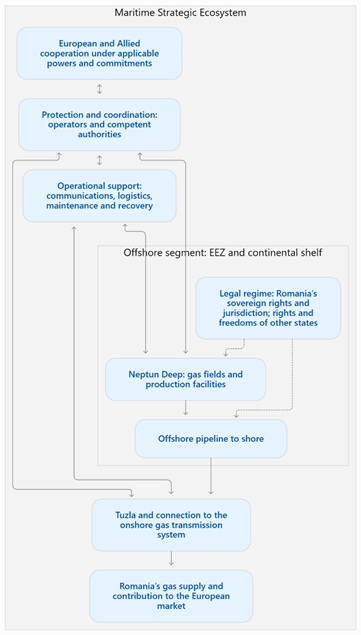
Key: solid arrows indicate energy flow and functional relationships; dotted arrows indicate the legal framework. The diagram does not represent locations, distances or an operational protection system.
Source: own work based on the FSM conceptual framework and the public configuration of the Neptun Deep project. [8]
2.2. Maritime Strategic Convergence and the interdependencies of Neptun Deep
Maritime Strategic Convergence explains the interaction between the components of the ecosystem and the effects that a change in one component has on the others. In the case under analysis, the concept can be applied to the relationship between gas extraction, infrastructure safety, communications continuity, the legal framework and institutional capacity for intervention.
A first relationship concerns the transformation of the resource into an actual supply. The presence of gas in the reservoir acquires economic value through the successive operation of production facilities, pipelines and transport infrastructure. The capacity of each component must be examined in relation to the entire route. A persistent bottleneck at one point can reduce the benefits available throughout the rest of the system.
A second relationship concerns the physical protection and operation of digital systems. Operational data enables the monitoring of processes and the taking of technical decisions. Consequently, the availability of equipment must be assessed alongside the integrity of the information used to operate it. Intact equipment may become temporarily unusable if the operator can no longer safely verify its condition.
A third relationship concerns the legal framework and institutional intervention. The detection of an incident must be followed by the determination of its location, nature and consequences, as well as the identification of the competent authorities. Protecting people, limiting pollution, preserving evidence and restoring operations may require simultaneous actions, each based on clear responsibilities and procedures.
Convergence should also be pursued in a positive sense. Information sharing, coordinated maintenance and joint exercises can reduce the duration of disruptions and improve the use of available resources. The assessment will need to determine, for each link, whether it contributes to continuity or facilitates the spread of a disruption.
2.3. Strategic Maritime Resilience and the Continuity of Essential Functions
For the Neptun Deep complex as a whole, Strategic Maritime Resilience can be assessed in terms of the ability to maintain essential functions, limit the consequences of an incident and safely resume operations.
A distinction must be made between two levels. Project resilience concerns the production, operation, maintenance and recovery of affected installations. Supply resilience concerns the energy system’s ability to compensate for a temporary reduction in supplies. Stocks, other gas sources and transport capacities can contribute to the continuity of supply, without replacing the technical function of an offshore installation.
This distinction is necessary for formulating recommendations. One measure may limit the economic effects of a disruption, whilst another may reduce the duration of repairs. Both are relevant, but address different issues.
The FSM article on maritime infrastructure and global systemic risks emphasises the continuity of the functions supported by infrastructure[9] . Applied here, this approach leads to the assessment of protection through its impact on production, transport and supply.
2.4. Guidelines for assessing protection
To apply these two concepts, the article proposes the following benchmarks:
| Guideline | Analytical question |
| Core function | What activity does the component under review support? |
| Critical dependency | What other functions are affected by its unavailability? |
| Compensability | Are there alternatives, and how soon can they be utilised? |
| The extent of the consequences | Do the effects remain confined to the project, or do they affect supply and other activities? |
| Recovery capacity | What technical, logistical and institutional resources are required to restore functionality? |
| Coordination | Who decides, who intervenes and how is information shared? |
These guidelines are proposed working tools for the case under analysis. They do not involve the assignment of pre-determined ratings and allow the limitations of publicly available information to be highlighted.
On this basis, the protection of the EEZ and Neptun Deep can be assessed in relation to the functions that must be maintained and the dependencies that require additional measures. Recommendations can thus be linked to specific issues, with clear responsibilities and objectives.
3. The EEZ and Neptun Deep: Romania’s interests and the European energy dimension
Protecting the Exclusive Economic Zone involves identifying the interests that Romania must defend and the conditions necessary for exercising its rights. In the case of Neptun Deep, these interests relate to the exploitation of resources, infrastructure safety, the continuity of economic activities and the contribution to gas supply. The links between them explain why the protection of the project must be integrated into the state’s maritime and energy policy.
3.1. Exercising rights over resources
Rights over resources provide Romania with the legal basis for authorising and regulating exploitation. Their effective exercise depends on the ability to ensure that activities are carried out safely, that operators fulfil their obligations, and that the authorities intervene when incidents occur.
The United Nations Convention on the Law of the Sea recognises the coastal state’s sovereign rights over resources and jurisdiction over offshore installations. These powers are accompanied by the obligation to take account of the rights of other states. The continental shelf regime also maintains the distinction between rights over the seabed and subsoil and the legal regime governing the waters above[10] .
For the purposes of this article, the consequence is that protective measures must be tailored to the subject matter and location of the intervention. The protection of a facility, the investigation of an incident and the supervision of navigation raise different legal issues. The strategic importance of Neptun Deep justifies the preparation of appropriate measures, but each measure must have a legal basis and a competent authority.
Clarity regarding these responsibilities contributes to the protection of the project. In a situation of uncertainty, delays may arise both from a lack of information and from a lack of clarity regarding responsibilities. Procedures established prior to the incident must allow for intervention to ensure safety and limit the consequences, whilst simultaneously investigating the causes and preserving evidence.
3.2. From offshore resource to national benefit
The strategic benefit of Neptun Deep depends on converting the estimated production into volumes available for consumption and sale. This conversion requires the entire supply chain from the field to the market to be operational.
For Romania, the analysis must address three categories of interest. The first concerns gas availability and the project’s contribution to meeting demand. The second concerns economic outcomes, including operators’ revenues, public revenue and suppliers’ activities. The third concerns the state’s ability to maintain predictable conditions for investment and operation.
These benefits are interlinked, but do not automatically materialise to the same extent. Increased production can improve gas availability, whilst the effects on prices also depend on demand, contracts, costs and market conditions. Similarly, the existence of an additional domestic source can strengthen security of supply, without eliminating the need for stocks, interconnections and other sources.
From the perspective of the Strategic Maritime Ecosystem, the national interest must be assessed in terms of the system’s overall capacity to sustain these benefits over time. The protection of facilities, maintenance, transport and institutional coordination all contribute to the same function: the safe and continuous utilisation of the resource.
3.3. Contribution to European energy security
The European dimension of Neptun Deep stems from the potential for the additional production to contribute to the diversification of supply and the availability of gas in markets connected to Romania. The annual peak production, estimated by the operator at approximately 8 billion cubic metres, provides a benchmark for assessing this contribution[11] . This volume represents a production estimate, not a volume intended entirely for export.
The actual contribution to European supply must be assessed in the light of domestic consumption, the commercial availability of gas and transport capacity. The significance of the project may vary from one market to another. For a consumer or a country with few alternatives, access to an additional source may carry greater weight than its share of total European Union consumption would suggest.
Consequently, the European relevance of Neptun Deep must be analysed in terms of both quantity and its ability to provide alternatives. This article will examine the extent to which the project can support regional supply and how dependent these benefits are on connecting infrastructure.
This aspect underpins the interest in cooperation in the areas of security, information exchange and incident preparedness. However, the European interest in the continuity of supply must be distinguished from the existence of specific legal obligations. These must be identified separately in the applicable instruments, without being derived solely from the economic importance of the project.
3.4. The connection between sea and shore
The link between offshore installations and onshore infrastructure is a key aspect of the analysis. The extracted gas must be transported to shore and fed into the transmission network, and the operation of the project requires communications, maintenance and logistical support. The continuity of production therefore also depends on components located outside the maritime zone.
This interface area brings together the responsibilities of operators and various authorities. An incident may require technical intervention, safety measures, environmental protection, security checks and public information. Coordination must ensure continuity of action along the entire affected route.
The FSM study on liminal maritime aggression draws attention to the vulnerabilities of the connections between subsea and terrestrial infrastructure and to the need for an assessment that encompasses the technical, legal and institutional dimensions[12] . For Neptun Deep, this observation justifies a joint examination of the offshore and onshore segments, whilst maintaining the distinction between the respective areas of competence.
3.5. Protecting a strategic pillar with multiple functions
The EEZ constitutes a strategic pillar for Romania through the resources and activities it supports. Neptun Deep amplifies its energy and economic importance and creates additional links with European supply. The protection of this system must be proportionate to its functions and the potential consequences of their disruption.
Applying the concept of Strategic Maritime Convergence enables the identification of the relationships through which benefits and disruptions are transmitted between sectors. Strategic Maritime Resilience provides the benchmark for assessing the capacity to maintain production, transport and supply, or to restore them following an incident.
In this context, threat assessment must examine which function may be affected, how the consequences propagate, and what measures can limit the disruption. These questions will guide the analysis of scenarios relevant to the protection of the EEZ and Neptun Deep.
4. The protection of Neptun Deep under the legal regime of the EEZ
The location of Neptun Deep within the maritime area subject to Romania’s sovereign rights and jurisdiction raises a distinct protection issue: the state must ensure the security of strategically important infrastructure in an area where vessels of other states enjoy freedom of navigation. The EEZ regime establishes both Romania’s powers and the limits within which they may be exercised.
This particular feature has a direct implication for the application of the concept of the Strategic Maritime Ecosystem. The legal framework influences the possibilities for prevention and intervention, the time required to reach a decision, and the forms of cooperation with other states. It must be included in the security assessment alongside the configuration of the infrastructure and the available technical capabilities.
4.1. Romania’s rights and freedom of navigation
Articles 56 and 58 of the United Nations Convention on the Law of the Sea set out the relationship between the rights of the coastal State and the freedoms of other States within the EEZ. Romania exercises jurisdiction over resources, installations and environmental protection, whilst other States enjoy, amongst other things, freedom of navigation. The exercise of these rights requires mutual consideration of the relevant rights and obligations[13] .
In the case of Neptun Deep, this highlights the need to distinguish between the transit of a vessel – an activity requiring verification – and conduct that breaches the applicable rules. Mere presence in the vicinity of the infrastructure does not constitute an unlawful act. The assessment must take into account position, behaviour, navigational conditions and the available technical information.
Consequently, protection entails the ability to observe and document the development of a situation before its nature can be established with certainty. Stopping, inspecting or taking other coercive measures against a foreign vessel requires a legal basis specific to the particular situation. The importance of the protected infrastructure does not, in itself, create a general power of control over navigation within the EEZ[14] .
4.2. Protection of installations and the extent of safety zones
Article 60 of the Convention permits the establishment of safety zones around installations, within which the riparian State may take appropriate measures to ensure the safety of navigation and of the installations. As a general rule, these may not exceed 500 metres, measured from each point of the outer edge, subject to the exceptions provided for in the Convention. The boundaries must be notified, and vessels are obliged to respect the zones thus established.[15]
This instrument provides an important basis for the immediate protection of installations. Its effectiveness depends on signalling, surveillance and the existence of procedures for responding to dangerous approaches or unauthorised entry.
However, the technical scope of the project extends beyond the immediate vicinity of a platform. The pipelines, subsea systems and communications required for operation form a distributed system. Protection must therefore be organised according to the specific characteristics of each component, without assuming that the safety zone regime around the installation automatically extends to the entire energy perimeter.
4.3. Subsea pipelines and the continuity of protection to the shore
The regime governing pipelines requires separate consideration. Article 79(4) preserves the jurisdiction of the coastal State over cables and pipelines constructed or used in connection with the exploration of the continental shelf, the exploitation of its resources or the operation of installations under its jurisdiction. This provision is relevant to the link between offshore production and onshore infrastructure[16] .
Its application must be considered in relation to the route and function of each segment. Jurisdiction over the pipeline does not amount to a general right to exclude navigation from the waters above it[17] .
For the Neptun Deep–Tuzla complex, the practical issue is the continuity of protection between segments subject to different legal regimes. Planning must set out how information is transmitted, who assesses the risk and how the response is coordinated when an incident successively affects both the subsea and onshore infrastructure.
In this regard, Strategic Maritime Convergence allows for the examination of a specific interdependence: the continuity of energy supply requires the coordination of distinct legal and institutional competences along the same technical route.
4.4. Suspicious activities and the difficulty of establishing the facts
Protecting infrastructure can become particularly difficult when the observed behaviour admits of multiple explanations. A change of course, an unusual stop, or a discrepancy between the transmitted data and the observed position may warrant further checks. Their significance must be established by cross-referencing information, including that relating to technical and navigational conditions.
The FSM article ‘Liminal Maritime Aggression in the Black Sea: Romania at a Crossroads of Energy Security’, authored by Sorin Learschi and Aurel Popa, examines the advantages that repeated and ambiguous conduct may offer a hostile actor. The authors highlight the difficulties of attribution and the pressure exerted on decision-making when the strategic implications are significant, but the legal framework remains uncertain[18] .
Applied to the present subject, this observation points to the need to maintain a coherent record of incidents. Events must be analysed individually and in sequence to identify any links. The repetition of certain anomalies may guide investigations, without replacing the evidence of unlawful conduct or liability for it.
A distinction must be made between identifying the vessel, establishing the technical cause of the incident, determining the liability of the persons involved, and the possible attribution of the conduct to a state. Each requires its own body of evidence. This distinction allows for the adoption of safety measures and the mitigation of consequences, whilst maintaining the rigour of the legal assessment.
‘Figure 2 summarises the link between fact-finding, determining jurisdiction and selecting protective measures in the EEZ.’
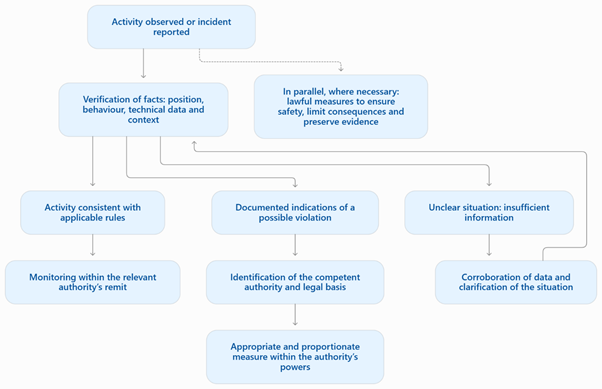
Key: solid arrows indicate the stages of the assessment; the dotted arrow indicates actions that may be carried out concurrently. The diagram is for guidance only and does not replace the procedures of the competent authorities.
Source: own elaboration, based on the legal regime of the EEZ and the issues surrounding the documentation of maritime incidents discussed in the FSM article on liminal maritime aggression. [19]
The diagram highlights the need to base any intervention on verified information and on a legal basis applicable to the specific situation. Unusual activity may require further clarification, without in itself proving the existence of a breach. At the same time, investigations into the cause and liability may continue in parallel with the legal measures available to protect individuals, limit the consequences and preserve evidence. For Neptun Deep, the effectiveness of this process depends on communication between the operator and the authorities and on preparing the decision before an incident occurs.
4.5. Implications for the organisation of protection
An analysis of the EEZ regime reveals three requirements for the protection of Neptun Deep.
The first is the legal preparation for intervention. For foreseeable situations, the powers of the authorities, the necessary information and the conditions for the available measures must be established. Procedures must distinguish between surveillance, communication with the vessel, safety intervention and coercive measures.
The second is the integration of technical and maritime information. It must be possible to cross-reference the operator’s data with the authorities’ information through legal and secure mechanisms. The aim is to verify any anomaly swiftly and to document decisions.
The third is continuity and recovery planning. Uncertainty regarding the perpetrator or cause of an incident must not prevent the authorities and operators from taking the measures legally available to them to protect people, limit pollution and restore operations.
The EEZ regime thus requires protection based on clearly defined responsibilities, verifiable information and coordination. For Romania, strengthening these elements is necessary for the effective exercise of its rights and the maintenance of the national and European benefits associated with Neptun Deep.
5. Disruption to Neptun Deep and the ripple effects on the Strategic Maritime Ecosystem
The legal regime of the EEZ influences the scope for protection, whilst the configuration of the infrastructure determines how the consequences of an incident may propagate to other activities. The analysis must examine the link between the initial event, the affected function and the system’s overall capacity to limit the disruption.
In the case of Neptun Deep, the scale of the consequences would depend on the component affected, the duration of the outage, the timing of the incident and the available alternatives. A controlled shutdown, followed by a rapid resumption of operations, must be distinguished from a breakdown requiring specialised intervention and a lengthy recovery period. Furthermore, the effects on supply must be assessed in relation to demand, stocks and the availability of other sources.
5.1. Convergence and propagation of disruptions
Maritime Strategic Convergence can be observed in the relationship between the operation of facilities, the availability of transport, data integrity and decisions by the authorities. A disruption becomes relevant to the system as a whole when it affects a function on which other components depend and when alternatives cannot be activated quickly enough.
The FSM article ‘Maritime Infrastructure and Global Systemic Risks’ highlights the role of interconnections between infrastructures in transmitting the effects of an incident. The authors focus the assessment on the continuity of the functions supported by these infrastructures and on the capacity to compensate for an unavailable component[20] .
Applied to Neptun Deep, this perspective requires the verification of every assumed link. A production outage does not automatically lead to a supply crisis, just as a technical incident does not necessarily result in military consequences. Between these levels, there are factors that may limit or amplify the effects: the duration of the incident, the possibility of isolating the affected component, the resources available for intervention, and the energy system’s capacity to compensate for the unavailable volumes.
The scenarios below are analytical assumptions. They do not represent an estimate of the probability of incidents and do not describe confirmed technical vulnerabilities of the project.
5.2. Temporary unavailability of a generation or transmission component
The first scenario concerns a fault or breakdown that necessitates the temporary reduction or shutdown of a generation or transmission function. The cause may be technical, accidental or, if evidence confirms it, the result of a deliberate act.
The immediate consequence would depend on the component’s role in the technical process. If the function can be isolated and the rest of the facilities can continue to operate safely, the effects might remain limited. If the unavailability prevents the transfer of production to shore, the consequences could extend to the volumes delivered and to commercial obligations.
At the national level, the assessment should determine the volume of gas unavailable, the estimated duration and the means of compensation. At the regional level, the effects would depend on contracted supplies and the alternatives available to buyers. Any consequences for prices must be analysed in the specific context of the market.
From the perspective of Strategic Maritime Resilience, the key question is how quickly the damage can be contained and the function of the ‘[21] ’ restored. What matters is the availability of expertise, equipment, spare parts and response resources, as well as the time required to authorise and carry out the work. These elements must be prepared in advance of an incident and verified through regular exercises and assessments.
5.3. Loss of confidence in operational data
The second scenario concerns the emergence of discrepancies in the information used for operation or monitoring. These may arise from faults, communication errors, cyber incidents or external interference. Determining the cause requires technical checks.
In such a situation, decision-making may be affected even if the installation has not suffered any physical damage. When the status of the equipment cannot be confirmed, the operator may be forced to scale back operations or implement safe shutdown procedures. Safety therefore also depends on the ability to verify the information through independent sources.
For the system under analysis, a distinction must be made between data relating to the production process and that concerning the maritime situation in the vicinity of the infrastructure. An inconsistency in one system does not prove that the other has been compromised. However, correlating the information can help to contain the incident and avoid decisions based on an incomplete picture.
Relevant measures include data validation procedures, alternative means of communication, record-keeping and the designation of authorised decision-makers in conditions of uncertainty. Their usefulness must be assessed in terms of their ability to maintain safety and reduce the time required to clarify the situation.
5.4. A sequence of ambiguous incidents in the vicinity of infrastructure
The third scenario concerns the accumulation of events which, taken separately, may have legitimate explanations, but which warrant a joint assessment: unusual navigational behaviour, contradictory information, technical alarms or repeated service disruptions.
In the EEZ, the assessment is influenced by freedom of navigation and the need to identify a legal basis for intervention measures. Suspicion may justify intensified checks within the limits of existing powers, but classifying conduct as unlawful requires additional evidence.
The FSM study on liminal maritime aggression is relevant to understanding the pressure generated by repeated incidents that are difficult to attribute. It highlights the costs of uncertainty and the need to correlate technical and legal assessments[22] .
When applied to the Neptun Deep case, a distinction must be maintained between the repetition of events and the demonstration of a coordinated action. Analysing the sequence of events may reveal links that require verification. Conclusions regarding intent and liability must be supported by evidence.
Possible effects include the repeated mobilisation of emergency response resources, preventative shutdowns, additional costs and pressure on decision-makers. Even in the absence of a major incident, the constant use of resources can affect preparedness for other situations. Resilience, in this case, requires procedures that allow for the proportionate verification of alerts and the maintenance of response capacity.
5.5. Disruption to coordination between the operator and the authorities
A fourth scenario concerns the malfunctioning of information exchange and institutional decision-making. The initial incident may be limited, but its effects can be amplified if notifications are delayed, responsibilities are unclear, or technical and legal assessments are not coordinated.
For the offshore–onshore system as a whole, coordination must enable several activities to be carried out simultaneously: ensuring safety, technical verification, environmental protection, documenting the facts and preparing for the resumption of operations. Establishing a definitive cause may take time; some protective measures must be adopted on the basis of available information, within the limits of legal powers.
This scenario shows that protection also depends on the quality of links between institutions. The existence of technical capabilities does not guarantee their timely use. Joint procedures must specify who issues the alert, who validates it, who makes the decisions, and how changes in the situation are communicated.
5.6. Comparative assessment of scenarios
| Scenario | Function affected | Potential extent of the consequences | Capacity to be tested |
| Technical unavailability | Production or transport | Reduced deliveries and economic losses | Fault isolation, intervention and recovery |
| Unreliable operational data | Operation and decision-making | Preventative shutdowns or delayed assessments | Validation of information and alternative communications |
| Repeated ambiguous incidents | Supervision and protection | Cumulative costs and resource consumption | Correlation of incidents and proportionate response |
| Delayed coordination | Institutional intervention | Prolonged disruption and amplified effects | Clear responsibilities and common procedures |
The four scenarios highlight different points at which a disruption can be contained. Physical protection, data verification, legal preparedness and coordination each contribute to overall continuity.
For Romania, the objective is to maintain the capacity to utilise resources and minimise the impact on supply. The European dimension of Neptun Deep adds significance to the continuity of supplies and cooperation with relevant partners. Recommendations must relate to these functions and the specific means by which they can be safeguarded.
6. European and allied responses to the maritime incidents of October 2026: implications for the protection of Neptun Deep
The attacks on commercial vessels in the Black Sea and the European and allied responses in October 2026 are relevant to the assessment of the protection of Neptun Deep. They highlight the difficulty of ensuring the safety of maritime activities in an area where commercial traffic, resource exploitation and security interests overlap. For Romania, the issue concerns the protection of essential economic functions within the framework of the competences recognised by the legal regime of the EEZ.
6.1. The European position and its relevance to Romania’s EEZ
At its meeting on 15–16 October 2026, the European Council condemned attacks on civilian shipping, explicitly mentioning the serious incidents in the Exclusive Economic Zones of Romania and Bulgaria. European leaders described the attacks on civilian shipping as serious violations of international and maritime law and called for the safe passage of ships carrying grain in the Black Sea to be restored.
The explicit reference to the two EEZs is significant for this article. It confirms that incidents occurring outside territorial waters can have consequences that warrant attention and cooperation at European level. However, the European Council’s position does not alter the competences of coastal states nor does it establish a general right to control shipping.
For Neptun Deep, this development reinforces the need to include the protection of energy infrastructure in the European assessment of maritime security. The safety of commercial transport and the continuity of offshore operations depend in part on the same surveillance, communication and response capabilities. A deterioration in navigational conditions may also affect access for support vessels, maintenance and the mobilisation of the resources required for a technical intervention.
The link to the energy project must, however, be demonstrated on a case-by-case basis. Attacks on commercial vessels do not, in themselves, constitute evidence of preparations for an action against Neptun Deep. They do, however, justify a reassessment of risks and a review of protective measures in light of developments in the maritime environment.
European leaders have described these attacks as serious violations of international and maritime law, including the United Nations Convention on the Law of the Sea, and have called for the immediate restoration of safe passage for all civilian and commercial vessels in the Black Sea[23]
6.2. Measures announced by NATO: surveillance and support for investigations
Following the North Atlantic Council’s discussions on 20 October 2026, NATO announced the deployment of additional assets to the Black Sea region. According to statements by Alliance representatives reported by Reuters, these include maritime patrol aircraft, radars and drones, as well as specialist support for the examination of evidence.
The relevance of these measures to Neptun Deep can be assessed by their contribution to the detection and clarification of incidents. Surveillance can facilitate the observation of unusual behaviour and the verification of available information. Technical support for the investigation can help establish the causes and document the facts.
These contributions must be distinguished from the existence of a mission dedicated to the project’s protection. The announcement regarding the reinforcement of regional capabilities is not sufficient to claim that Neptun Deep benefits from a permanent allied protection mechanism. Such a conclusion would require information on the mandate, responsibilities and specific arrangements for cooperation.
For Romania, the practical opportunity lies in aligning these additional capabilities with national requirements for maritime situational awareness. This entails procedures for the exchange of information, the identification of recipient institutions, and the possibility of transmitting relevant data held by the operator to the authorities.
6.3. Protection of infrastructure in the context of freedom of navigation
Recent incidents highlight the difficulty of protecting energy infrastructure within the EEZ. Romania must be able to identify risks and act within the limits of its rights and powers, whilst vessels of other states continue to enjoy freedom of navigation[24] .
In this context, surveillance is valuable for the information it provides to support decision-making. The presence of a vessel, a change of course or an unusual stop must be assessed in the specific circumstances. Moving from observation to a coercive measure requires identifying the applicable legal basis.
Therefore, European and allied cooperation must be accompanied by the legal preparedness of national authorities. For foreseeable situations, the necessary information, the competent authority and the available measures must be established. Clarity on these elements can reduce delays and the risk of insufficiently substantiated decisions.
The FSM article on liminal maritime aggression is useful for explaining the pressure created by ambiguous conduct and the difficulties of attribution. Applied to Neptun Deep, it supports the need to correlate maritime observations with technical and legal assessment, whilst maintaining the distinction between suspicion, documented facts and proven responsibility.
6.4. The application of the concepts of convergence and resilience
From the perspective of Strategic Maritime Convergence, recent responses highlight the link between the safety of navigation, economic activities and security cooperation. The same maritime intelligence may be relevant to the protection of a merchant vessel, the assessment of a risk to offshore infrastructure and the preparation of an intervention. Its usefulness depends on the ability of institutions to verify and utilise it collectively.
For Neptun Deep, the analysis must examine whether this cooperation improves the protection of production, transport and support functions. The number of available resources must be assessed alongside the coverage provided, the continuity of surveillance and the time required to transmit the information to decision-makers.
adds a further requirement: preparedness for situations where an incident occurs despite preventive measures. Detection and investigation must be coordinated with the mitigation of consequences, access for technical teams and the restoration of operations. ’s ability to clarify responsibility and its capacity to restore the affected function must be developed in parallel.
6.5. Implications for the protection of Neptun Deep
The responses in October 2026 support the strengthening of cooperation to protect Romania’s interests in the EEZ. Their application to Neptun Deep must be structured around specific needs: surveillance of the relevant area, incident reporting, preservation of evidence, preparedness for intervention and operational continuity.
The project’s European energy dimension strengthens the case for cooperation. Its potential contribution to energy supply depends on the safe operation of the entire offshore–onshore system and on access to transport infrastructure.
For Romania, the priority is to transform the available regional support into effective protection capacity, through clear responsibilities and proven procedures. In terms of the Strategic Maritime Ecosystem, the intended outcome is to maintain functional relationships between the resource, infrastructure, operator and authorities, including when security conditions deteriorate.
7. Directions for strengthening the protection of the EEZ and the Neptun Deep complex
The scenarios analysed show that the protection of Neptun Deep depends on technical preparedness, clarity of responsibilities and cooperation between operators and authorities. Measures must aim to maintain essential functions and limit the consequences of a disruption, taking into account the legal framework governing each segment of the infrastructure.
Within the Strategic Maritime Ecosystem, these requirements are reflected in the organisation of relationships between the components that support resource exploitation. The recommendations below concern the strengthening of these relationships. They do not imply that existing mechanisms are lacking, but rather highlight aspects that need to be assessed and, where appropriate, improved.
7.1. A joint risk assessment for the entire system
The first approach is a joint assessment of the risks that may affect offshore production, transport to shore and connection to onshore infrastructure. Operators’ technical assessments must be cross-referenced, in accordance with the law and whilst safeguarding sensitive information, with the assessments carried out by the competent authorities.
This approach would enable the identification of interdependencies between components and situations where a local disruption could affect the entire route. For each critical function, the tolerable duration of unavailability, available alternatives and the resources required for recovery must be established.
The joint analysis must distinguish between risks to facilities, risks to transport and the consequences for supply. A measure designed to protect a platform may serve a different purpose from a measure that ensures the temporary compensation of undelivered volumes. Priorities must be established with reference to the protected function and the consequences of its disruption.
7.2. Response procedures adapted to the EEZ regime
The second area concerns the preparation of procedures that link technical information with legal assessment. For foreseeable situations, the competent authority, the legal basis for the measure, the conditions for intervention and the arrangements for cooperation with other institutions must be specified.
The procedures must cover dangerous approaches to installations, breaches of the rules applicable to safety zones, incidents affecting pipelines, and activities whose nature requires clarification. Each situation requires its own assessment. The EEZ regime does not permit the inference of a general power of control over foreign vessels merely on the basis of the importance of the protected[25] infrastructure.
Legal preparation must support timely decision-making. To this end, authorities and operators must be aware of the information required to justify the available measures and the obligations regarding the preservation of evidence. Joint exercises should include scenarios where the cause of the incident is uncertain and safety measures must be adopted before checks are completed.
7.3. Exchange of information between operators and authorities
The third area of focus is the strengthening of notification and information-sharing mechanisms. It must be possible to link data on the operation of installations with relevant maritime information, without unduly disclosing technical or commercial details.
Such a mechanism must specify the types of events to be reported, the recipients, the deadlines and the procedures for confirmation. Rules are also required for updating information when the initial assessment changes.
The FSM study on the operationalisation of the European Maritime Security Hub addresses inter-institutional coordination and the links between transport and security infrastructures. Its relevance to the subject under consideration lies in the opportunity to examine the mechanisms through which existing information and capabilities can be utilised jointly.
National cooperation must be able to function independently of the development of a European mechanism. Any connection to the Hub should add information, expertise and coordination capabilities, based on responsibilities that have already been clarified at the domestic level.
7.4. Response and recovery capacity
The fourth area concerns the resources required to restore affected functions. The assessment must cover access to specialist personnel, equipment, spare parts, inspection services and underwater intervention resources.
For each category of damage, the available resources and the estimated mobilisation time must be known. Where in-house capabilities are insufficient, contractual arrangements or forms of cooperation must be put in place to allow access to specialist support.
The availability of equipment must be verified alongside logistical access, operating conditions and authorisation procedures. An existing capability located at a distance may be of limited use if its mobilisation exceeds the timeframe within which the effects of the incident can be contained.
In the energy sector, recovery plans must be coordinated with measures to ensure continuity of supply. Compensating for unavailable volumes and repairing the facility are complementary activities, with different responsibilities and timeframes.
7.5. Joint exercises and verification of procedures
The fifth area of focus is the regular verification of how operators and authorities work together. Exercises must be structured around specific scenarios: reporting a fault, confirming conflicting data, managing a near-miss, or coordinating a response involving both maritime and land-based elements.
The evaluation of results should focus on notification times, the clarity of decisions, the availability of resources and the continuity of communication. Findings should be translated into procedural changes and measures with designated responsible parties and deadlines.
Exercises involving a series of low-intensity incidents are also useful. These can test whether organisations are able to correlate information and maintain their response capability without treating every anomaly as a confirmed threat.
7.6. European and allied cooperation for specific functions
Neptun Deep’s contribution to European energy supply justifies the development of cooperation on protection and continuity. This must be built around specific needs: information sharing, technical expertise, training, recovery support and the assessment of energy-related consequences[26] .
Forms of cooperation must be differentiated according to the mandate of the participating institutions. European support for resilience, cooperation between coastal states and allied contributions in the field of security can address distinct requirements.
The FSM flagship study provides a framework for examining these links in relation to the actors, infrastructure and functions of the Strategic Maritime Ecosystem. Its application to Neptun Deep must specify what contribution is required and how this fits within Romania’s responsibilities.
The project’s European significance may support prioritising cooperation, but every commitment and every intervention must be aligned with the applicable legal instruments. The common interest in energy security must be translated into clear, verifiable and practical arrangements in specific situations.
7.7. Applying IMSA to the assessment of Neptun Deep’s protection
The findings and recommendations of this article can be synthesised through the adapted application of the Integrated Maritime Security Architecture (IMSA), as proposed in the FSM study. This framework enables an examination of the links between the strategic environment, actors, convergence processes, and adaptation and decision-making mechanisms. In the case of Neptun Deep, these levels are used to verify whether the protection of the offshore–onshore complex fulfils its energy-related functions and complies with the legal conditions under which these operations take place.[27]
Fig 3. Assessment grid for the protection of Neptun Deep using the adapted IMSA framework
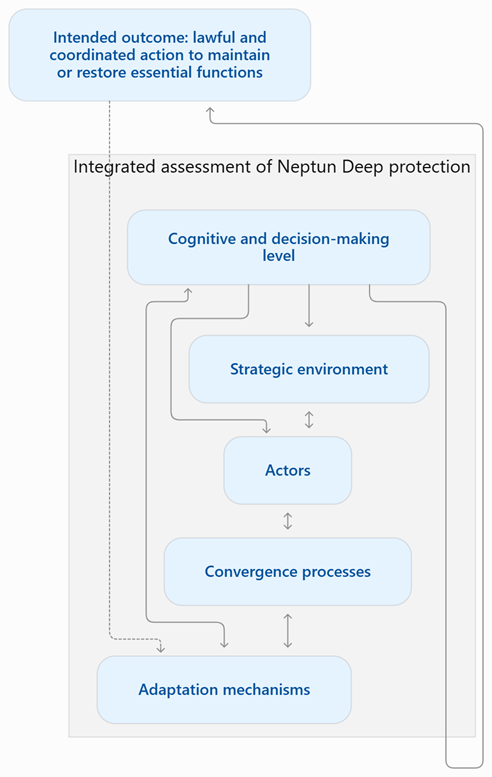
Key: bidirectional arrows indicate interdependencies between the levels of assessment; solid arrows show the influence of decision-making on the organisation of protection; the dotted arrow indicates the use of results to review measures.
Source: adapted by the author from Popa et al., The Strategic Maritime Ecosystem, section 4.9.
The framework enables the examination of protection through the relationships between capabilities and responsibilities. Surveillance must provide information that is usable for decision-making; the decision must have a legal basis and means of enforcement; intervention must be coordinated with the mitigation of consequences and the restoration of the affected function. A difficulty arising in any of these links may reduce the effectiveness of the entire response.
The legal framework of the EEZ influences every level of the assessment. It establishes the scope of Romania’s jurisdiction, the conditions under which measures apply to foreign vessels, and the balance between infrastructure protection and freedom of navigation. Legal preparedness must therefore be incorporated into protection plans and tested in joint exercises.
The European dimension of Neptun Deep is relevant to determining cooperation needs. Support from partners can contribute to surveillance, information exchange, expertise and recovery, subject to the applicable mandates and commitments. The assessment must specify the contribution of each mechanism to the protection of energy functions.
The application of IMSA thus leads to a final question: can the authorities and operators transform the available information into legal, coordinated action that is sufficiently rapid to limit the disruption of essential functions? The answer requires a review of procedures, resources and cooperation in specific situations.
Based on publicly available information, the matrix identifies the requirements that need to be examined. It does not establish the existence of confirmed shortcomings, nor does it assign scores to protective capabilities. The absence of publicly available information about a measure does not prove that it does not exist.
8. Conclusions
The Exclusive Economic Zone is a strategic pillar that must be protected for Romania. The resources, infrastructure and economic activities it supports contribute to the state’s security and development. Neptun Deep amplifies this importance through the prospect of additional gas production and through the links between offshore exploitation, onshore infrastructure and the supply of national and European markets.
Applying the concept of a Strategic Maritime Ecosystem allows for an examination of these links and their implications for protection. The strategic value of Neptun Deep depends on the functioning of the entire system that enables the resource to be utilised: facilities, pipelines, communications, support services and relevant institutions. Security must be organised in relation to the interdependencies between these components and the effects that the unavailability of one might have on the others.
Maritime Strategic Convergence explains how energy benefits are linked to operational safety, transport continuity, information integrity and institutional cooperation. These same links can facilitate the spread of a disruption. The scale of the consequences, however, depends on the duration of the incident, the possibility of isolating the affected component and the available alternatives. The systemic nature of an incident must be demonstrated by analysing these relationships.
The legal regime of the EEZ constitutes one of the essential conditions for protection. Romania exercises sovereign rights and competences determined by jurisdiction within an area where other states enjoy freedoms recognised under the law of the sea. This situation requires a distinction to be made between a vessel’s lawful presence, behaviour requiring verification, and unlawful conduct. Surveillance, the documentation of facts and the legal preparation for intervention must be developed in tandem.
For Neptun Deep, effective protection requires procedures that enable the timely adoption of measures legally available to the authorities and operators. Uncertainty regarding the cause or perpetrator of an incident may persist, whilst the safety of persons, the mitigation of consequences and the preservation of evidence require immediate action. Clarity of responsibilities is, in this regard, a component of protective capability.
Strategic Maritime Resilience focuses the assessment on maintaining and restoring essential functions. Preparedness must include access to response resources, expertise, equipment and logistical support, as well as the regular review of standard operating procedures. Supply continuity must be assessed separately from the restoration of facilities, as the temporary compensation for undelivered gas and the repair of infrastructure meet different requirements.
The responses from Europe and its allies in October 2026 underscore the importance of cooperation for the security of operations in the Black Sea. Applying the available support to the protection of Neptun Deep requires the establishment of concrete contributions and the ways in which these complement national capabilities. The effectiveness of cooperation must be assessed through improvements in the detection, clarification and management of incidents.
The European significance of Neptun Deep stems from its potential contribution to the diversification of supply sources and to the supply of markets connected to Romania. The extent of this contribution will depend on actual production, demand and transmission capacities. The protection of the project therefore has both national and European implications, which justify the development of forms of cooperation with clearly defined responsibilities and objectives.
The assessment remains subject to the forward-looking nature of some of the analysed benefits and to limited access to information regarding specific security measures. The scenarios presented identify issues that need to be examined and capabilities that need to be verified; they do not constitute findings regarding the existence of technical or institutional shortcomings.
For Romania, safeguarding this strategic pillar requires continuity between the exercise of rights within the EEZ, the security of infrastructure and the capacity to exploit resources. Neptun Deep can strengthen energy security and Romania’s position as a regional supplier, provided that its development is accompanied by a capacity for protection and recovery commensurate with the functions it supports.
MARITIME SECURITY FORUM
Bibliography
Studies and articles by the Maritime Security Forum
- Learschi, Sorin, and Aurel Popa. ‘Liminal Maritime Aggression in the Black Sea: Romania at a Crossroads of Energy Security.’ Maritime Security Forum, 10 April 2026. Full text.
- Popa, Aurel, Constantin Ciorobea, Cornel Rogozan, Ioan Crăciun, Ion Custură and Sorin Learschi. Romania’s Maritime Resilience in the Era of Hybrid Threats and the Importance of a Maritime Security Strategy. Constanța: ‘Mircea cel Bătrân’ Naval Academy Press, 2023. Volume available on the FSM website.
- Popa, Aurel, and Sorin Learschi. ‘Maritime infrastructure and global systemic risks. Why the fragility of world trade is the strategic challenge of the 21st century.’ Maritime Security Forum, 17 August 2026. Full text.
- Popa, Aurel, and Sorin Learschi. The Operationalisation of the European Maritime Security Hub in the Black Sea: Romania’s Urgent Institutional Obligations between Strategy, Governance and Capacity. Maritime Security Forum, 2026. Study.
- Popa, Aurel, Sorin Learschi, Constantin Ciorobea and Ioan Crăciun. The Strategic Maritime Ecosystem and the Transformation of the Euro-Atlantic Security Architecture. Ankara 2026 – the turning point in the evolution of contemporary maritime security. Maritime Security Forum, 2026. Study.
Legal Instruments and Case Law
- International Court of Justice. Maritime Delimitation in the Black Sea (Romania v. Ukraine). Judgment of 3 February 2009. I.C.J. Reports 2009, 61. Judgment.
- United Nations. United Nations Convention on the Law of the Sea. Adopted at Montego Bay, 10 December 1982. Entered into force on 16 November 1994. United Nations Treaty Series 1833: 397. Full text.
- Romania. ‘Law No. 17 of 7 August 1990 on the legal regime of Romania’s internal maritime waters, territorial sea, contiguous zone and exclusive economic zone.’ Republished, with subsequent amendments and additions. Legislative Portal. Legislative text.
European documents
- The European Commission and the High Representative of the Union for Foreign Affairs and Security Policy. The European Union’s Strategic Approach to the Black Sea Region. Joint Communication to the European Parliament and the Council. JOIN(2025) 135 final, 28 May 2025.
- European Council. ‘European Council, 15–16 October 2026.’ 16 October 2026. Official page of the meeting.
- Council of the European Union. Council Conclusions on the Revised EU Maritime Security Strategy (EUMSS) and Its Action Plan. Document 14280/23, 24 October 2023. Document.
Sources on the Neptun Deep project
- OMV Petrom. “Neptun Deep – A stronger Romania. With energy from the Black Sea.” Accessed 25 October 2026. Project page.
- OMV Petrom. “Neptun Deep moves towards first gas production, expected in the first half of 2027.” 28 September 2026. Press release.
Press source for NATO measures in October 2026
- Reuters. “NATO to Send Planes and Drones to the Black Sea following Attacks on Shipping.” 20 October 2026. Updated 21 October 2026 . Article.
[1] Chair of the Maritime Security Forum
[2] Director of the Maritime Security Forum
[3] United Nations, United Nations Convention on the Law of the Sea, adopted at Montego Bay on 10 December 1982, entered into force on 16 November 1994, United Nations Treaty Series 1833: 397, Articles 55–58, 60 and 77–80.
[4] OMV Petrom, ‘Neptun Deep moves towards first gas production, expected in the first half of 2027’, 28 September 2026, https://www.omvpetrom.com/ro/media/stiri-recente/2026/neptun-deep-avanseaza-catre-prima-productie-de-gaze-preconizata-pentru-prima-jumatate-a-anului-2027
[5] Aurel Popa, Sorin Learschi, Constantin Ciorobea and Ioan Crăciun, The Strategic Maritime Ecosystem and the Transformation of the Euro-Atlantic Security Architecture. Ankara 2026 – the turning point in the evolution of contemporary maritime security (Maritime Security Forum, 2026), Chapter 4, Sections 4.1–4.5.
[6] Popa et al., The Strategic Maritime Ecosystem, Chapter 4, Sections 4.5–4.6.”
[7] Popa, The Strategic Maritime Ecosystem, Chapter 4, Sections 4.1 and 4.5.
[8] https://www.forumulsecuritatiimaritime.ro/wp-content/uploads/2026/07/CONVERGENTA-STRATEGICA-MARITIMA-SI-TRANSFORMAREA-ARHITECTURII-DE-SECURITATE-EURO-ro-1.pdf
[9] Aurel Popa and Sorin Learschi, ‘Maritime infrastructure and global systemic risks. Why the Fragility of Global Trade is the Strategic Challenge of the 21st Century’, Maritime Security Forum, 17 August 2026, section ‘From Protecting Infrastructure to Safeguarding the Continuity of Global Functions’, https://www.forumulsecuritatiimaritime.ro/infrastructura-maritima-si-riscurile-sistemice-globale/.
[10] United Nations, United Nations Convention on the Law of the Sea, Articles 56, 58, 60, 77 and 78.
[11] OMV Petrom, ‘Neptun Deep is moving towards its first gas production, expected in the first half of 2027’.
[12] Sorin Learschi and Aurel Popa, ‘Liminal Maritime Aggression in the Black Sea: Romania at a Crossroads of Energy Security’, Maritime Security Forum, 10 April 2026, section ‘The Neptune Deep Junction Point and Vulnerability’, https://www.forumulsecuritatiimaritime.ro/liminal-maritime-aggression-in-the-black-sea-romania-at-a-crossroads-of-energy-security/.
[13] United Nations, United Nations Convention on the Law of the Sea, Article 56(2) and Article 58(1)–(3).
[14] United Nations, United Nations Convention on the Law of the Sea, Article 58(2), read in conjunction with Articles 92 and 110. The assessment of a control measure must take into account the special powers of the coastal State, the status of the vessel and any applicable treaty provisions.
[15]The delimitation must be notified, and vessels are obliged to respect the zones thus established. United Nations, United Nations Convention on the Law of the Sea, Article 60(4)–(7) and Article 80; Romania, Law No. 17/1990, Article 16.
[16] United Nations, United Nations Convention on the Law of the Sea, Article 79(4).
[17] United Nations, United Nations Convention on the Law of the Sea, Article 58(1), Article 78 and Article 79(4).
[18] Learschi and Popa, ‘Liminal Maritime Aggression in the Black Sea’, sections ‘Legal Ambiguity: Law Enforcement at Sea versus the Use of Force’ and ‘Guidance Protocol for Responding to Sabotage or a Major Incident’.
[19] United Nations, United Nations Convention on the Law of the Sea, Articles 56, 58 and 60.” https://www.un.org/depts/los/convention_agreements/texts/unclos/part5.htm
[20] Popa and Learschi, ‘Maritime Infrastructure and Global Systemic Risks’, sections ‘Strategic Maritime Convergence: the mechanism of vulnerability propagation’ and ‘From protecting infrastructure to safeguarding the continuity of global functions’.
[21] For the conceptual framework of the assessment, see Popa et al., The Strategic Maritime Ecosystem, Chapter 4, Section 4.6.
[22] Learschi and Popa, ‘Liminal Maritime Aggression in the Black Sea’, sections ‘Legal Ambiguity: Law Enforcement at Sea versus the Use of Force’ and ‘Guidance Protocol for Responding to Sabotage or a Major Incident’.
[23] European Council, European Council meeting (15 and 16 October 2026) – Conclusions, EUCO 14/26, 16 October 2026, para. 17, https://www.consilium.europa.eu/media/4tglqede/en-20261016-european-council-conclusions.pdf.
[24] United Nations, United Nations Convention on the Law of the Sea, Articles 56 and 58; for jurisdiction over offshore installations and safety zones, Articles 60 and 80.
[25] United Nations, United Nations Convention on the Law of the Sea, Articles 56, 58 and 60, as well as Articles 92 and 110, applicable in the EEZ subject to the conditions set out in Article 58(2).
[26] For the general European framework for maritime cooperation, see the Council of the European Union, Council Conclusions on the Revised EU Maritime Security Strategy (EUMSS) and Its Action Plan, annex on the revised strategy and action plan; the European Commission and the High Representative, The European Union’s Strategic Approach to the Black Sea Region.
[27] Popa et al., The Strategic Maritime Ecosystem, Chapter 4, Sections 4.9–4.10. The adaptation of the IMSA levels and the formulation of the assessment questions for the Neptun Deep–Tuzla complex are the work of the authors of this article.