


Romania: Between a Theoretical Threat and a Layered Defence-Comprehensive assessment of the risk posed by Iranian and Russian missiles, the limitations of air defence, and the strategic implications for Romania
STUDY: MARITIME SECURITY FORUM
AUTHORS: Admiral (ret.) PhD. Aurel POPA, Captain (ret.) PhD. Sorin Learschi
A serious strategic analysis must do more than merely list weapon systems: it must link technical data to the strategic behaviour of the actors, the relevant geography, the logic of layered defence, and the economic constraints of modern warfare.
The general premise remains this: Romania must be analysed simultaneously from the perspective of its exposure to ballistic, cruise and unmanned systems originating from two distinct directions, namely the Middle East and the Russian Federation. From Iran, the issue is predominantly theoretical, though not imaginary; from Russia, the issue is closer to the realm of a demonstrated threat, as many of the relevant systems have already been used in the war against Ukraine. It is precisely this dual perspective that calls for a cautious approach. Declared capability must not be confused with demonstrated capability, and geometric range must not be confused with strategic probability of use.[1]
From a methodological standpoint, the analysis consistently distinguishes between three categories of information. The first comprises publicly confirmed data, i.e. those elements supported by official sources, NATO documents, recognised defence reports or verifiable Reuters articles. The second category consists of credible analytical assessments, often derived from specialised projects such as the CSIS’s Missile Threat, which provide plausible figures for range, payload or operational status, without, however, claiming absolute certainty. The third category includes reported claims, particularly those derived from statements by interested parties or from conflicting information sources. This distinction is essential in security studies, as in the field of missile defence the difference between ‘claimed’ and ‘demonstrated’ has direct strategic consequences.
1. The Iranian dimension: between extensive capability and operational uncertainty
In assessing the risk posed by Iran, the first necessary observation is that, according to specialist assessments, Tehran possesses the largest and most diverse missile arsenal in the Middle East. This arsenal comprises thousands of ballistic and cruise missiles, some of which are considered capable of reaching eastern or south-eastern Europe. This does not mean that Romania is under an imminent threat or that any Iranian system can be used with the same effectiveness across its entire declared range. It does, however, mean that analysing the theoretical exposure of Romanian territory is legitimate and indeed necessary, especially given that the distances between certain areas of Iran and south-eastern Europe fall within the range typical of medium-range ballistic missiles.[2]
In this regard, the systems most frequently cited are the Sejjil, Emad, Ghadr and Khorramshahr. They do not share the same technological maturity, the same operational certainty, nor the same relevance for Romania. Sejjil is significant primarily because it uses two-stage solid fuel, which, in military terms, reduces the reaction time between order and launch and makes the system more suitable for survivability and mobility than liquid-fuelled missiles. CSIS indicates a range of approximately 2,000 km and a warhead of around 700 kg for the Sejjil, but notes at the same time that the system’s operational status remains uncertain. For this very reason, in a rigorous analysis, the Sejjil should not be treated as a ‘mass-produced’ system, but rather as a delivery system of high strategic relevance and with a still significant degree of ambiguity.[3]
Emad and Ghadr essentially belong to the advanced Shahab-3 family. The differences between them mainly concern structural improvements, the re-entry profile and relatively better accuracy compared to previous generations. Ghadr is cited in the specialist literature as having a range of approximately 1,950 km, whilst Emad is described as a variant with improved guidance within the same general class. For Romanian territory, their relevance lies not in operational certainty of a strike, but in the fact that, from a geometric and technical perspective, they fall into the category of systems that must be taken into account when discussing the ballistic defence of the south-eastern flank.[4]
Khorramshahr occupies a special position. In official Iranian discourse, it often appears as a symbol of technological progress and the ability to carry significant payloads. CSIS records a range of 2,000 km and a payload capacity of up to 1,800 kg, but explicitly warns that some Iranian claims regarding ‘multiple payloads’ should not be automatically interpreted as a mature MIRV capability, i.e. the ability to launch multiple independent warheads comparable to that of the major nuclear powers. Therefore, the correct formulation is that there are Iranian claims regarding multiple warhead configurations, but public evidence does not firmly support the attribution of an operational MIRV capability.[5]
At the same time, the analysis cannot ignore the cruise missile component. Soumar, followed by subsequent developments such as Hoveyzeh, represents a different type of threat from ballistic missiles. Whilst the ballistic missile exerts pressure through speed and an exo-atmospheric trajectory, the cruise missile exerts pressure through low-altitude flight, more flexible flight paths, and the difficulty of radar detection at long ranges. The methodological issue, however, is that the Soumar’s range remains controversial. Although figures ranging from 2,000 to 3,000 km have frequently circulated in the public domain, the CSIS technical analysis suggests that the publicly presented variant likely does not reach the maximum range initially claimed, and treating it as a missile definitively capable of 3,000 km is excessive.[6]
Added to these is the Shahed-136 drone, which should not be confused with a ballistic missile or a conventional cruise missile. Its strategic relevance lies elsewhere: its low cost, relative ease of production, the possibility of launching in large salvos, and the ability to wear down the enemy’s defences through logistical and psychological exhaustion. CSIS has convincingly demonstrated, both in its analyses of Russia’s ‘ ’ Shahed campaign and in studies on the cost of air defence, that drones of this type have become saturation weapons, not merely platforms for pinpoint strikes. In relation to Romania, this means that the discussion about Iran concerns not only the range of a missile to a specific point on the map, but also the military economics of modern defence.
Table 1. The main Iranian systems relevant to the theoretical assessment of Romania’s exposure
| System | Type | Estimated range | Payload / observations | Level of certainty |
| Sejjil | MRBM, solid fuel, two-stage | ~2,000 km | ~700 kg; operational status unclear | assessed |
| Emad | MRBM, Shahab-3 variant | ~1,700–2,000 km | improved guidance; relevance to South-Eastern Europe | assessed/partially confirmed |
| Ghadr | MRBM, Shahab-3 variant | ~1,700–1,950 km | superior performance to previous generations | partially assessed/confirmed |
| Khorramshahr | MRBM, liquid fuel | ~2,000 km | up to ~1,800 kg; claims regarding multiple warheads remain controversial | assessed |
| Soumar / Hoveyzeh | land-based cruise missile | under 2,500 km in conservative estimates | low-altitude flight; range disputed in open sources | assessed |
| Shahed-136 | UAS / loitering munition | long range, mission profile dependent | saturation weapon, low cost | confirmed as a threat type |
2. Diego Garcia and the limits of strategic inference
One of the issues that needed to be clarified unequivocally in the original document concerned the so-called attack on the Diego Garcia base. In the raw form of the material, the episode was used almost as definitive proof that major European capitals are already under direct and certain threat. Such a conclusion goes too far. What can be said with certainty is this: on 21 March 2026, Reuters reported that, according to the semi-official Iranian news agency Mehr, Iran had launched two ballistic missiles at the US-British base on Diego Garcia. The same report stated, citing the Wall Street Journal, that the base had not been hit. Two days later, Reuters also reported the position of British Prime Minister Keir Starmer, according to whom London saw no evidence that Iran was targeting the UK.7
The significance of the episode is important, but it must be interpreted. The fact that a base located at a great distance was targeted by a publicly reported launch suggests an intention to send a strategic signal and, possibly, a practical test of certain technological or operational limits. However, it does not, on its own, justify the conclusion that the whole of Europe is already exposed to a robust, reproducible and precisely demonstrated operational threat. More specifically, the incident reduces the margin of analytical comfort and necessitates a reassessment of certain scenarios, but it does not transform a risk assessment into a strategic certainty. For Romania, the useful conclusion is not alarmism, but the need to understand that the boundary between ‘theoretical’ and ‘practically possible’ can shift relatively quickly when an actor invests heavily in longer-range delivery systems and strategic signalling doctrines.
3. The Russian dimension: demonstrated threat, propaganda and the selection of relevant criteria
Whilst the Iranian dimension calls for caution due to the gap between what is declared and what is demonstrated, the Russian dimension calls for a different form of caution: distinguishing between systems of genuine military utility and those used primarily for intimidation, propaganda or political signalling. In relation to Romania, the assessment should not start with the systems that attract the most media attention, but with those that have already produced repeated operational effects in the Ukrainian theatre.
In this respect, the Iskander-M remains the main benchmark. It is a mature, mobile system, used extensively by Russia and difficult to intercept due to the combination of its trajectory, manoeuvrability, short warning time and the flexibility of its launch platform. Although its typical range of approximately 500 km does not make it an intercontinental strategic threat, it is relevant to Romania precisely because it represents a realistic assessment of the Russian tactical ballistic threat in the vicinity of the eastern flank. In the analysis of a Black Sea littoral state, the Iskander-M matters more than many exotic systems that are much discussed but have been used rarely, opaquely or controversially.
The Kh-101 and Kalibr, for their part, remain benchmark systems for analysing the cruise missile threat. Both have demonstrated long-range strike capability, but neither should be idealised. In the practice of warfare, their performance depends on the quality of production batches, maintenance, jamming, navigation and the specific manner of integration into attack waves. Analytical reports on the Russian strike campaign have shown that the effectiveness of these systems cannot be reduced to the declared maximum range or a theoretically optimal CEP; what matters is the production rate, the reliability of the batches and the ability to be used in a prolonged attrition campaign. For this reason, the comprehensive document avoids overly optimistic figures regarding the Kalibr’s accuracy and prefers more cautious phrasing, such as ‘demonstrated long-range strike capability, with performance varying according to the operational context’.[7]
Regarding hypersonic or quasi-hypersonic systems, such as Zircon or Oreshnik, the correct approach is to maintain a critical distance from official rhetoric. Russia has an interest in projecting an image of a qualitative technological advantage that discourages Western support for Ukraine and amplifies the perception of European vulnerability. Analysis, however, must focus on what is demonstrated, not what is proclaimed. Some uses of the Zircon have been reported, but their volume, military effect and degree of operational maturity do not justify elevating it to the ‘backbone’ of the threat. All the more so, the Oreshnik missile cannot be treated as a fully understood system in the absence of robust independent verification of its parameters. The accurate assessment is that Russia continues to experiment with and exploit the hypersonic category for propaganda purposes; however, for Romania’s defence, the immediate and quantitative threats remain primarily tactical ballistic missiles, cruise missiles and drones.
Table 2. Russian systems relevant to the risk assessment for Romania
| System | Category | Range / profile | Demonstrated use | Analytical observation |
| Iskander-M | tactical ballistic missile | ~500 km; manoeuvrable trajectory | extensive in Ukraine | realistic benchmark of the tactical threat |
| Kh-101 | air-launched cruise missile | ~2,500–2,800 km | proven | high strategic utility, performance dependent on production and navigation |
| Kalibr | naval cruise missile | ~1,500–2,500 km | demonstrated | relevant to the Black Sea; avoidance of overly optimistic CEP figures |
| Zircon | hypersonic / anti-ship missile | parameters still disputed in open sources | reported limited | more caution than certainty |
| Oreshnik | reported / experimental system | incomplete public data | controversial | analytical value inferior to official rhetoric |
4. The arithmetic of distance is not strategy: why theoretical exposition must be separated from intention and effectiveness
One of the common errors in public debates about missiles is the mechanical deduction that ‘if the range reaches that far, then the target is already completely vulnerable’. In reality, the threat is built up from several layers.
The first is the geometric layer: can a particular missile, under ideal conditions, reach a specific area of Romanian territory?
The second is the technical layer: can it do so with a relevant warhead, on a realistic flight path and with sufficient accuracy?
The third is the operational layer: are there sufficient systems available, trained personnel, launch platforms, command-and-control and logistical support to turn this possibility into a repeatable option?
The fourth is the political layer: does the actor in question have the strategic intent, freedom of action and cost-benefit calculation necessary for such a strike?
Applied to Romania, this framework leads to a measured conclusion. Yes, certain Iranian systems may enter the equation regarding the exposure of south-eastern Europe. Yes, Russia possesses proven systems capable of affecting the vast expanse of the eastern flank. But not every system with sufficient range automatically constitutes an equal and immediate operational threat. A mature analysis must resist the temptation to turn range maps into political prophecies. Precisely for this reason, the scope of this document devotes more space to distinguishing between declared capability, assessed capability and demonstrated capability. Without this distinction, any technical table becomes a source of strategic confusion.
5. Romania’s defensive architecture: real capabilities, real limitations
Romania possesses a defensive architecture that is significantly more robust than the alarmist public discourse suggests, but it is neither omnipotent nor evenly distributed. The central element of the discussion is the Aegis Ashore system at Deveselu, integrated into NATO’s ballistic missile defence architecture. NATO has made it clear that the site in Romania, modernised in 2019, is a defensive component designed to intercept short- to medium-range ballistic missiles. It is therefore necessary to explicitly correct the claim that Aegis Ashore, in its current configuration, constitutes a general response to cruise missiles or hypersonic glide vehicles. This is not its primary function.[8]
The technical core of the system lies in intercepting ballistic threats during the mid-course phase of the trajectory, that is, in a segment where the target is still following a relatively predictable trajectory outside the atmosphere or at its edge. SM-3 interceptors use the principle of direct kinetic impact, which explains why the system was designed for ballistic threats, not for targets that fly low, follow the terrain or manoeuvre in a manner incompatible with the engagement profile for which it was optimised. In simple terms, the ‘shield’ at Deveselu is indispensable to the equation of ballistic defence of the south-eastern flank, but it cannot be rhetorically transformed into a universal umbrella for all categories of threats.
The second pillar of the architecture is the Patriot systems. Reuters reported in September 2024 that Romania had received four Patriot systems, two of which were operational at the time, in the context of the debate regarding the donation of a battery to Ukraine and its replacement by allies. From this perspective, the Patriot must be treated as an essential national layer, not as a miracle solution. It is effective against both tactical ballistic missiles and aerodynamic targets, but its actual effectiveness depends on deployment density, the stock of interceptors, integration with sensors, and rules of engagement. Particularly in saturation scenarios, its performance cannot be assessed in the abstract, but only in relation to the volume, rate and composition of the attack wave.[9]
The lower layer of defence has also seen significant reinforcement. In July 2025, Romania signed a framework agreement for six integrated SHORAD-VSHORAD systems supplied by Rafael, with an explicit role in defending against low- and medium-altitude air threats. In November 2025, Reuters also reported the signing of an agreement for 231 Mistral man-portable systems and 934 missiles, along with training, a dedicated simulator and logistical support. These details are important because they allow the vague talk of ‘layering’ to be replaced with a factual description of an ongoing strengthening. Conversely, systems such as NASAMS should not be included as a definite part of the Romanian inventory without similar official public confirmation. Such insertions, present in the raw material, undermine precisely the accuracy that the study claims to uphold.[10],[11]
Table 3. Romania’s defence in layers: functions and limitations
| Layer | System / category | Dominant role | Main limitation |
| NATO BMD | Aegis Ashore Deveselu | interception of short- to intermediate-range ballistic missiles within the allied architecture | not designed as a general response to cruise missiles and HGVs |
| Long-range national defence | Patriot | protection against certain tactical ballistic missiles and aerodynamic targets | Deployment density and the stockpile of interceptors are decisive factors |
| SHORAD/VSHORAD | systems procured from Rafael; Mistral MANPADS | low-altitude defence, protection of infrastructure and specific targets | limited territorial coverage, dependence on C2 integration |
| Air component and sensors | aviation, radars, NATO integration | detection, warning and flexible response | does not replace, but complements ground-based defence |
6. Saturation attack, the cost of interception and the problem of defensive density
In reality, air and missile defence is constrained simultaneously by three factors: the ability of sensors to rapidly detect and classify targets, the ability of command to correctly prioritise engagement, and the logistical capacity to sustain the consumption of interceptors. Contemporary attacks increasingly employ a mix of ballistic missiles, cruise missiles, kamikaze drones, electronic decoys and delivery systems with vastly differing costs, precisely to create overload across all three of these dimensions.
The concept that must be explicitly introduced here is the cost-exchange ratio. An adversary does not merely seek to penetrate the defence; they seek to force the defence to spend disproportionately on each engagement. When a relatively cheap drone or a one-way attack munition forces the defender to use valuable interceptors, the adversary’s victory lies not only in the possibility of a direct hit, but also in the economic and logistical erosion of the defensive shield. In its analysis of the costs of the first hundred hours of a major conflict with Iran, CSIS estimated that modern air defence can very quickly become a matter of financial and industrial sustainability, not merely one of technical performance.[12]
For Romania, this observation is all the more important given that the territory is relatively large, critical infrastructure is dispersed, and defensive density cannot be uniform. To say that Romania has ‘layered’ defence is correct in doctrinal terms, but insufficient in operational terms. What matters is where the systems are actually deployed, which sectors can be covered simultaneously, how long reloading takes, what level of redundancy exists in the sensor network, and how integration with the NATO network is achieved. A country may have several high-performance systems and yet remain exposed in other sectors if the deployment density is insufficient or if the volume of the attack exceeds the capacity to respond.
Furthermore, saturation attacks alter the nature of the discussion regarding effectiveness. Under test conditions or in point-engagement scenarios, a system’s success rate may appear very high. In wartime conditions, when multiple waves, decoys, jamming and time constraints overlap, actual operational effectiveness may differ significantly. For this reason, figures such as ‘97%’ for certain portable systems should not be automatically transferred from marketing or testing to strategic analysis. They may be mentioned, but only as indicators of experimental performance, not as operational guarantees.
7. The air component, command and control, and the role of NATO integration
The performance of a layered defence depends equally on command and control, data fusion and the air component. A Patriot system or a high-performance SHORAD is worth far less if it is not fed with accurate and timely data. That is why Romania’s integration into NATO structures represents not merely a political context, but an operational multiplier. From early warning to the recognised air picture, the added value of belonging to the allied architecture lies precisely in shortening the time between detection, classification, decision-making and engagement.
This does not mean, however, that integration automatically solves all problems. An integrated system can enhance effectiveness, but it cannot compensate for a lack of air density, a shortage of interceptors, or the vulnerability of critical infrastructure. Furthermore, the air component has its limitations. Combat aviation can contribute to air policing, deterrence and a flexible response, but it cannot replace point defence nor the continuous deployment of a large number of inexpensive drones. The lessons of the war in Ukraine show precisely that the defence of the future will increasingly combine expensive, high-performance systems with cheaper, mobile and distributed solutions, ranging from modernised anti-aircraft guns to electronic warfare and low-cost-per-shot systems.
8. Strategic significance for Romania: beyond the inventory of systems
The essential question is not, in essence, whether Romania ‘has’ or ‘does not have’ a defence, but how the Romanian state’s strategic position should be understood in a security environment where the proliferation of long-range delivery systems, the emergence of saturation campaigns and the convergence of missiles and UAS are changing the rules of the game. From Iran’s perspective, the major implication is that south-eastern Europe can no longer be treated as a space implicitly outside the equation of medium-range missiles. Even if Romania is not currently a likely target in a direct scenario, the mere fact that certain Iranian systems can enter the relevant theoretical range changes the way in which flank ballistic defence must be conceived. From Russia’s perspective, the significance is even clearer: the eastern flank is already living under the conditions of a demonstrated threat, in which missiles, drones and pressure on civilian infrastructure are common instruments of coercion.
In this context, Romania should be analysed less through the static logic of inventory and more through the logic of resilience. What becomes relevant is not just the number of systems, but also the rate of replenishment of stocks, sensor redundancy, unit mobility, dispersal capability, the protection of energy infrastructure and command nodes, as well as the extent to which national capabilities can be rapidly integrated into the allied operational picture. A 21st-century defence is not merely about having high-performance systems; it involves being able to sustain, deploy, and coordinate these systems under the pressure of a campaign of attrition.
9. Three working scenarios for risk assessment
To avoid both underestimation and exaggeration, it is worth formulating three working scenarios. The first is the limited strike scenario, in which a small number of assets are used for a political signal, a demonstration of reach, or psychological pressure. In this case, Romania’s existing architecture and its integration with allies provide relatively favourable conditions for warning and response, and the primary value of defence lies in deterrence and reducing the likelihood of success of such an action.
The second is the combined attack scenario, in which ballistic missiles, cruise missiles and drones are used together against specific targets or critical infrastructure. This is where the real challenges of layered defence arise: prioritisation, the differentiated and selective use of interceptors, coordination between levels and the management of tactical uncertainty. For Romania, this is perhaps the most useful analytical scenario, as it corresponds to current trends in regional warfare and in medium- to high-intensity conflicts.
The third is the prolonged saturation scenario. In this scenario, the issue is no longer merely whether a particular wave can be repelled, but whether the defensive system can withstand a protracted campaign of attrition, in which stocks, maintenance, personnel and command infrastructure become targets in their own right. Here, industrial resilience, allied cooperation and the ability to replenish stocks are almost as important as the performance of the interceptors themselves. The general lesson is that Romania’s defence must be designed not just for the moment of the strike, but for the duration of the campaign.
Combating a ballistic missile across the three segments of its trajectory
A ballistic missile is not countered by a single universal system, but by a layered defence system, in which each phase of flight opens a different window for detection and interception. In doctrine, the three relevant phases are the boost phase, the midcourse phase, and the terminal re-entry phase. Each of these involves a different relationship between reaction time, altitude, trajectory predictability, and the type of interceptor that can be used. NATO describes the European missile defence architecture precisely in terms of this layered defence logic, and the Aegis Ashore component in Romania is intended for the interception of ballistic missiles, not for general defence against all types of air threats.
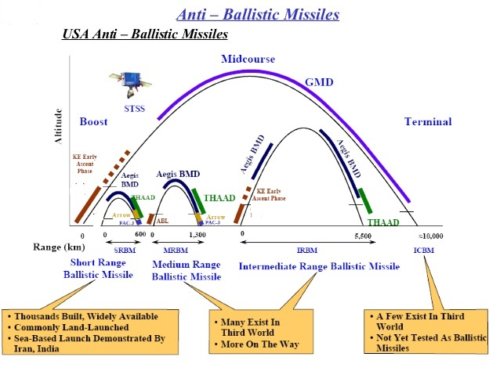
Categories of ballistic missiles
- Tactical ballistic missiles with a range of 50–110 km, usually fuelled by solid propellant and unguided. They may carry conventional or nuclear warheads.
- Short-range ballistic missiles (SRBM) with a range of less than 1,000 km.
- Medium-range ballistic missiles (MRBM) with a range of 1,000–5,500 km.
- Intercontinental ballistic missiles (ICBMs) with a range of 5,500–12,000 km.
Trajectory and its phases. Interception zones.
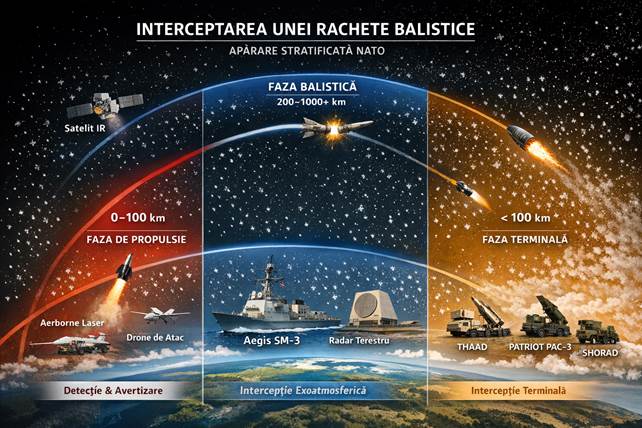
During the propulsion phase, the missile is easiest to detect, as the engine is running, the thermal signature is very intense, and the missile body is still large and relatively simple in terms of target discrimination. From a theoretical perspective, this is the optimal interception phase: early destruction prevents the mission from continuing and avoids the problem of warhead or decoy separation. However, it is precisely this window that is the most difficult to exploit in practice, as it lasts for a very short time — generally between one and a few minutes — and the interceptor or strike platform must be very close to the launch site. For this reason, boost-phase defence has remained more of a conceptual or experimental solution, historically associated with ideas such as space-based infrared sensors, interceptors positioned very close to the launch area, or directed-energy weapons, rather than a current and robust European solution. American doctrinal sources highlight precisely this paradox: the phase is highly favourable from a physical standpoint, but rarely accessible from a geographical and operational perspective.
In practice, a ballistic missile launched from the Middle East towards Europe would be very difficult for European states to counter during the propulsion phase, precisely because they do not normally have interception platforms positioned close enough to the launch area. However, countries in the missile’s flight path, such as Greece, Turkey, etc., do have systems capable of countering it. In such a scenario, the European contribution is more one of early warning and tracking, via allied radar networks and sensors, than of immediate effective interception. Therefore, the boost phase must be described in the study as being ‘the most advantageous in theory, but the least accessible in practice’ for European defence.
In the mid-course phase, after propulsion ceases, the missile follows a ballistic trajectory at very high altitudes, often exo-atmospheric. This is the phase in which NATO and US architectures are best suited for defence against short-, medium- and intermediate-range ballistic missiles. The central system for this stage is the Aegis Ballistic Missile Defence system, in both its naval and land-based Aegis Ashore versions, including the site at Deveselu. NATO explicitly states that Aegis Ashore in Romania forms part of the allied ballistic missile defence system, and Reuters has summarised the same European architecture by including the Aegis Ashore sites in Romania and Poland, the Aegis destroyers permanently stationed at Rota, and the early warning radar in Kürecik, Turkey.
The typical interceptor for this phase is the SM-3, which uses the hit-to-kill principle, i.e. the destruction of the target through direct kinetic impact, rather than a conventional explosive warhead. This method is optimised precisely for intercepting ballistic missiles during their midcourse flight, before re-entry into the atmosphere. The major advantage of the midcourse phase is that the engagement window is longer than in the boost phase, and the trajectory is relatively predictable. The disadvantage is that discrimination issues arise: in space, the defence system must distinguish between the actual target to be struck and any associated objects, debris or decoys. For this reason, the midcourse phase is not just a matter of the interceptor, but also of sensors, data fusion and command and control.
For Romania, this is the most relevant phase from the perspective of the broader NATO architecture. The correct formulation for the study is that the first real barrier against a ballistic missile launched from a great distance is midcourse defence, where Aegis Ashore and allied sensors provide the capability for detection, tracking and, under certain conditions, interception. In other words, whilst the boost phase is largely beyond Europe’s reach, the midcourse phase is the central doctrinal focus of allied missile defence in Europe.
In the terminal phase, the missile or re-entry vehicle re-enters the atmosphere and descends towards the target at very high speed. This is the last possible moment for defence. Precisely for this reason, the terminal phase is considered the most dangerous for the defender: the reaction time is very short, the interception geometry is much more severe, and any error or delay can mean the loss of the last opportunity for neutralisation. US strategic analysis sources describe terminal defence as the ‘last shot at interception’, i.e. the last real chance to stop the threat. The latest technical modifications to missiles make it possible to perform course changes, which poses a problem for fire control systems and, above all, for the interceptor’s manoeuvring.
The systems associated with this phase are primarily the Patriot PAC-3 / PAC-3 MSE and THAAD. Lockheed Martin describes the PAC-3 and PAC-3 MSE as interceptors capable of defending against tactical ballistic missiles, cruise missiles and aircraft through direct contact, hit-to-kill, whilst the MSE version extends the interceptor’s combat range and performance. THAAD, in turn, is officially presented as an effective defence against short-, medium- and intermediate-range ballistic missiles in the terminal phase of the ‘ ’, at higher altitudes than Patriot. In simple terms, THAAD covers the upper part of the terminal defence, and Patriot the lower part, closer to the defended area.
Another layer of defence is provided by NASAMS: Romania’s “drone hunter”
NASAMS (Norwegian Advanced Surface-to-Air Missile System) is a medium-range surface-to-air system developed by the Norwegians at Kongsberg in collaboration with Raytheon. Romania acquired this system to fill the gap between Patriot (long range) and portable systems such as the Stinger or Mistral.
| Features | Details |
| Manufacturer | Kongsberg (Norway) & Raytheon (USA) |
| Main missile | AIM-120 AMRAAM (the same missile used by F-16 aircraft) |
| Range | Up to 40–50 km (depending on variant) |
| Maximum altitude | Up to 15–20 km |
| Interception capacity | Up to 72 targets simultaneously (one complete system) |
NASAMS is specifically designed for low-flying threats with a low radar signature, precisely the category into which Shahed drones and cruise missiles fall.
- AIM-120 AMRAAM missile: Uses the same type of missile as F-16 aircraft. It has an active radar guidance system, meaning that once launched, it ‘sees’ the target itself, without requiring continuous radar illumination. It is extremely accurate;
- Modern radars: The system uses AN/MPQ-64 Sentinel or Giraffe radars, specialised in detecting small, slow-moving targets flying at low altitude (helicopters, drones, cruise missiles);
- Mobility: NASAMS is a modular and mobile system. Unlike Aegis Ashore (fixed) or Patriot (more cumbersome), NASAMS can be rapidly redeployed to protect critical infrastructure depending on the threat;
- Reaction speed: It can intercept 11 missiles in less than two minutes after detecting a threat, being optimised for rapid, saturated attacks (large volumes of drones/missiles).
Romania’s air defence is built on multiple layers (layered), and NASAMS occupies the ‘middle’ layer:
Distribution of missile defence layers
- Layer 1 – Long range Patriot Interception of ballistic missiles and high-altitude aircraft Up to 150 km
- Layer 2 – Medium range NASAMS Interception of drones, cruise missiles and low-altitude aircraft Up to 40–50 km
- Layer 3 – Short range Mistral 3 / Stinger Point defence of critical targets (last line of defence) Up to 7–8 km
As mentioned earlier, the main challenge in defending against cheap drones is the economics of warfare. NASAMS addresses this issue better than Patriot:
- Patriot (PAC-3): Cost per interception ~ $4 million. It is designed for ballistic missiles, not drones;
- NASAMS (AIM-120 AMRAAM): Cost per interception ~ $1–1.5 million. Although still expensive compared to a Shahed drone, it is 3–4 times cheaper than Patriot;
- The ideal solution: Electronic warfare (EW) and directed-energy weapons (lasers) remain the ultimate goal to reduce the cost to a few dollars per kill.
Until then, NASAMS represents the most effective ‘kinetic’ solution for these threats.
In conclusion, Romania has in NASAMS a specialised system for “shooting down” drones and cruise missiles. It operates in coordination with Patriot, the air force and portable systems.
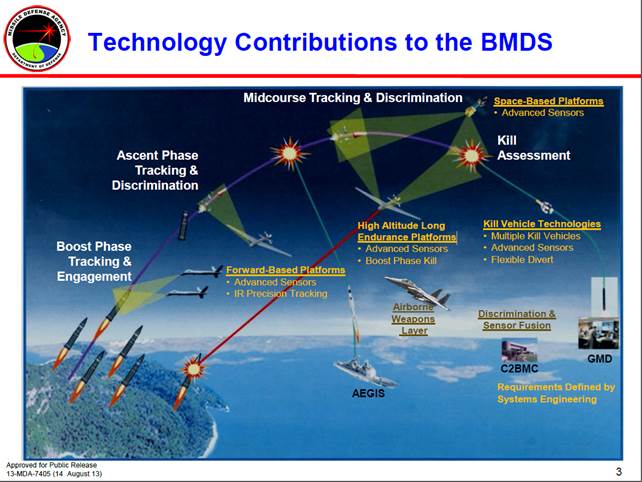
For Romania, the relevant and publicly confirmed terminal system is Patriot, not THAAD, but Turkey has such a system. Therefore, in a scenario involving a ballistic missile that has bypassed mid-course defence or is entering the terminal intercept geometry, the Patriot PAC-3 MSE represents the last major line of defence. In precise academic terms, one could say that terminal defence “does not replace mid-course defence, but complements it, providing the final interception window before impact”. This nuance is very important: a terminal system is not proof of invulnerability, but of the defensive redundancy required in a layered system.
From an analytical perspective, the most accurate conclusion is that a ballistic missile can be countered in all three segments of its flight, but not with the same probability and not with the same means. In the propulsion phase, countermeasures are theoretically very effective, but in practice rarely available to European defences. In the mid-course phase, interception is doctrinally and technologically the most important for Europe, through Aegis BMD and SM-3 interceptors. In the terminal phase, defence is essential, but it functions as a last line of defence, through systems such as Patriot and, in other theatres, THAAD. A credible missile defence system is therefore not based on a single ‘miracle’ interceptor, but on the overlapping of multiple engagement windows, supported by sensors, command and control, and allied integration.
Integration of ballistic trajectory and layered defence
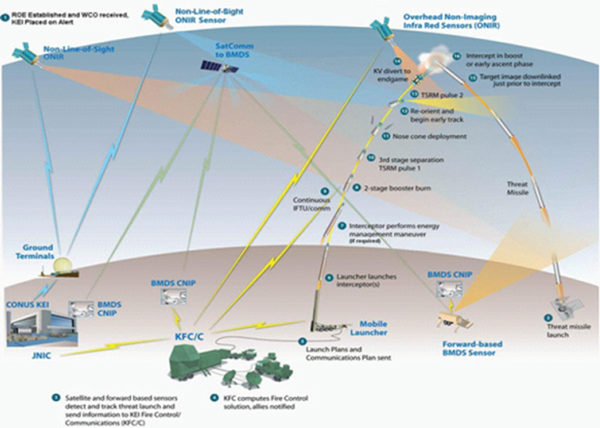
In modern missile defence analysis, the ballistic trajectory must be directly correlated with the defensive architecture. A ballistic missile passes through three distinct phases – boost, midcourse and terminal – each generating different windows for detection and interception. This structure is not merely a physical one, but defines the entire NATO doctrine of missile defence.
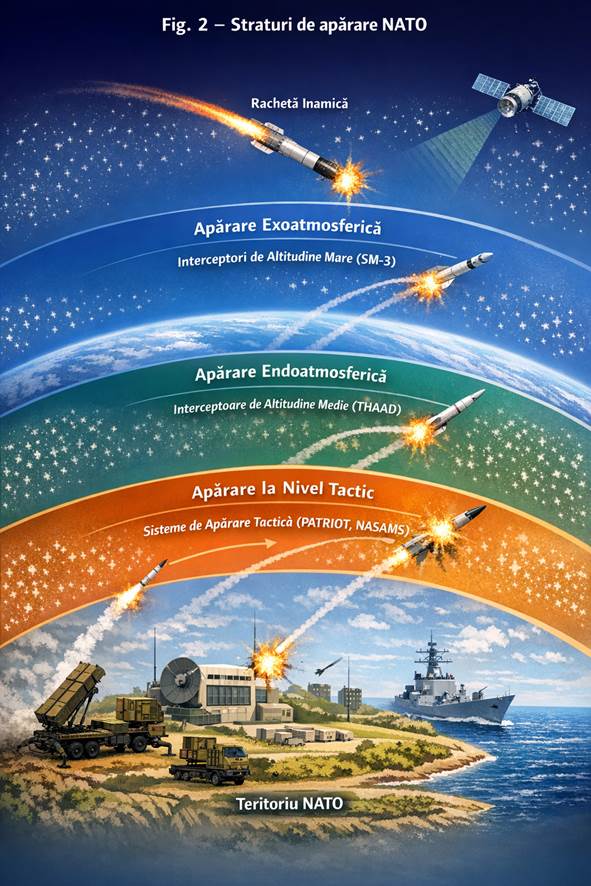
In the boost phase, interception is theoretically the most effective, but is geographically constrained. In the midcourse phase, interception becomes central to European defence, being the domain of the Aegis and SM-3 systems. In the terminal phase, interception is the last opportunity, dominated by systems such as Patriot.
This distribution explains Romania’s role in the NATO architecture: Deveselu is optimised for the mid-course phase, whilst Patriot systems cover the last line of defence.
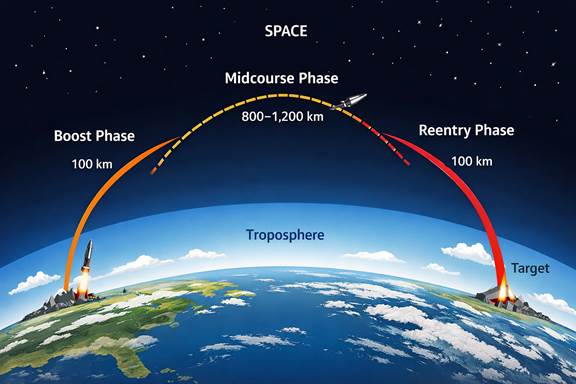
Correlating flight phases with interception systems
The correlation of flight phases with defensive systems highlights a fundamental reality: there is no single defence solution. The systems are functionally distributed. Aegis Ashore operates in the midcourse phase, Patriot in the terminal phase, whilst the boost phase remains largely inaccessible to European defence.
This distribution creates a critical dependence on the integration of sensors and command-and-control systems. Actual performance is determined not only by the interceptor, but by the entire detection–decision–engagement chain. The integration of the ballistic trajectory into strategic analysis changes the way risk is assessed. Romania is not merely a potential target, but a node in a complex defensive architecture. Vulnerabilities are not only technical, but also economic and operational, particularly in saturation scenarios. Consequently, the analysis must remain methodologically rigorous and avoid both downplaying and exaggerating the risk.
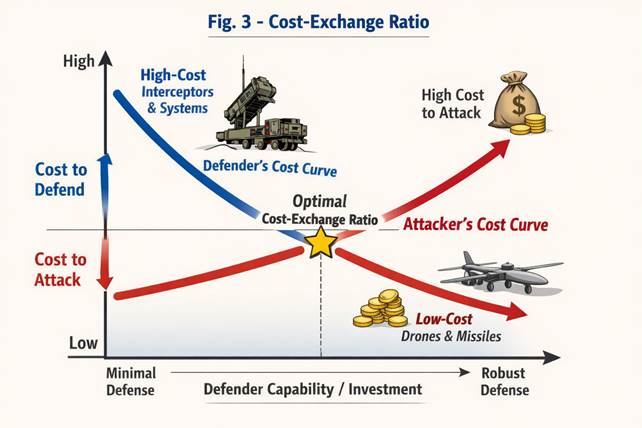
Conclusions for Romania
A strategic analysis of the risks posed by ballistic and cruise missiles and drones originating from Iran and the Russian Federation highlights that Romania is not under an imminent threat, but its territory is theoretically exposed to systems with a range sufficient to justify the continued strengthening of its defences. From Iran, the threat remains largely conceptual, with the focus on declared capabilities and operational uncertainty. From Russia, the threat is demonstrable and practical, reflected in the repeated use of Iskander-M, Kh-101 and Kalibr systems, as well as saturation drones, in the conflict in Ukraine.
Romania has a layered defensive architecture, comprising Aegis Ashore, Patriot and SHORAD/VSHORAD systems, complemented by integration into NATO structures. However, challenges remain: deployment density, the consumption of interceptors and the economic cost of defence constitute structural limitations that cannot be ignored. The effectiveness of defence depends not only on the number of systems, but also on the ability to replenish stocks, sensor redundancy, unit mobility and the protection of critical infrastructure.
For Romania, the key lies not in technological triumphalism, but in strategic realism. A credible defence requires methodological discipline, adaptation to saturation scenarios, allied cooperation and industrial resilience. The strategic position of the Romanian state must be understood not only through its inventory of systems, but also through its ability to coordinate and sustain these systems under the pressure of attrition campaigns. Romania must continuously strengthen its layered defence, invest in redundancy and cultivate operational vigilance, avoiding both risk minimisation and unjustified alarmism.
Thus, risk analysis becomes a useful tool for strategic reflection and public policy, providing the basis for rational decisions and for adapting to a dynamic security environment, in which threats can rapidly shift from theoretical to practical.
Final conclusions
This study leads to a more balanced and, precisely for that reason, more robust conclusion. Romania is not under an imminent and inevitable threat from Iran, but it is in a zone of serious theoretical exposure, which justifies the systematic analysis of vectors such as Sejjil, Emad, Ghadr and Khorramshahr and the implications of the emergence of extended-range cruise missiles. The Diego Garcia incident should not be exaggerated, but neither should it be ignored: it signals that certain psychological and geographical thresholds can shift.
From Russia’s perspective, the conclusion is more severe. The practical threat is more immediate and better demonstrated, and the systems of greatest analytical importance for Romania are not necessarily the most spectacular in the media, but those that have proven their repeated use, volume and operational utility: Iskander-M, Kh-101, Kalibr, saturation drones and combinations thereof.
On the defensive front, Romania possesses a solid foundation of protection: Aegis Ashore, as part of NATO’s ballistic defence architecture; Patriot, as an essential national layer; and a verifiable process of strengthening SHORAD/VSHORAD. However, no honest assessment can ignore the fact that deployment density, saturation attacks, the consumption of interceptors and the cost-effectiveness ratio remain structural limitations. For this reason, the key lies not in technological triumphalism, but in strategic realism.
Finally, the main gain of this study is methodological. It shifts the focus from threat rhetoric to the discipline of formulation. Fewer certainties where public sources do not support them; greater attention to the distinction between declared, assessed and demonstrated capability; greater correlation between technical data, geography, military economics and operational logic. Only in this way can the analysis of the risks facing Romania be useful not merely as a descriptive text, but also as a serious tool for strategic and public policy reflection.
MARITIME SECURITY FORUM
[1] Missile Defence Project, “Missiles of Iran”, Missile Threat, Centre for Strategic and International Studies, last modified 3 March 2026.
[2] Ibid.
[3] Missile Defense Project, “Sejjil”, Missile Threat, Center for Strategic and International Studies.
[4] Missile Defense Project, “Emad, Ghadr (Shahab-3 Variants)”, Missile Threat, Center for Strategic and International Studies.
[5] Missile Defense Project, “Khorramshahr”, Missile Threat, Center for Strategic and International Studies, last modified 23 April 2024.
[6]Missile Defense Project, “Soumar (Hoveyzeh, Abu Mahdi)”, Missile Threat, Center for Strategic and International Studies.
[7] Centre for Strategic and International Studies, “Russian Firepower Strike Tracker: Analysing Missile Attacks in Ukraine”, accessed March 2026.
[8]NATO, “Aegis Ashore ballistic missile defence system in Romania completes scheduled update”, 9 August 2019.
[9]Reuters, “Romanian government approves draft law to give Patriot defence system to Ukraine”, 2 September 2024; Reuters, “Romanian lawmakers approve donation of Patriot missile system to Ukraine”, 3 September 2024.
[10] Reuters, “Romania signs deal to buy French Mistral air defence systems”, 27 November 2025.
[11] Reuters, “Romania to buy Israeli anti-aircraft systems for $2.3 bln”, 21 July 2025; Ministry of National Defence of Romania, “The Framework Agreement on the procurement of the SHORAD-VSHORAD air defence systems was signed”, 21 July 2025.
[12] Center for Strategic and International Studies, “$3.7 Billion: Estimated Cost of Epic Fury’s First 100 Hours”, 5 March 2026.